.png.c363cdf5c3fb7955cd92a55eb6dbbae0.png)

Maitland
-
Posts
128 -
Joined
-
Last visited
-
Days Won
1
Content Type
Profiles
Forums
Events
Gallery
Blogs
Everything posted by Maitland
-
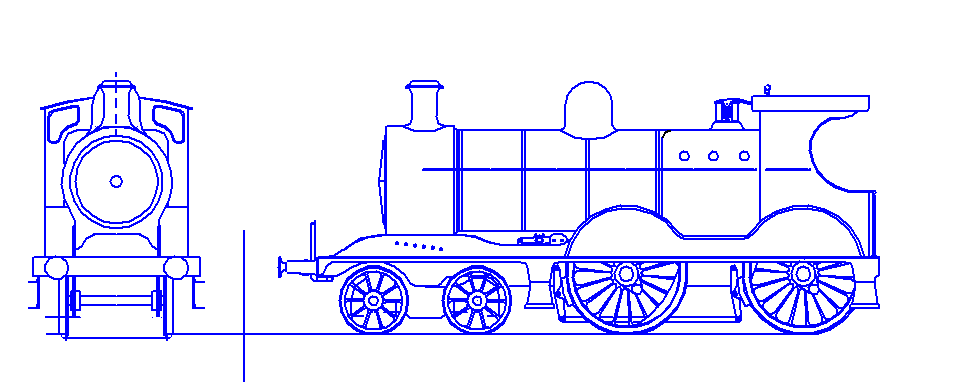
Progress on SLNCR small tank. I've decided to use a cheap Chinese gearbox/ motor set at least initially. A fiver with Now, a question for you mech eng experts: have any of you tried printing driving wheels? I was thinking of the spokes etc of ABS type resin, the P4- ish tyres of mild steel (made with my trusty Unimat CNC lathe!), the lot "somehow" glued together. The motor has D shaped axles, and printing the wheels would make quartering easy as well as solving the problem of extracting the axle to replace it with a round one. And save £50+ for wheels. As you see from the screenshot, I haven't decided yet how to fix the wheelsets in the frames - I'm aiming for a Sharman type 3 point suspension with the driving axle rigid. Any experiences here would be gratefully listened to.

-
 Just realised I put this in a rather stupid place... could anyone move it somewhere better?
 -
Still climbing the learning curve for Solid Edge. My Chinese van prints still haven't arrived - they say they got lost in the system, so it doesn't just happen here. In the meantime I thought I'd have a go at one of my favourite locos- the SLNCR "Leitrim" class small tanks. This is the all - in - one assembly, actually it's 3 parts - boiler, tanks & cab, and frames and running board. I thought I'd do that last bit together to give it a bit of depth in the hope that it will actually print. So work in progress: SLNCR Small Tank.stl
-
Northroader: Please don't even to begin to think such a thing is funny. It's quite possible that the "mug" is wearing oily overalls, and perfectly possible that your smouldering waste is hot enough to ignite it. Result? Burning to death, or at best a painful recovery. Or, especially in the case of volunteers who might be as past it as I am, a breathing crisis. Or a volunteer leaving the group. A prank went wrong last year in Swansea: (sadly the original newspaper report is behind a paywall). https://www.railforums.co.uk/threads/man-in-court-for-setting-fire-to-fellow-worker.302502/ No intention of being a killjoy, but that doesn't count as joy.
-
A3 & A5 awaiting trials. They were found guilty.
-
About 25 years ago, in the flatter south bit of Derbyshire near the Trent, a bloke got fed up of people raiding his shed for tools and stuff. So he rigged up a sawn off shotgun and a tripwire to tonimartinate the next intruder. Which, he having forgotten about it, was his good self. Apart from shooting his own wibbly bits off, he got several years for the illegal weapon. Leek & Manifold... it wouldn't have worked even if it had started from Leek rather than the middle of nowhere. A bit of an ego trip by a competent engineer but a poor economist, and not helped by the lead and copper mines that were supposed to supply the traffic being shut even before it was built.
-
Hope it goes well with the approaches. But I've a horrible feeling... about 10 years ago, there was an archaeology dig going on not far from here (the rules about amateur archaeology are very different from Ireland), and I got chatting to the people on site. They were very professional about it, they'd been digging there about 10 seasons, everything was recorded carefully, diagrams, photos, context sheets, artifacts, the lot. A year or so later I passed the same place, just a couple of people there. The group had basically dissolved after the death of one of the members. It turned out that the entire archive was in his (very secure) garage, but he'd died, and his relatives wanted to get the house sold. They cleared the garage, and everything went to the tip. They'd had reports published, fortunately, but only about some aspects of the findings, and it was so rich that there was years' worth of work still to be done. No longer possible.
-
Be patient, I'm waiting on a (4mm scale) resin print on a slowboat from China. I'll post photos when that's ready, but the design is evolving, it's in debug stage at the moment (see above). I think for most people who only want a small number occasionally, outsourcing is likely the best option.
-
The layer lines give it a bit of a wood effect. But at some point the buffer holes vanished. I'll fix that in Github. Flying Snail, I'd lay off that diesel wine. Even Co-op screwtop tastes better. V0.3 with buffer holes now in Github.
-
Link to the Github repository: Maitland's CAD model(s). The license is as open as can be: do as you will with it, but don't blame me! This will be true of anything I put there.
-
Looks like Cumbria was built specially for use on the Derry Central, and that "Kilsea" should be Kilrea.
-
There was one attractive if rather obscure contractor's saddle tank that worked in Ireland, details in PDF. It worked on the Great Central London extension, these pics from Contractors Locomotives G.C.R. by N Cossons BA (Leicester Museums 1963). Cumbria.pdf
-
Regarding the Mont Cenis tunnel and traction.
Maitland replied to spudfan's topic in Letting off Steam
The Fell system. It was trialled on the Cromford & High Peak line not all that far from me, and was meant to complete the Mont Cenis route while the tunnel was being built. Unfortunately for the promoters, the tunnel was completed using pneumatic drills much quicker than expected, the line was then obsolete, and they lost a lot of money. The centre rail was installed, for braking purposes only, on the Snaefell railway in the Isle of Man, and is still in use. Fell had other ideas for quickly built, lightly engineered railways, that never quite seemed to hit the target. The first two locos on the Pentewan Railway in Cornwall were to his design, and apart from having the cylinders above track level (!) were similar to those build for an experimental rapid- deployment "train set" military railway that didn't get adopted either. He had a very strange taste in locomotive design, even for that age. If you can be bothered scanning, I'd love a copy. -
It would be tragic if the artwork were lost. WW has been a major resource for years, and a project to digitise Allen's work (crowdfund it)? would be a gift to the future.
-
Rob: Thanks for the invite, but that's Chester folk festival weekend and another of my too- often less than healthy pursuits. I've got (somewhere) an article on tarp covers, but a quick web search suggested Tunnocks caramel wafer wrappers: https://yourmodelrailway.net/forum/index.php?page=topicview&id=hints-tips-smaller%2Fmaking-wagon-sheets.
-
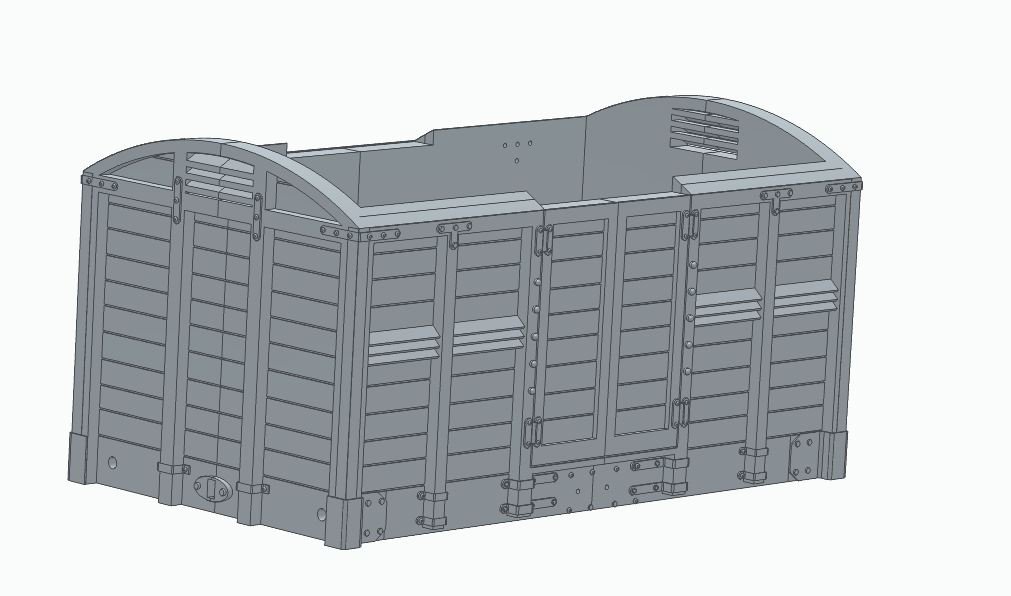
Thanks for all the help, very much appreciated. I've decided in the end to leave the roof off. Having looked at the suggested supports that would be added, I wondered how I would get the ones inside off. So for now it's an open topped body with no running gear. Next phase of design follows for that. I've ordered 2 prints from Seeed at about £10 each including delivery & taxes, so let's see how it goes. I'll post a photo when I get them, should be 3-4 weeks. One of the slight surprises was the STL file repair needed when I loaded it into slicer software. I would have thought Dassault Siemens, who design Solid Edge and were also on the committee that designed the 3MF format, would have checked that during the STL generation process. But perhaps that's an artifact of having to learn the CAD package as I went along - when I used it 25 years ago it was almost entirely for 2D wiring diagrams. The whole process so far has taken about 3 (not at all continuous) weeks, including 4 iterations from scratch of the body shell as I worked out how to navigate through the vagaries of Solid Edge. One of the weirdest things about it is that it seems, when stressed, to switch sketches from where I designed them to another sketch. Another is that unless you keep a close watch on it and stay ready to hit the Undo button, you find that some trivial change made half an hour ago has had a drastic effect on some long- ago added feature and you have to unwind all that work. Moral, use save frequently and check everything after messing with it. I'll probably do the floor and roof in styrene sheet using the van ends as a template for ribs positioned to locate the roof securely. I'll put the body "as it stands" on Github here.
-
Thanks for all the comments, and sorry I've been slow responding- away for bank holiday weekend. I don't intend to market anything- I had quite enough of that being self- (un)employed for 20+ years, the world's worst businessman. If I had a gold brick I couldn't sell it. But anything I design will be made available freely for anyone to use, via Github probably, along with details of where it can As for the cost, well, count the hours of conventional scratch- building or high- quality kit assembly, and charge yourself- even at the minimum wage or less, it's not a cheap hobby. Now what I'm really after is to pick your brains. I've not done resin printing before, so what resin gives an acceptable level of detail (what level is realistically printable? 0.5mm, 0.2mm, 0.1mm?), what about thermal stability, do I correct for shrinkage or does the software do that, where to put supports, which way up to print it, etc. etc. I don't even know what questions to ask yet - but you've done it and probably learnt the hard way. If you've posted about this elsewhere, links please. Odd questions: If I have a van or carriage with a roof and a floor, or a tank wagon, how does the surplus resin get out? Can I print buffers, brake gear, door handles etc in- situ, or are they best separate? How do you get axles into the bogie or chassis? Is there any snazzy trick to allow an axle to float for 3 point suspension? What sort of paint for what sort of resin? I'm sure I've got dozens more questions coming as soon as the computer- generated ideal meets the sticky, messy real world.
-
This represents the 1893 series, drawing in Ernie Shepherd's book. Created using Solid Edge community edition, and not quite complete- I haven't worked out how to do the door fastenings, obviously the undergear and roof are missing. It's actually to 4mm scale, but the STL (about 3MB) can be scaled. When reasonably complete, I intend to put this on Github so anyone can use it. I got a quote to make it from the Chinese company Seeed Studios, who I've used in the past to make very good PCBs, about $26 for two, including shipping and taxes. Actually I'm not very sure what they've quoted for, they could have taken dimensions as mm not inches, a bit like Spinal Tap's Stonehenge (how do I check the dimensions field in STL?), and I can't contact them as it's Chinese holidays. Who would grudge Chinese workers their holidays? Anyway, you resin printing experts: should I do the roof/ buffers as separate parts or will it print with them in place? I can't try it out as my order for a printer and washer hasn't been delivered yet, boohoo. Has anyone tried printing open- spoked wheels?
- 59 replies
-
- 13
-

-

-

-
It's only numbers you need? PMB's photos give you 0,1,2,3,4,5,6 and 8, so copying those as images, correcting for perspective (only for a couple), and hamming 7 and 9 should give you something even a connoisseur couldn't argue with. And is that coach 58 or 88?
-
220 million Euro development by Iarnród Éireann with NO rail facilities!
-
Donal Murray's "Great Southern Railways" pictorial has a photo of 386, with the curved bit just visible at one end only - a bit odd as it presumably ran both ways. You can be proud of your ancestor- the design of C and D makes contemporary railcars (and most of those of 20 years later) look crude. Unfortunately I only get error 403 (permission) from flickr.
-
Roddy Ring it is, Specsavers appointment made. There's no information on the later career of the sets in the booklet. It concentrates on their technical history, in particular the batteries. There's also a rather hilarious account of a demonstration run from Amiens St to Gorey and back, with all the GSR and government top brass on board. It nearly ended in humiliation when, instead of allowing a half- hour recharge at Bray on the way back, De Valera decided he had better things to do than sample the buffet provided, and insisted on leaving after only ten minutes. They would have made it, except that a director of the Drumm company told the driver to stop at Blackrock because it was near his house. The battery drain on restarting meant they ran out at Westland Row. There's only the briefest mention of the sets in Desmond Coakham's "Irish Broad Gauge Carriages", and no clue there as to the identity of "Experimental Coach no. 386". However, Wikipedia says it was one of the Drewry petrol railcars, which have been discussed here: GSR Drewry Inspection Car, with lovely model by KMCE.
-
I picked up a fascinating booklet recently. It shows no publisher, ISBN number or publication date, though from internal evidence it's after 1994 and the author is Roddy King. Publication was "supported by the Electricity Supply Board". It gives a potted history of the Drumm train development, from information given by Brian Hogan, apparently the last survivor of the development team. Development started much earlier than the brief mentions it gets in normal histories, and the idea of battery vehicles was satirised in Dublin Opinion (what was that)?) in 1927. The GSR supported development enthusiastically, assisting in the conversion of a 4 wheeled inspection carriage with end windows into a battery- electric car - "Experimental Coach no 386 Drumm Patent". Trials from August 1929 proved the concept, and the Government supported the construction of two full- scale trains after commissioning an independent report. A few questions- who was (is?) Roddy King? Can the inspection carriage be identified? And what became of Dr Drumm after the collapse of the Drumm Battery Company when further development became impossible in the Emergency? He lived apparently till 1974. It's a real pity the battery design was forgotten. It seems to have several characteristics that might have been useful today. It doesn't flare like a lithium battery in an accident or through mis- charging (Though as with any powerful battery, a short circuit can set fire to anything flammable within range). It can withstand short circuits without damage. It's made of cheap and readily available materials. It can charge very fast, and source high currents without damage. Maintenance is simple. And it is obviously rugged - the sets lasted over 5 years after the demise of the company that made them.
-
Ramsey IOM. Of course, they'd have to reopen the line from Douglas via St Johns to get to it.
-
Thanks, the blueprints are useful as well, and the drawing is progressing at a moderate pace. I'm finding it impossible to reconcile different drawings completely, so I'm relying on stated dimensions wherever possible, and I'll make it clear what I've guessed when I post the result. Just to show progress so far: