.png.c363cdf5c3fb7955cd92a55eb6dbbae0.png)


BSGSV
-
Posts
328 -
Joined
-
Last visited
Content Type
Profiles
Forums
Events
Gallery
Blogs
Posts posted by BSGSV
-
-
Gerry Beasley's photo album now on the IRRS site has several photos of these things at Inchicore, when apparently new.
-
 1
1
-
-
9 hours ago, Mol_PMB said:
- Also listed in the secondary stock are some of the former Drumm trains, now loco-hauled. They are numbered in the 250x series, which helps to explain why the former SLNCR railcar ended up being numbered 2509 (and their railbus 2508) - they follow the Drumm car numbers.
- Also, one of the Drumm cars is listed as through-wired for railcar operation. This is plausible but new to me.
- Specific carriages and railcars were allocated to 'Named Trains'
2508 was an ex-DUTC single decker converted to a railbus for the Cashel branch.
One of the GSR Brake-3rds was wired for Drumm trains, and I seem to recall a Drumm being wired for railcars but not successful.
The "Named Trains" would probably have had the more recently shopped carriages. They also had carriage nameboards, which I suspect nobody would have been anxious to change around between carriages on a regular basis. I have the impression that utilisation of stock at this time seems to have been fairly low, with mainline train sets making just one round trip a day.
-
2
-
16 hours ago, Mol_PMB said:
I think there were a few more, later. I’ll check.
I thought so too, so I had a read last night. There were another ten, not too long later, but there's no list of them. Two of these were GNR vehicles, but it appears were withdrawn too quickly to receive their numbers. 2491 became 4054 later still, and that's the last 4xxx number I know about.
I have seen some nicce colour photos in the IRRS photos of 4xxx series numbers in a siding in Cork for Cobh services, 4027, 4036, 4043.
-
1
-
-
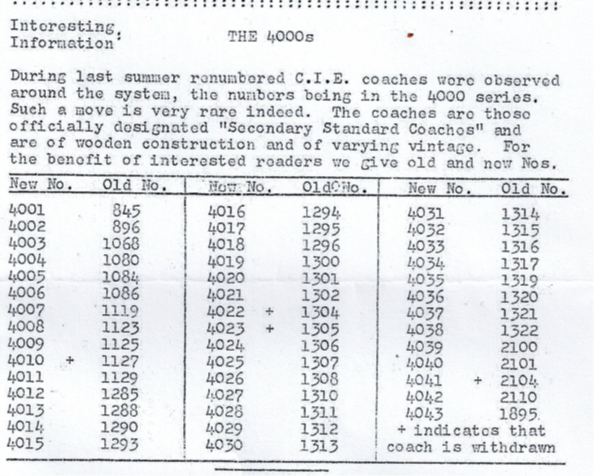
4xxx from IRN 15.4 November 1969

-
 1
1
-
-
If you haven't encountered this already, this thread may also be of interest: C.I.E. 32XX Conversions
-
1
-
-
The 4000's were "Secondary Stock" vehicles. These were older vehicles which were previously identified by CIE with an "S" suffix to the number, but which were renumbered in the 4xxx series later. A few GNRI carriages made the 4xxx series which was mainly GSWR and GSR stock.
-
1
-
-
On 31/8/2025 at 2:20 PM, Niles said:
Excellent resource, well done.
Hear, hear! Amd many thanks to @flange lubricator and @seagoebox too. Thank you for all your work.
-
I seem to recall seeing something in passing, and with no details, about a proposed "cut-off" line from the MGWR to the GSWR line near Lucan, after 1945. I don't know if there was any truth to it, or just a mis-interpretation about something else, as I've never seen any further reference to it.
-
1
-
-
4 hours ago, Galteemore said:
RPSI 1142, which is a corridor 1st, is close to this style. Downpatrick have a GSWR 3rd but don’t think it’s gangwayed
Downpatrick's 836 was a gangwayed Open 3rd, but the corridor connections weren't re-instated by DCDR. 836 was gas lit, 1124 seems to be electric.
-
1
-
2
-
-
20 hours ago, leslie10646 said:
Good find, @Mol_PMB! It goes to show that you can get away with almost any combination of your layout - it will have happened somewhere, sometime!
As the railcars were vacuum braked they could be loco-hauled, and were at times. From memory, IRN has pieces referring to use of railcars as loco-hauled coaches for a relief train from Waterford to Dublin, and on the final day of the Thurles - Clonmel line.
-
1
-
-
Singling on the MGWR started on the Navan branch during WW1 (to get rails). On the main line it went west to east, then the Mayo and Sligo "branches". It carried on in the 1930's.
There was also GSR singling Limerick - Limerick Junction, Waterford - Fiddown, Sallins - Naas, Newcastle - Wicklow and probably a couple of others I've forgotten, mostly before the MGWR was done, so that probably accounts for the GSR records you were looking at.
The IRRS archive in Dublin holds GSR weekly circulars which include the dates of singling of individual sections.
-
1
-
-
I don't know what the doom and gloom is about.
Re-opening closed railway lines at significant costs per kilometre, for the taxpayer, is currently very fashionable...
...as Greenways.
-
3
-
-
On 2/6/2025 at 7:36 PM, Patrick Davey said:
Actually......I wonder was it double track through Killylea, @jhb171achill can you verify or correct?
I always thought Portadown - Clones was double.
Or maybe it was doubled at one stage then singled later on...
No reference books to hand just now.....
Double, Portadown Junction to Armagh, and later also Clones to Monaghan.
Single elsewhere, and the double line appears to have been singled in the early 30's, except from Portadown to Richhill.
-
 1
1
-
-
1915 is the date for carriages according to a Brendan Pender article in the IRRS journal (61), in that 1290 appears the earliest built in the new numbering, and was 1915.
Don't forget the TPO from 2950, and the GSR brake compos 2490/1.
The Park Royals went to 1948. And 1949 was the last (RPSI, GNR 9) in the 2000's.
-
3
-
-
On 4/3/2025 at 1:32 AM, jhb171achill said:
It was single unique vehicle, specially converted for the Waterford & Tramore. After it closed, it was re-converted to "irdinary" format and returned to the main line.
Didn't work between closure of the W&T and conversion to an Ambulance carriage.
-
1
-
2
-
-
On 3/3/2025 at 6:26 PM, Mol_PMB said:
Certainly into the Irish Rail era…
When I found and uploaded this photo a couple of years ago it was with some from Mullingar and I captioned it as Mullingar, but I’m having second thoughts now. I think it might be Gort.
Anyway, a brown H van dumped in a siding in the early 1990s, note the IR and Irish Cement sign on the goods shed.
Yes, It is Gort.
The shunter "missed" dropping the handbrake on it as it went into the siding, and it hit the stops with a bang, which left one axlebox bent out. Couldn't move then...
The delights of unbraked stock.
-
1
-
-
I'm more familiar with mainline locos, but pipe colours would be blue for water and green for fuel oil, as you say. Air is yellow, electrical is brown. Hence the yellow air receivers. Exposed pipes might well lose their paint.
-
1
-
1
-
1
-
-
1 hour ago, Mol_PMB said:
I see a photo of A28 in its odd livery has just been uploaded. I’m sure I commented on that somewhere in another thread here!
https://flic.kr/p/2qLJtfU
I still don’t know what colour it was, dark all over with numbers only on the ends, nothing on the sides at all. Possibly primer or undercoat?
Anyway, fascinating pics, thanks IRRS!I may be wrong, but I think I see a number just to the right of the works plate.
-
The C class was bought for branch use, and closures reduced the need for them, so a lot were out of use by the end of the 60's. A branch surviving would probably have had one in preference to a 141, which would have been out on main line work. A railcar set was used on Thurles - Clonmel. 60's carriages GSW or GSR or early CIE built, with 70's early-CIE. Alas, most of these are not RTR - yet!
However, what RTR is available would not be much hardship while you wait. God bless all the manufacturers, who continue to amaze with the gaps they are filling.
-
3
-
-
Not sure about model intermediates, but for prototype information you could try here:
-
On 9/11/2024 at 5:44 PM, minister_for_hardship said:
Gas wagons but with CIE broken wheel logos, why were these retained so late in the day??
I think oil gas was still used in one or two of the carriages of the old set that would come out on the Dublin Suburban on Summer Sundays and the like?
Also, there were probably older diners which needed it for cooking/heating, even CIE built ones, which got converted to calor gas in the 1960's.
-
2
-
-
As I understand it, the guys in NIR tried very very very hard to get the money to make it a double track structure at the time, but couldn't swing it. Alas, with the way it was done, it now also seems very difficult to double without building a viaduct throughout for the extra track.
-
16 hours ago, leslie10646 said:
I can't help except to offer Lance's photo taken of the UTA Enterprise entering Amiens Street in 1959, in full GNRB Regalia, bar the little UTA Roundel - if you know how to identify a half cab from the window shapes - feel free to look at the back of a fairly short train.
God bless your eyesight if you can see the back of that train well enough to know! Looks like a 6-piece set, 900, trailer, 700 series, two trailers and another power car.
-
1
-
-
23 hours ago, murphaph said:
The buffer spacing was very different between the 121 and 141/181 on the prototype?
I'm not detecting any heat or disrespect in this thread to be honest, just a good mannered discussion about the merits of both ways of doing things.

I would counter the "sure we're using tension locks" argument by reminding readers that IRM provides an alternative to said tension locks by including much more prototypical coupling options in the accessories bag. The tension locks are fitted by default but the magnetic hose type couplings supplied with the new coaching stock for example are superb and far closer to reality.
My apologies. The preceding posts were about the chassis and that's what I was commenting on. With the benefit of hindsight, I should have known you were asking about buffer spacing!
-
2
-

ERNIE's Irish Railway Archive, photos , Working Timetables etc from ca 1900 to the 2000's
in Photos & Videos of the Prototype
Posted
It's 23 the Up Home. Apparently for sighting reasons. There's a photo is Tom Middlemass' "Irish Standard Gauge Railways". The footbridge from the Khyber pass entrance might have been an issue?