.png.c363cdf5c3fb7955cd92a55eb6dbbae0.png)


BSGSV
-
Posts
332 -
Joined
-
Last visited
BSGSV's Achievements






-
Done! Although I fear AI has a better memory than any of us.
-
Er, no he can't! I am sorry. I'm afraid I typed Cashel, instead of Clonmel. 2508 was apparently completed in 1953, a bit late for Cashel which lost its regular service in 1947. I had always understood it was tried on the Clonmel line. Cashel is not listed in the GSR 1935 Appendix as having a turntable, so no way of turning 2508 or anything else. The Steam Railmotor had the virtue of not needing turning.
-
It sounds like the model has scaled down the time it takes for the driver to walk through from end to end too! On A's, C's, Hunslets the driver would have walked through the loco. You get wet changing ends on a GM. A and C class fans and (I think) the Hunslet, had electric motors for the fans, driven by current from the Auxiliary generator. The aux gen doesn't produce if the engine isn't running. Older locos aren't as sophisticated as your car! Fans have ball bearings and can run down for a long time after taking power off.
-
Based on my observations/activities over thirty+ years, I would comment as follows. Others can differ! The driver will have a torch at night, and may just rely on it and ambient light until they are sitting down, to maintain their night vision. Or could stick on a cab light, perhaps for a while to read paperwork etc. Each to their own! Marker lights will be set for that end for the direction of travel - two whites for forward, red(or reds, could be one or two depending on class/period) if this cab is the rear, one white/one red each end if shunting. The full headlight won't tend to be used where there is good light - stations, yards etc., or when meeting an oncoming train in the opposite direction - you don't want to blind your colleague - so you'll dim the headlight or turn it off. Like all humans, drivers can forget or mess up any or all of these at times! As you guessed, the marker lights lights each end are set independantly, and stay that way until altered in the relevant cab. Changing ends requires the engine in idle, brakes applied and no direction set, but the engine isn't shut down. I am not familiar with the cooling system on the Hunslet, but different classes have different set ups for the fans. I would guess the Hunslets would have a fan controlled by thermostat on the cooling water with perhaps two/three different speeds (aside from off). Cooling tater temperature will vary depending on load, road, ambient temperature, how well the radiators is working (i.e. are the fins clogged with dirt/cement dust like 102's were when it was last shunting at Adelaide). The engine itself was fine. The cooling system has Marmon couplings in the main pipes from engine to header tank, oil cooler, radiator and such, and if these weren't right, could drip badly. I was told a story (I hope apocrophal) that the Marmons leaked so freely that the water was coming out faster than they could fill the system. The cooling water boiler was to keep temperatures up, the engine warm, everything expanded and avoid frost damage. Ethelene Glycol tends to be added to the cooling water, certainly these days, but was not always used. Antifreeze will not, however, help a cold battery crank an engine - starting stuff in the cold can often be a pain.
-
It's 23 the Up Home. Apparently for sighting reasons. There's a photo is Tom Middlemass' "Irish Standard Gauge Railways". The footbridge from the Khyber pass entrance might have been an issue?
-
Bogie flat wagons with steel floors 30091-30098 - photos?
BSGSV replied to Mol_PMB's question in Questions & Answers
Gerry Beasley's photo album now on the IRRS site has several photos of these things at Inchicore, when apparently new. -
2508 was an ex-DUTC single decker converted to a railbus for the Clonmel branch (Thurles - Clonmel). One of the GSR Brake-3rds was wired for Drumm trains, and I seem to recall a Drumm being wired for railcars but not successful. The "Named Trains" would probably have had the more recently shopped carriages. They also had carriage nameboards, which I suspect nobody would have been anxious to change around between carriages on a regular basis. I have the impression that utilisation of stock at this time seems to have been fairly low, with mainline train sets making just one round trip a day.
-
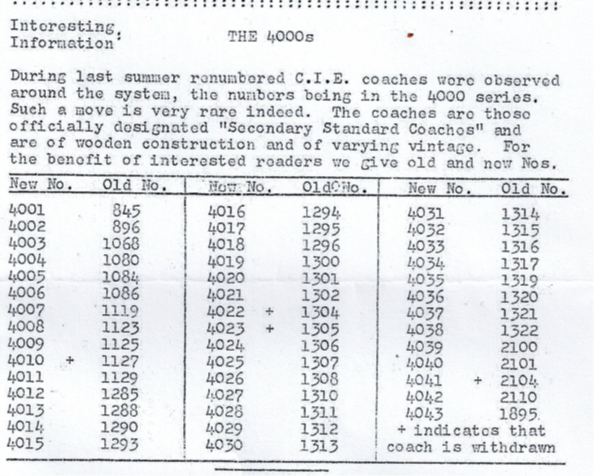
I thought so too, so I had a read last night. There were another ten, not too long later, but there's no list of them. Two of these were GNR vehicles, but it appears were withdrawn too quickly to receive their numbers. 2491 became 4054 later still, and that's the last 4xxx number I know about. I have seen some nicce colour photos in the IRRS photos of 4xxx series numbers in a siding in Cork for Cobh services, 4027, 4036, 4043.
-
4xxx from IRN 15.4 November 1969

-
If you haven't encountered this already, this thread may also be of interest: C.I.E. 32XX Conversions
-
The 4000's were "Secondary Stock" vehicles. These were older vehicles which were previously identified by CIE with an "S" suffix to the number, but which were renumbered in the 4xxx series later. A few GNRI carriages made the 4xxx series which was mainly GSWR and GSR stock.
-
Hear, hear! Amd many thanks to @flange lubricator and @seagoebox too. Thank you for all your work.
-
I seem to recall seeing something in passing, and with no details, about a proposed "cut-off" line from the MGWR to the GSWR line near Lucan, after 1945. I don't know if there was any truth to it, or just a mis-interpretation about something else, as I've never seen any further reference to it.
-
Downpatrick's 836 was a gangwayed Open 3rd, but the corridor connections weren't re-instated by DCDR. 836 was gas lit, 1124 seems to be electric.
-
As the railcars were vacuum braked they could be loco-hauled, and were at times. From memory, IRN has pieces referring to use of railcars as loco-hauled coaches for a relief train from Waterford to Dublin, and on the final day of the Thurles - Clonmel line.