.png.c363cdf5c3fb7955cd92a55eb6dbbae0.png)


mfjoc
-
Posts
89 -
Joined
-
Last visited
-
Days Won
2
Content Type
Profiles
Forums
Events
Gallery
Blogs
Everything posted by mfjoc
-
Thought I would bump this thread. I still have the ballast wagons and the H vans for sale and could arrange to meet at either Bray this weekend or the MRSI show on the bank holiday weekend.
-
My understanding is that most of the traffic of asylum seekers is in the opposite direction
-
The photo of Woodenbridge was taken on the RPSI special to Arklow. The loco has just been turned and will work tender first to Arklow before heading back to Dublin. I was on that trip as a young 13 year old schoolboy. Not a high vis in sight! We just wandered around wherever we could. Most of the track was still in place even though the branch was long closed. The special also called into Wicklow Murrough. I don't think it called into Shelton Abbey which was a pity.
-
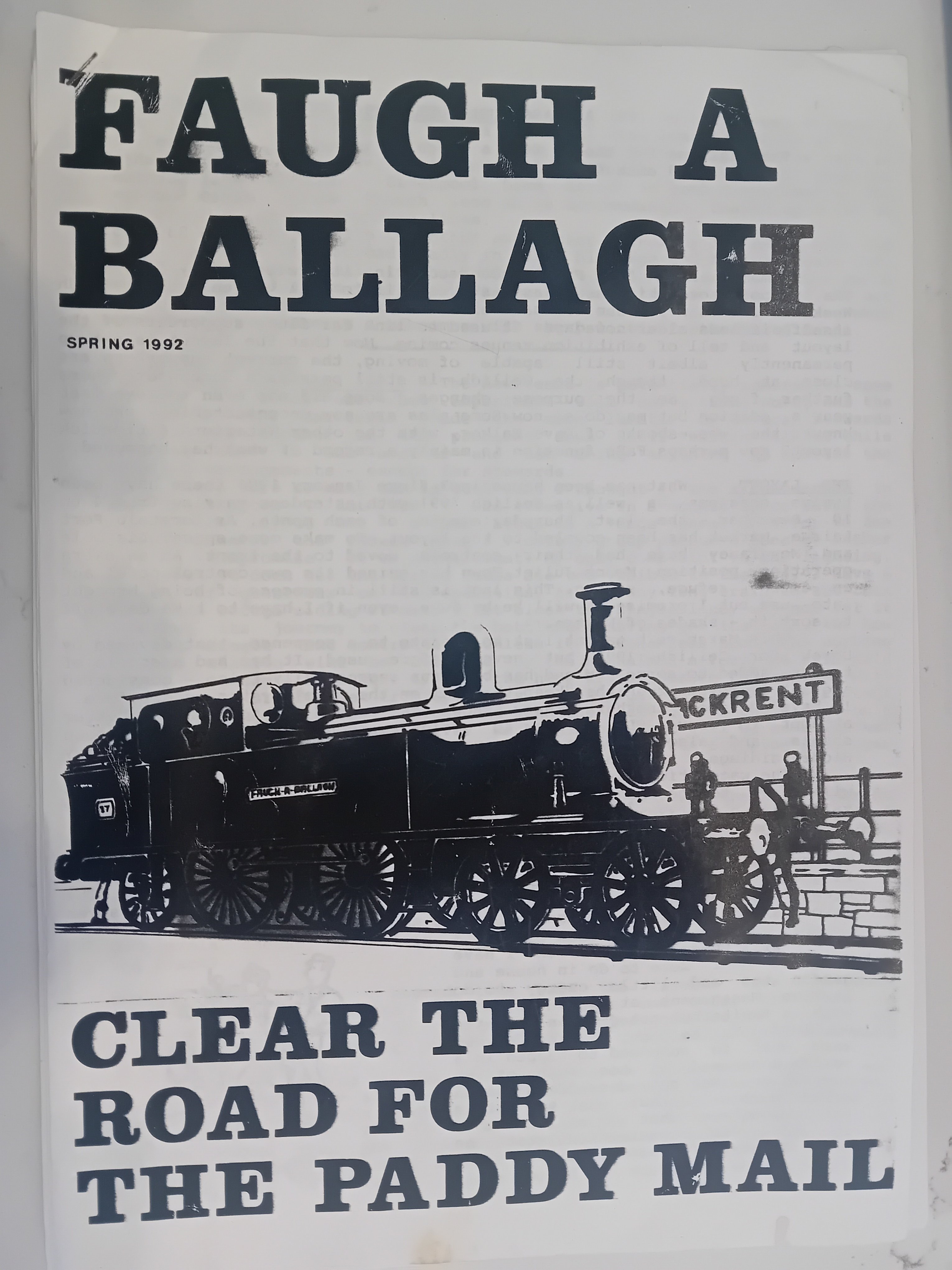
During the 80's and early 90's Richard produced a photocopied newsletter called Faugh a Ballagh He used it to keep in contact with the group that helped him operate the layout and others who were interested in Irish Railways at the time. He used to send it out once or twice a year. I was lucky enough to be included so I still have copies from 1981 to 1992 It included information on the layout, riviews of model railway exhibitions, drawings of Irish railway interest and sometimes a polemic from Richard on the state of the hobby or his job with BR. I loved it, though at the time I had three young kids, a large mortgage and a stressful job so had no time for modelling. I still treasure them.

-
Pallet vans sold others still available
-
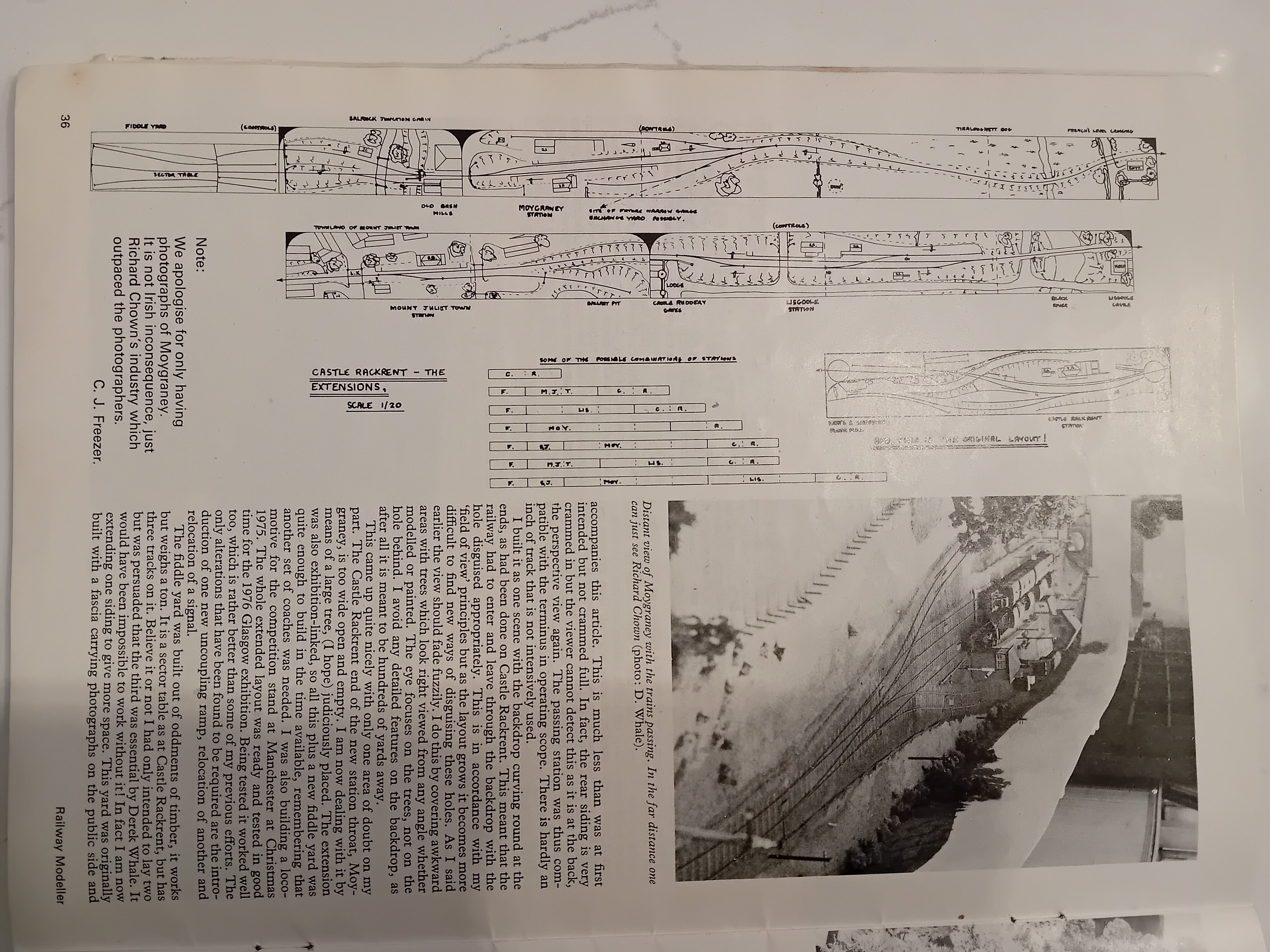
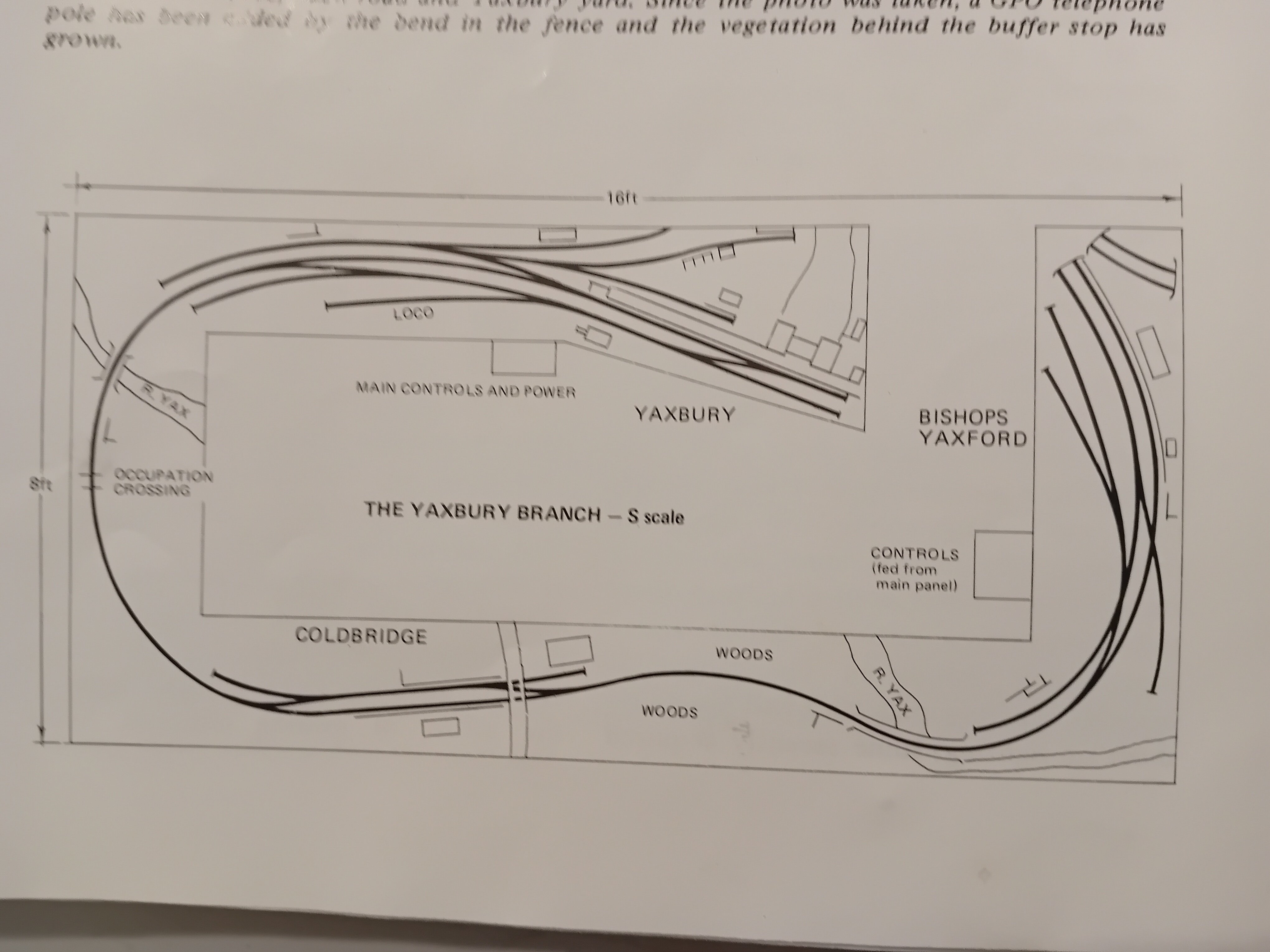
Castlerackrent featured as the railway of the month in February 1978 Railway modeller. At the time he worked as a civil engineer for BR in Scotland hence the availability of the storage area in Waverly station. I went over the one of the Ceiledh's around 1981 where the whole layout had been set up and the inspiration has stayed with me to this day. Another Inspiration that I never saw was The Yaxbury branch with some beautiful black and white photos in MRJ.
-
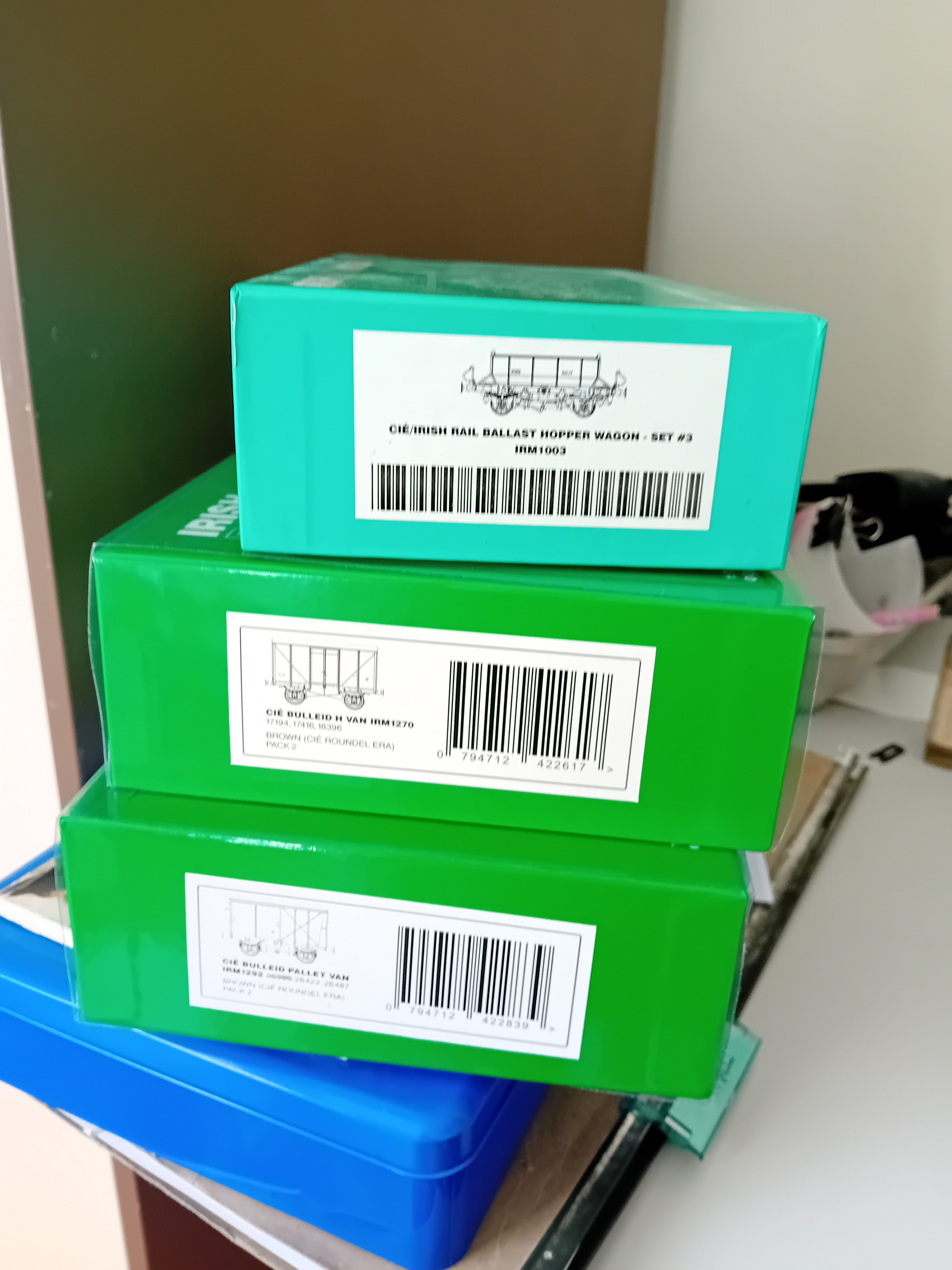
I have the following wagon Packs for sale €100.00 per pack plus postage. All are as new. The hoppers were run for a short while on the layout, the others were hardly removed form the packaging. I am based in the Dublin area so can arrange pickup if that suits better IRM1003 Ballast Hopper wagons - The origionals , for some reason I have two of these sets so happy to let one go IRM1270 H Vans CIE Brown - I ordered two sets but can only justify one on the layout IRM 1292 Pallet vans CIE Brown - Again I ordered two sets but the advantage here is that I have replaced one of the wagons with no. 26070 with the different end pressing. These are now sold Please PM if interested.
-
I really think you are on the right track here (forgive the pun) Get some track down and run some trains. You don't need much scenery just a few buildings and maybe a platform. For years I didn't have even a basic layout. I have had so much fun running trains on the bare baseboards of my own layout in the last few months.
-
@GSR800 where did you get the frames for the station overall roof?
-
Thanks for the advice David, I will certainly take it on board
-
The D&WJR is primarly designed for operation using hand held trottles and manually operated points. 1270mm height was chosen for this reason. What I am actually thinking about is building a completely seperate layout above the D&WJR using the "air rights" so to speak. I have lots of american rolling stock sitting in boxes in my daughters attic and am under pressure to use them or loose them. Operationally it would be very simple but there would be the space to run some decent length trains.
-
Keep us posted Paul Even I might be interested to try and build an unpowered pair or four to run as a push pull set behind the new IRM re-engined C class
-
MOL’s comments above about his Swiss layout got me thinking. Before Murphy Models and IRM seduced me I bought a lot of American rolling stock and built a 10’ long shunting layout, but longed for something bigger. I still have a large amount of it including a model of the Rio Grande Zeypher passenger train and many locos and wagons. One option would be to periodically take all the Irish stock off the D&WJR, put the American stock on and rename it the Denver Terminal Railroad. But then what to do about the Irish scenery when I ever get around to building it? While out hillwalking in Wicklow today I had a brainwave, Why not build above the existing layout? I had always considered double deck layouts too complex to build because of the gradients and or helixes required to connect the two levels. But what if I built a separate layout above the D&WJR? Baseboard height of the D&WJR is 1270mm and height to the top of the backscene is 1570mm. A baseboard above this would be about 1650mm which is close to my eye level. I am approximately 1800mm high, Roof height of my shed is 2100mm so I could stand on a 250mm high stool or bench to operate the layout. My thinking is that while the upper level would mimic the lower level it would be a lot simpler and narrower and would not need complex supports.
-
I held the first operating session last Saturday with my cousin who is an engineer with the transit authority in Washington. I took about 2 hours to run through a sequence where we ran every train except the container wagons. It was great fun and a huge learning experience. I had spent an hour the previous night setting up the trains in staging and transferring the full dolomite wagons to the mine and empties to the magnesite plant. I have two handheld controllers. One operator looked after the passenger station, yard area and staging. The other looked after the branch terminus, junction and mine. In general the operator drove the train into the area where they were operating rather than following the train all the way round the layout and trying to squeeze past the other operator. Main takeouts: I could do with a few more locos. As there are no runarounds in the staging yard, I need an extra loco if I want to run a train back out of staging during an operating session. I need to assemble the turntable and get it working so I can turn the 121 class locos after arrival at the passenger station. Some stock runs better than others on my trackwork, which is all Peco. All the carriages run fine, two axle wagons and the Taras run great but I need to do some work to get the ferts and container flats running smoothly without derailing somewhere on the layout. I need to improve coupling and uncoupling. Tension lock couplings are not great but I can’t afford to fit Kadees. Most trains run in fixed rakes so we were mainly just running round or dropping off a cut of wagons. We were using a plastic spoon as a manual uncoupler which wasn’t great. I have now fitted home made ramps to the staging yard and also have a new manual uncoupler made from an angle bracket covered in insulating tape. Both seem to work ok but probably can be refined further. We didn’t get direction right all the time. With DCC forward is always the fan end, not right or left. I need to program my CV’s better, some locos have too much momentum and others have none. Only one loco runs less than perfectly. All points are manually controlled. The theory is that the driver sets the points and walks around with the train. We had derailments due to not remembering to set all the points correctly before running the train. This will improve with experience. Looking at the photos everything is very brown without any scenery. I think I will paint the backscene sky blue. My wife is doing an art course so the long term plan is for her to paint appropriate scenes on it.
-
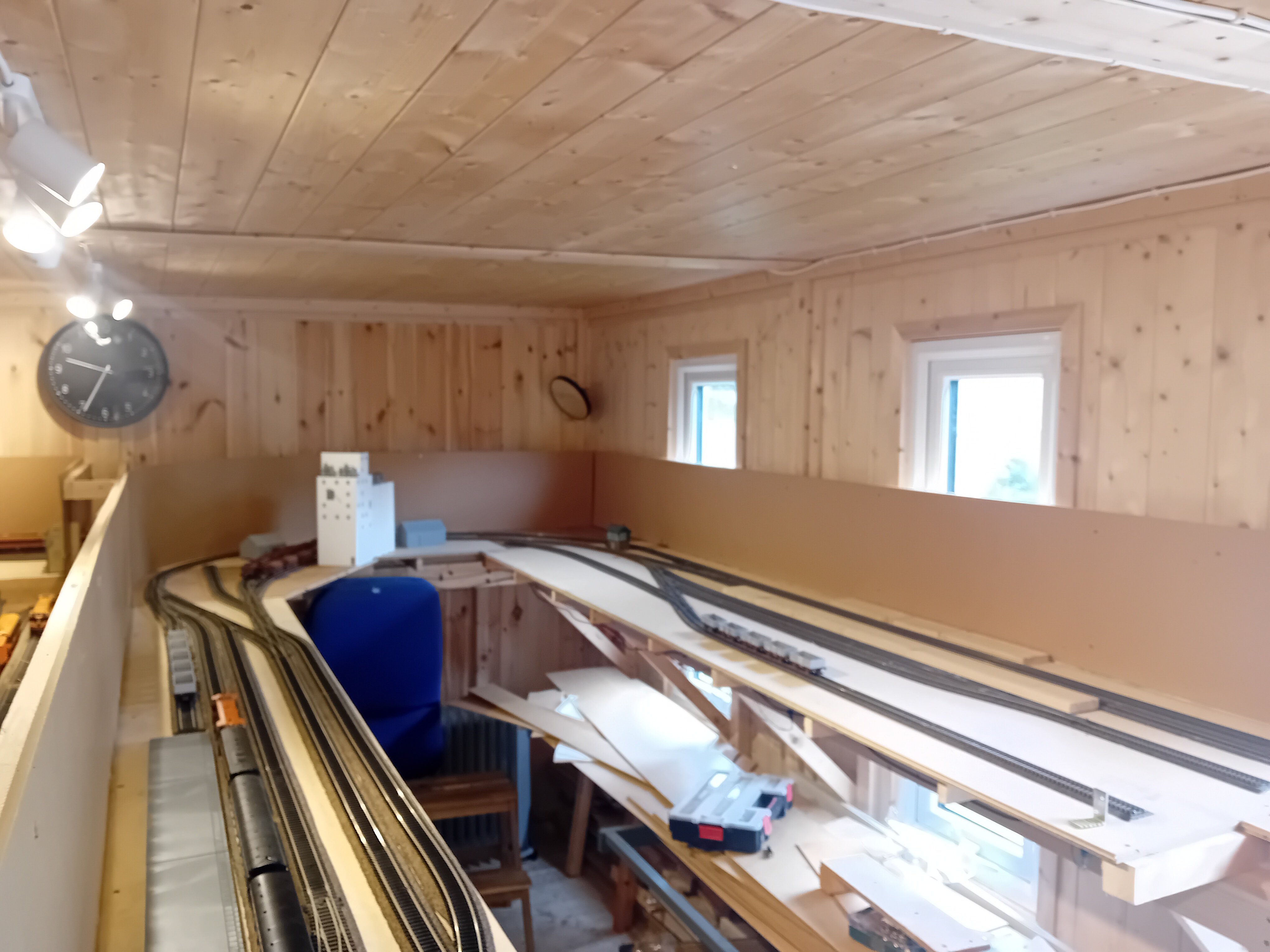
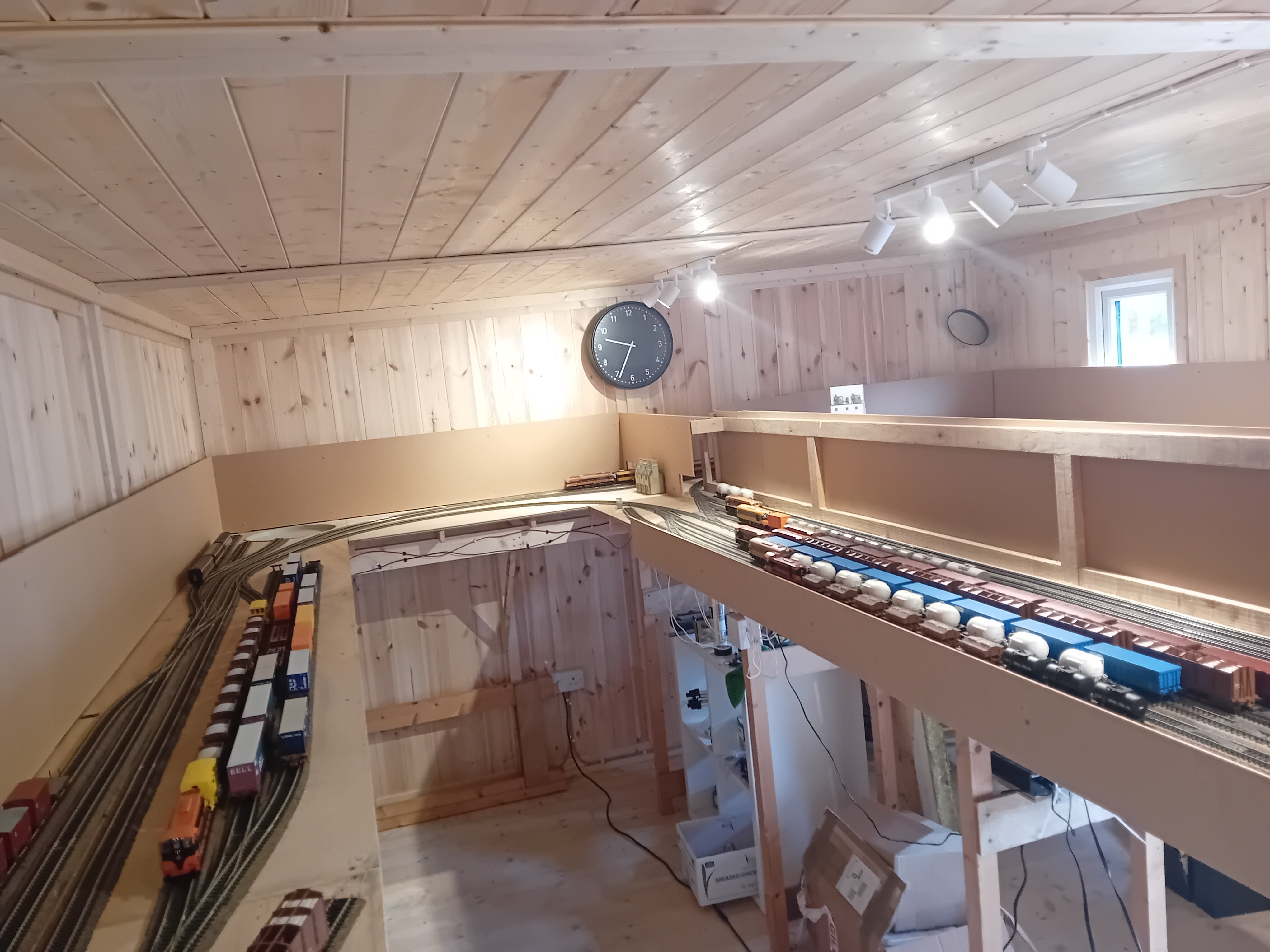
This photo shows the branch terminus on the left with the magnesite plant in the middle distance and the junction station on the right. The staging yard is behind the backscene on the left. Southbound trains come out of the staging yard behind the curved backscene in the left distance. The view of the exit is masked by the high silo. This photo shows the yard and station throat with the loco sidings and turntable pit in the left distance. In the right distance 086 is poking its head out of the passenger station while on the right is the nine track staging yard.
- 28 replies
-
- 12
-

-

-
John Allen was considered a pioneer in his day particularly in the development in scenery and photography. The layout was mainly a stage for him to take beautiful photographs. John died in 1972 and the layout was destroyed in a fire shortly after. A more modern emphasis in layout design is an American track planner called Bill Beranek. Among the principals he espouses are: Walk Along Mainlines Narrow Shelves Long Mainline or Branch-line Runs Trains Traveling Through Scenes Once View Blocking Peninsulas Staging Yards (both hidden & open) Prototypical Operations It’s worth watching him on YouTube, you will learn a lot. Even if you have a lot of space it does make sense to start with something smaller and incorporate into a larger later. It has taken a year for me to get my layout to get to the operational stage, i.e. baseboard built, track laid and wired but no scenery yet. I retired a few years ago but would never have found the time to get that far while I was working.
-
From what I have seen on Youtube and from being a suscriber to Model Railroader in the past is that the americans either have huge layouts in their basements operated by a gang of people or short lines but still with operating potential. Here Dugort Harbour and Patricks layout before he had to dismantle it are closest to that concept. A single track branch with multiple stations. Scenic developement on both are way above anything I hope to achieve. The initial Castle Rackrent terminus was small but every siding and every spot had a purpose so at exhibitions the passenger train didn't just shunt back and forward. Wagons were spotted at the dock, the mill the good siding etc. He used home made Jackson couplings. The big advantage of a smaller layout is that you can change era just by changing the rolling stock. From 1900 up to the mid 1970's the railway infastructure hardly changed at all. Track layouts, signalling, buildings in a station could be set in 1900 or 1970 or even 1980, when a branch line closed the junction track layout hardly changed and often the stub was used for storing old rolling stock. The only thing that was substantially different was the rolling stock. From the mid 70's on things did change substantially with CTC, Railplan 80 etc. Before Paddy and IRM arrived on the scene I bough a large amount of american HO equipment as I was not happy with the running qualities or Hornby or Lima. It would be a huge job to change but maybe some time in the future the W&DJR will become the Denver Terminal and I can watch my Californial Zeypher leave Union station and head up the front range. Rule number one!
-
Following on from my latest post in the layout section I thought a general discussion on layout operation would be interesting. Has anyone else on the forum got a layout that has more than one station and runs prototypically based operating sessions? Does anyone go to operation sessions on a friend’s layout? Are people interested in model railway operations? I love models of any type, ships, planes, cars etc but there is something about model trains that has been etched into my DNA by my grandmother who bought me my first train set at six years of age. I love looking at them, but I also love that model trains can run on a model railway layout. One of my heroes was the late Richard Chown. Richard was an Englishman living in Scotland who modeled Irish railways. His 0 Gauge Castle Rackrent layout was amazing, The layout was based on an imaginary branch of the WL&WR that connected with the MGWR and set around 1900. The layout was a single track main line with multiple stations and two branches one to the MGWR and a market branch. During the 1970’s and 1980’s he would take various parts of the layout to exhibitions. Even at exhibitions it was always operated in a prototypical manner with block signals and bell codes. Later on he built a house with a big enough basement to set up the whole layout on a permanent basis. He used to hold operating sessions regularly and could keep up to 12 operators busy. I was lucky enough to see the whole layout in operation at one of his famous Ceilidh’s and had to be dragged kicking and screaming out of the hall. Scenery was important to him as well but secondary to operation. Another layout I was lucky to see in operation was Sam Carse’s County Donegal layout. This was purely operational with 3 rail Hornby 00 track but with hand built rolling stock. Sam also operated using bell codes and block working. I assume that the biggest constraint is that anything more than a branch terminus takes up a lot of space. I am lucky that part of the deal when we downsized was my garden room.
-
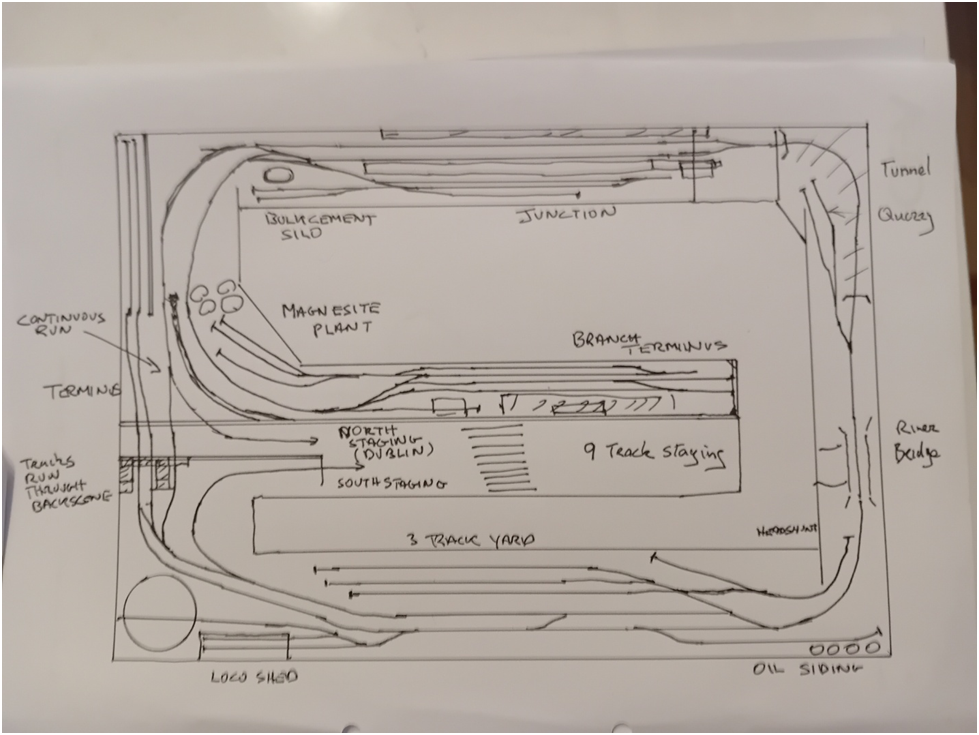
The layout is designed primarily for operation. I am currently drawing up a draft sequence timetable based on the rolling stock that I have collected over the last twenty years, what is expected to be produced soon and CIE operating practices from the 1980’s. This is the operation schematic North Staging Junction Mine Yard South Staging Branch Terminus Passenger Terminus Locomotives I currently have 2 x 001 class, 2 x 071 class, 2 x 121 class, 3 x 141 class, 1 x 181 class, 1 x Hunslet which is probably not enough so I am eagerly awaiting the production of the C class from IRM in supertrain livery. I have nine staging tracks, I hope this is enough but it may not be possible to run every train in each operation session. Passenger trains Mk2 6 coach max train length Mk3 6 coach max train length Branch passenger Dutch van plus 2 max - length GSV plus 3 Weekend extra GSV plus 5 max Special Hunslet plus 6 NIR mk2’s Future Night mail? One train based overnight in Belview passenger station, one train based in north staging, Branch train to include morning and evening through workings from Branch terminus to Belview passenger station. The NIR train will substitute for the mk’3 until they are available from either Murphy or IRM. Through Trains Ballast Van plus 9 laden hoppers plus van North to South or vise versa If stopping to drop ballast will need Engineering possession As it is always laden it will run in one direction only using one of the middle staging tracks Tara Mines 8 wagon train North to South and return Lisheen Mine 8 wagon ‘dickie tara’ North to South and return Gypsum Train Up to 12 laden hoppers Dublin to South Esso train 8 tanks plus barrier north to south and return Loose coupled trains Beet train Up to 10 wagons plus 30 ton van pick up from Branch Terminus and Junction and on to south staging and return empty. PW train Pallet vans H vans flats lomac and opens plus 30 ton brake van Dublin to any station to pick up or drop off materials Oil Train 3 wagon plus van South to loco shed . In the short term these wagons are being used for supplying the Magnesite plant. Liner trains Mixed Liner 6-9 2 axle wagons Pallet cement, sundries,fertilizer,containers North to Junction and Belview yard. Container train 6-8 bogie flats North to Belview yard and return Bulk Cement train 7-10 wagons North or South to Junction and return Fertiliser train 6 bogie wagons North or south to Belview yard and Junction Dolomite 6 laden wagons Quarry to Drinagh 6 empty wagons Drinagh to quarry In the short term the gypsum hoppers will substitute for dolomite wagons. Laden and empty wagons will be restaged before each operating session. Magnesite & oil 6 plus 3 laden Drinagh to south 6 plus 3 empty South to Drinagh To run the above trains I am only short a Mk 3 set, a GSV, a few extra Cravens or Park Royals, pallet cement wagons, 20’ CIE oil tanks, another 30 ton brake van and a few extra locos.
-
To me, Dart Underground, four tracking to Malahide, a spur to the airport and extending the Luas from Finglas to the Airport would probably cost a lot less and make more sense than the Metro as currently planned.
-
The same train passing through the junction while the branch passenger waits in the bay platform.
-
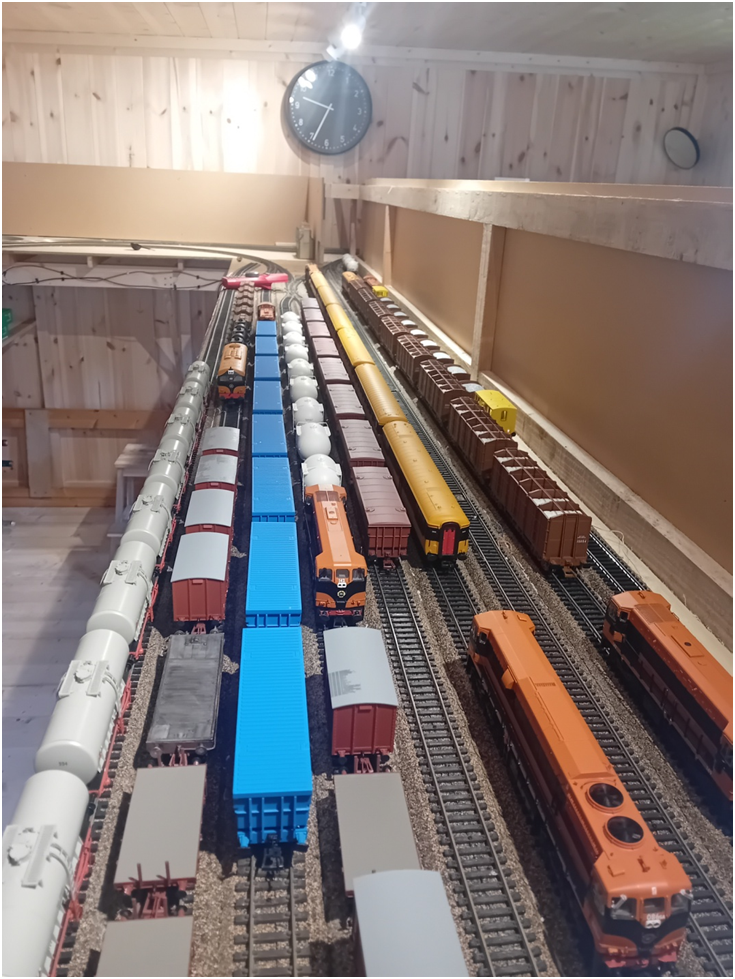
Tracklaying is now complete. As with the previous layout I used Midwest cork roadbed glued to the plywood baseboard. The Peco track is then screwed to the cork using 6mm x 1,2mm screws bought on Temu. Most of the track is reused from previous layouts. Indeed most of the electrofrog points are at least 30 years old. Droppers recycled from telephone wire are soldered to the rail and connected to a ring main of 1.5mm square recycled household wiring using clip on connectors. I am reusing the Roco multimaus DCC controller. The finished track plan is almost identical to the above sketch. The oil siding is now a carriage siding and doesn’t extend into the corner. The crossover on the main line in Belview is facing rather than trailing and only one siding for bulk cement at the Junction. I have unboxed most of my Irish rolling stock that I have accumulated over the last twenty years. I am enjoying test running my sound equipped Hunslet and all the other stock. I have never got around to doing any scenic work on any of my previous layouts so now I have many buildings to assemble and scenery to build. The first area I will try is the end baseboard where the bridge and the quarry are situated. As the main focus of the layout is operation as opposed to scenic accuracy, my first priority is to devise a working timetable for the layout and available rolling stock that would be appropriate for 1980’s Ireland. In my world the Hunslets did get beyond Inchicore! Due to the withdrawl of timber bodied stock 102 and the NIR mk. 2’s will remain on loan to CIE until the Mk. 3’s are available. Staging yard . The three tracks on the left are the south staging representing connections to the port and also Cork and Limerick. There will be a bridge over the entrance track to form a scenic break from the passenger station. The two middle tracks can be accessed from either end. As these tracks form a reversing loop they are isolated for reversal of polarity. There is also a programming track. The four tracks on the right represent north staging or Dublin. 102passingmine.mp4 The same train passes the dolomite mine and through the soon to be built tunnel , across the liftout flap and into the Junction. Belview230726.mp4 102 has left the passenger station and heads a train of 6 coaches passing the yard at Belview junction230726.mp4
-
In CIE days we never refered to locomotives as 'Traction' . They were always 'Locos' or 'Engines' By the 1980's maintenance was only carried out in Inchicore in Diesel 1, the old steam errecting shop ( major overhaul), Diesel 2 also known as the ramps ( body repairs) or the Running shed ( daily and weekly service checks). As part of the DART works Connolly shed was upgraded for service checks on locos working the Belfast, Rosslare and Sligo lines. A failure anywhere else and the loco was hauled to Inchicore.
-
The trees are probably younger than the railway?
-
The GM engine had a tendency to dump its coolant if it was shut down and let go cold. After the first oil crisis boilers were fitted to keep the engine warm but these were not reliable and drivers tended to leave the engine idling overnight rather than risk a restart.