.png.c363cdf5c3fb7955cd92a55eb6dbbae0.png)

Horsetan
-
Posts
2,754 -
Joined
-
Last visited
-
Days Won
4
Content Type
Profiles
Forums
Events
Gallery
Blogs
Everything posted by Horsetan
-
21mm gauge wheel sets for IRM Park Royals and Mark IIs
Horsetan replied to lucas's topic in Irish Models
Might do. Want to give it a go? -
21mm gauge wheel sets for IRM Park Royals and Mark IIs
Horsetan replied to lucas's topic in Irish Models
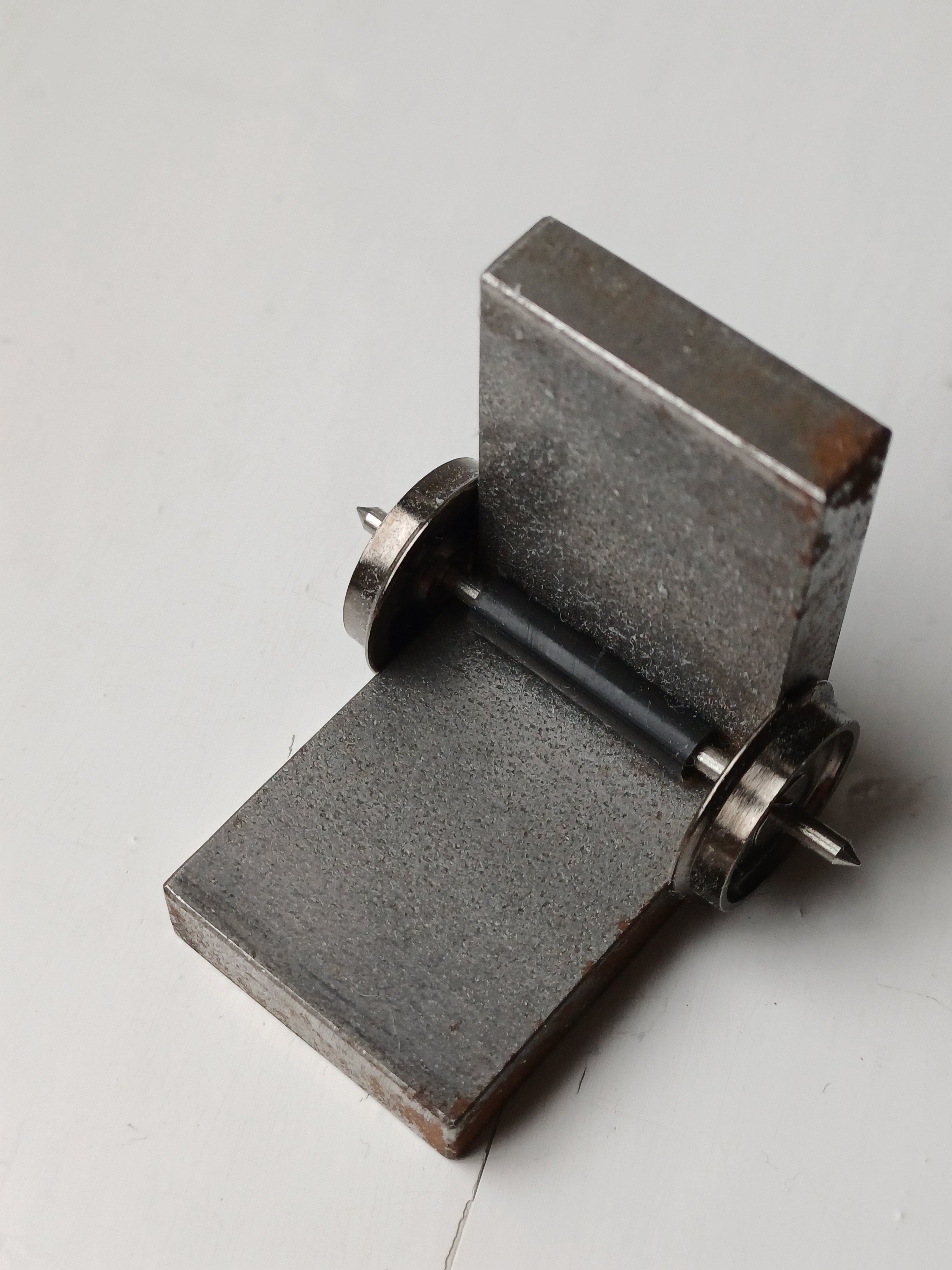
The ideal solution would be a 2mm o/d bush pressed into the new wheel and bored 1mm/1.5mm for the stub axle. That's the only way of retaining the original "live" function for lighting and other things. It's not meant to be easy. When Rapido started doing RTR OO, it was quite clear that it had been designed to prevent people from tampering with the model, so rewheeling to a wider gauge was very difficult indeed or virtually impossible. -
To be fair, with the number of thefts of farm equipment by feral gangs nowadays, maybe more farmers should go the full Tony Martin on intruders. Perhaps the message would then get through.
-
21mm gauge wheel sets for IRM Park Royals and Mark IIs
Horsetan replied to lucas's topic in Irish Models
The wheels are force-fitted on the stub axles, so the only way of shifting them is with a proper press tool. If you take the expedient route and try to hammer it from the pinpoint end, you may well end up blunting the pinpoint, which will result in detrimental running. A new IRM stub axle, and a new wheel is the best solution, but I don't know if IRM's Chinese contracting factory keeps stocks of 1mm pinpoint axles for spares purposes. They are certainly listed as spares and even have parts references, but that's not the same as actually being available to purchase. -
21mm gauge wheel sets for IRM Park Royals and Mark IIs
Horsetan replied to lucas's topic in Irish Models
Pushing the IRM stub axles out on the insulating muff results in quite a wobbly wheelset, as there's little grip left.
-
I don't think many are taking the Red Sea route via Suez owing to the unpredictability of the Iran-supporting Houthi rebels in Yemen.
-
21mm gauge wheel sets for IRM Park Royals and Mark IIs
Horsetan replied to lucas's topic in Irish Models
I only work to P4 standards, so I wouldn't be in the market for these. Bear in mind that both the Mk2 and the Park Royal bogie wheels are based on a 1mm/1.5mm dia stub axle, and the "live" pinpoint bearings are matched to this. A 2mm diameter pinpoint does not work properly in the IRM bearings as the angle of coning is different - this was the first thing I tried, using Scalefour Society 28mm axles, and found that a 2mm pinpoint results in significant rolling resistance / dragging. P4-profile coach wheels commonly come on a 2mm axle, so that means finding a suitable converter bush to press into the wheel centre to reduce it to 1mm/1.5mm. Bushes of that kind are very hard to find. Most 1.5mm i/d bushes on the market have an outer diameter of 2.4mm so cannot be pressed into a standard P4 coach wheel. IRM list their pinpoint stub axles as spares in the coach instruction leaflets but whether they are actually available is another thing altogether. -
"Voiding the Warranty" - Mol's experiments in 21mm gauge
Horsetan replied to Mol_PMB's topic in Irish Models
I notice a lot of the top-end German HO loco kits tend to be mostly all brass castings for this very reason.... -
If Allen is that unwell now, he may already be struggling with everyday tasks, so that answer may never be forthcoming
-
The view over Waterford is interesting for me, as that gives a distant view of the road traffic signal arrangement at the junction with the bridge. This being the late 1970s, the signal equipment would have been relatively new, and Siemens got the gig here as it did all over Ireland in this period, notably in Cork and especially so in Dublin, where brand new signals regulated the complex O'Connell Street / O'Connell Bridge intersections for the first time ever, finally displacing Gardaí officers from hand-signalled traffic control. Unfortunately, signal maintenance in the decades following wasn't a strong point and in 1988 I regularly observed Siemens signals with missing hoods, lenses or simply non-operational. I've had a go at trying to identify a few of the cars waiting at the lights: the yellow one is a Fiat 128, whilst the aquamarine blue at the back of the queue is a Fiat 127. The big brown hatchback is a mystery: I thought it might be a Rover SD1 but the tail lights are the wrong shape. The only other big cars that adopted the hatchback/fastback shape at this time were the Lancia Gamma and the Citroën CX. It's definitely not a CX as the tail light and concave rear windscreen would be easily spotted even at this distance.
-
If anything, I'd think the mails were treated with greater priority than the passengers....
-
Mine's a kit, so I have every opportunity to make my own mistakes on paint shades
-
You know it makes sense. The bogies will need to be widened somewhat for 21mm gauge.
-
Is it your intention to take on the 4mm Irish 5ft 3in etches as well? There were a great many of those too....
-
Like Sambo, it does seem to have been an improvised one-off.
-
Further TPO update: The CIE TPO is now available, and I'm just after paying for one. The basic kit only (not RTR) is 90 Euros, plus a further 20 Euros for delivery to UK by DPD. Tommy accepts payment by Revolut, or IBAN transfer to his Revolut account.
-
Early Black and Tan Livery (late 1961, early 1962)
Horsetan replied to Mol_PMB's topic in General Chat
For now, anyway -
Longer insulating muffs would help
-
Early Black and Tan Livery (late 1961, early 1962)
Horsetan replied to Mol_PMB's topic in General Chat
I'm guessing that with typical Irish summers back then tending to lack that essential ingredient - actual heat - heat absorption problems with a predominantly black livery were not considered a problem. -
Making an ‘E’ – the Maybach Diesel Model Assembly thread
Horsetan replied to Mol_PMB's topic in Irish Models
"Mass now is ended. Go in Peace to love and serve the Lord." -
Making an ‘E’ – the Maybach Diesel Model Assembly thread
Horsetan replied to Mol_PMB's topic in Irish Models
I'm sure priests use the same two fingers when making the sign of the cross.... -
Theoretically, I should have one green one, and a BnT one, coming this way. Both being the preserved vehicles. I wonder if they'll be as challenging to convert to 21mm as the Mk2s (split 1mm pinpoint axle and insulating muff arrangement)
-
Just after paying the second Park Royal invoice
-
I wonder what the spares situation at IRM is for "A" class parts at the moment? I'm sure there's bits in there he could cannibalise....
-
It's a hybrid of two different engines, - frames and wheels of 61.002 - rear frames, trailing truck and outside cylinders of 45.024 topped by a Reko 39E boiler. I think the tender came from a Br44.