.png.c363cdf5c3fb7955cd92a55eb6dbbae0.png)


Mayner
-
Posts
5,206 -
Joined
-
Last visited
-
Days Won
130
Content Type
Profiles
Forums
Events
Gallery
Blogs
Everything posted by Mayner
-

A campaign has started on You Tube to support local model shops
Mayner replied to Dawn Quest's topic in News
Media and political pushback against competitors is nothing new: Back in the day Dinny Guiney in conjunction with the GSR ran excursions to Dublin and offered reduced train fares to customers shopping in his Talbot St and Clearys Department store resulting in media and no doubt political pushback from provincial retailers. I remember the media storm created by major Irish supermarket chains (Dunnes, H Williams, Quinnsworth, Superquinn) during the 1970s before Albert Gubay opened his 3 Guys low-cost grocery chain. Ironically in the end H Williams bought 3 Guys Irish stores immediately before going bankrupt itself. There is an old saying that empty vessels make the most noise which appears to be particularly true of social media. Personally I havent bought anything significant from Rails since MM introduced its origonal 141 Class models in 2007, but little bit by buying a Gaugemaster walkaround controller at approx 80% of the RRP from Peter's Spares last week rather than direct from Gaugemaster for the full RRP. -
As far as I recall the TMD (Terry McDermott) E Class/J26 was originally introduced in 1983/4 TMDs first Irish kit. TMD initially produced a SDJR milk van (etched brass & plasticard) followed by an etched kit for a Glasgow & South Western 0-6-2T both 4mm scale. The Midland Tank introduced during the early stages of the development of etched kits, more a set of parts similar to a traditional pressed metal kit rather than the rather complex kits with slot and tab construction and half etched parts that evolved in later years. I think the etched n/s chassis was introduced during the late 80s in response to problems experienced by some customers while assembling the original chassis. Some modellers who assembled the chassis with a rigid chassis (as described in the original chassis) found that the etched brass chassis distorted (& de-railed)when fixed (at both ends) to the body. I recently read an Iain Rice magazine article on compensation and as a novice builder (1984/5) got around the problem by assembling the kit as a compensated loco simply by using Sharman hornblock bushes (on all axles) in combination with the etched hornblock cut outs in the original brass chassis. I fitted a compensation beam above the leading and centre axle with the axles free to move up and down in their etched hornblock cutouts and treated the trailing (driving axle) as rigid without vertical movement, I fabricated a keeperplate to retain wheels in place and represent brake pull-rods as the original etched brake gear was extremely fragile. I overhauled and re-painted the model about 10 years later. I was a novice kit builder when I first assembled the loco (Frylux paste flux and goodness knows what solder) and I liked to believe that my standard of workmanship had improved during the 10 years since I originally assembled the kit, 30 years later loco still looks and runs reasonably, but could potentially do with a mechanical upgrade (new gearbox and motor). But probabably better to let sleeping dogs lie, goodness knows when I'll actually get around to building a 21mm gauge layout or find work for my current collection of locos. Like Horsetan I prefer the origonal brass chassis to the n/s replacement although we have different preferences when it comes to wheel/track standards and suspension systems.
-
"NEM Chain" used in conjunction with Kadee's will improve the reliability of the coupling/uncoupling of short wagons like the GN & SLNCR cattle wagons produced by Provincial & CK Prints. Back in the day (1990s) we experienced coupling reliability problems with short (14') cattle wagons fitted with Kadees, but not the longer 'Standard Irish" covered and open wagons used when operating the MRSI Loughrea layout. The cause the standard Kadee magnetic uncoupler was too long to allow the coupling droppers to operate reliably, resulting in a kind of uncoupling 'chain-reaction" when attempting to 'couple up" and remain coupled up to a rake of wagons close to an uncoupling magnet. I got around the problem by fitting my 14' GN Cattle Wagons (MIR & Model Wagon Co) with a Kadee coupler at one end and 3 Link at the other, effectively running the GN cattle wagons in pairs with the 3Link effectively acting as a permanant coupler, while providing the options of shunting a short cut of 2 wagons.
-
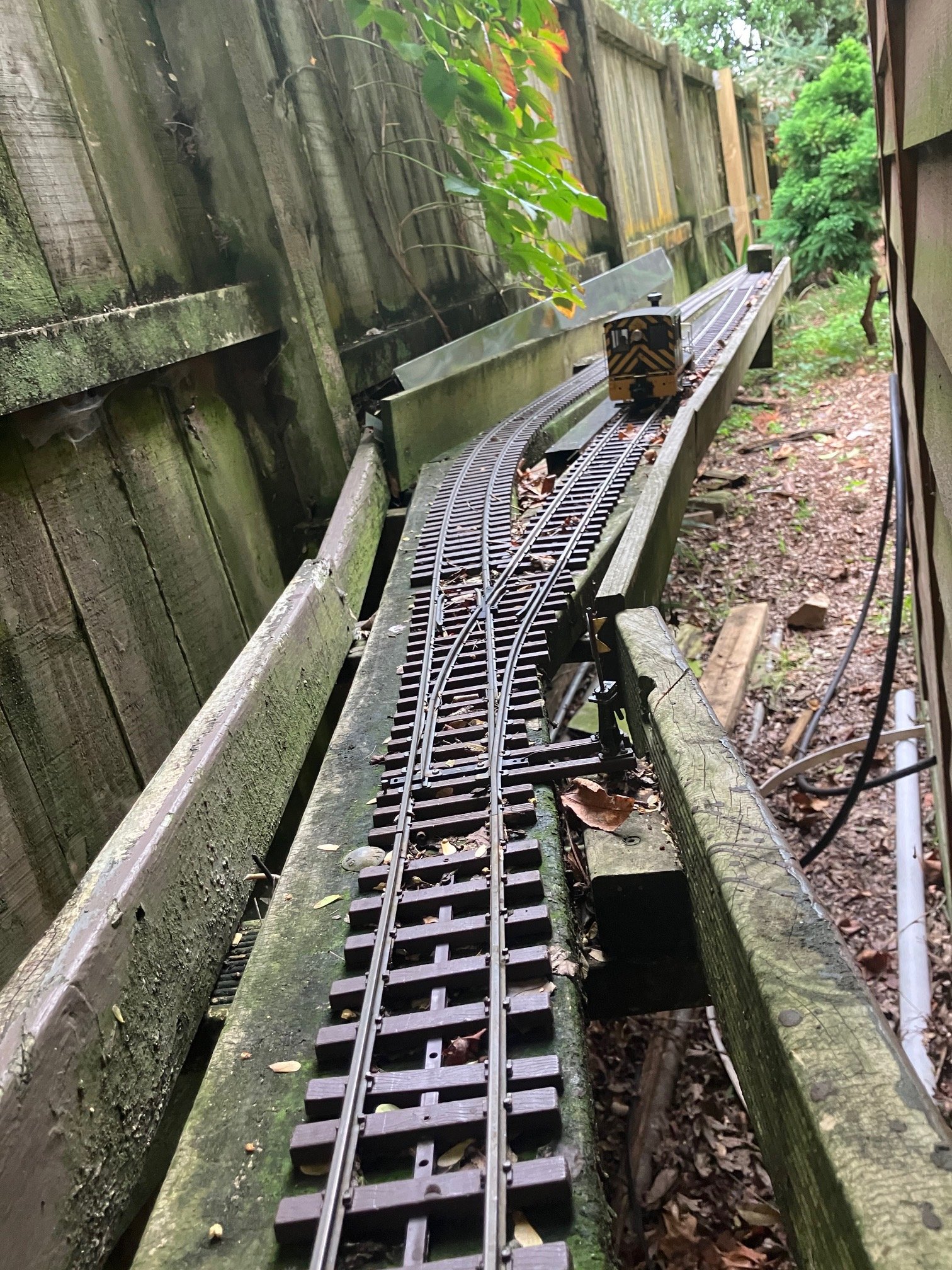
Probabably worth contacting the Gauge 1 Association on the availability of rail and track building parts. https://www.g1mra.com/portfolio-items/new-members-brochure/ I model the American 3' gauge in the garden to a scale of 1:20.3 on 45mm or gauge 1 track using Code 250 brass rail. Sunset Valley RR https://sunsetvalleyrailroad.com/product-category/track/ in the United States who produce Gauge 1 standard gauge is my main supplier of rail and tracklaying components. Its possible that forms like Peco and Temmille may supply similar components in the UK/Europe. At one stage I had timber sleepers specially milled from supposedly rot resistant yellow cedar which unfortunately failed due to rot after approx 15 years outdoor use in a wet humid climate.
-
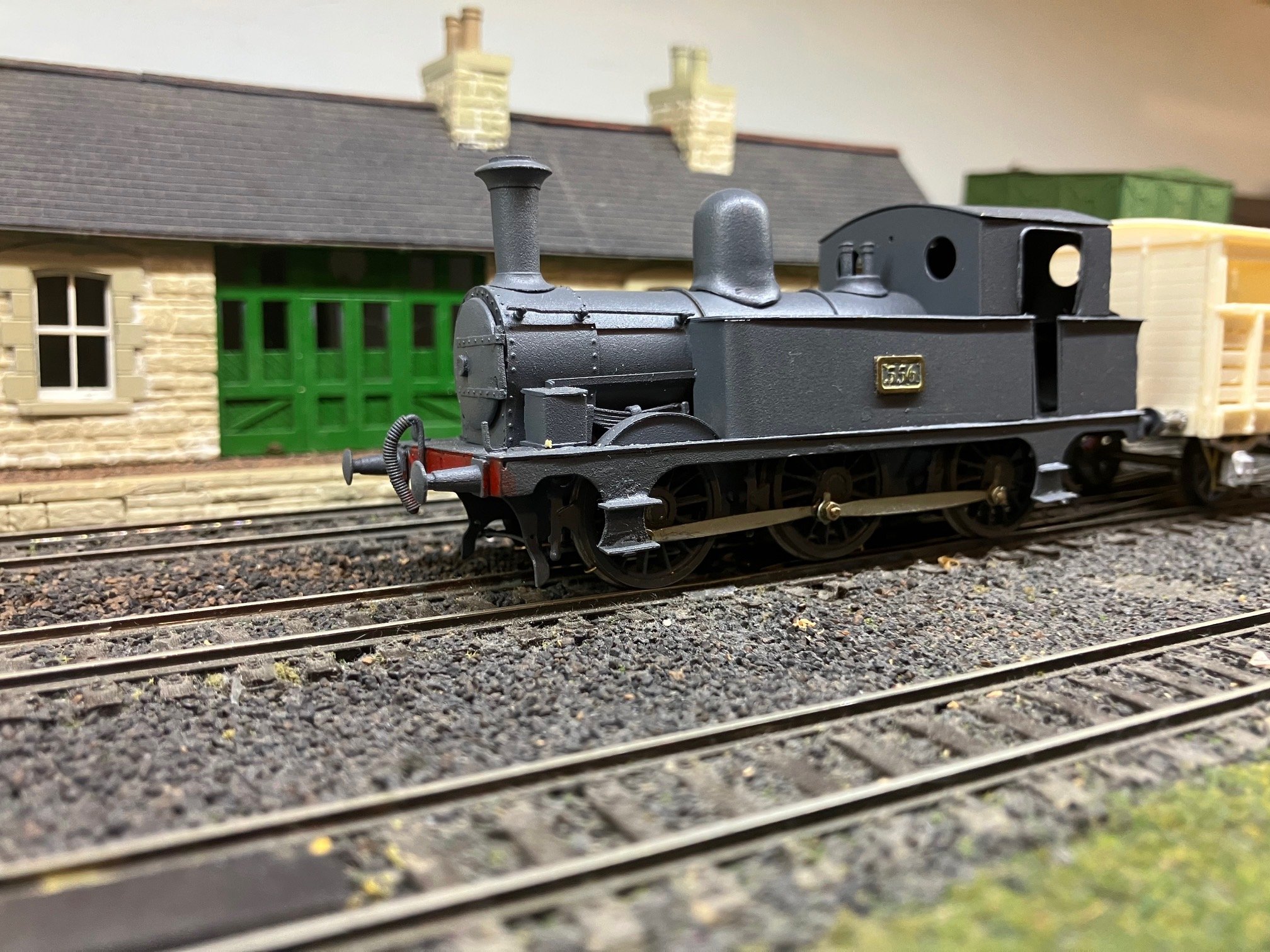
4'6" OO/EM profile Sharnan wheels fitted within the splashers on both my 21mm guage TMD E Class, the main issue is that the (scale width?) splasher tops do not fully cover/enclose the wheel tyres when viewed from above. Like Alan I never got round to fitting my E Class/J26 or most of my Irish outline steam locos with cab interior, challenging enough to get them to run reliably and complete the normally visible detail. 556 cab interior view, wheels OO/EM profile 21mm gauge 19.5mm B-B. A raised cab floor would appear to be the simplest option for modelling a detailed cab interior in OO. Again wheel typres partially visible with OO/EM profile wheels in 21mm. Possibly wider splasher tops in OO, potential clearance problems with smokebox wrapper & spring? I modelled the loco in late GSR condition with riveted smokebox. Looks like I used the original ornate TMD smokebox door with most of the raised detail removed, etched riveted strapping and wire for door hinge detail. Loco hasn't run since being largely completed 7-8 years ago, still have to fit couplings.

-
A campaign has started on You Tube to support local model shops
Mayner replied to Dawn Quest's topic in News
Ranting on about something is a sure fire way to get votes/social media likes works for populist politicians so why not model railway influencers? MMRGA (Make Model Railways Great Again)! Nothing remotely connected with the real world. -
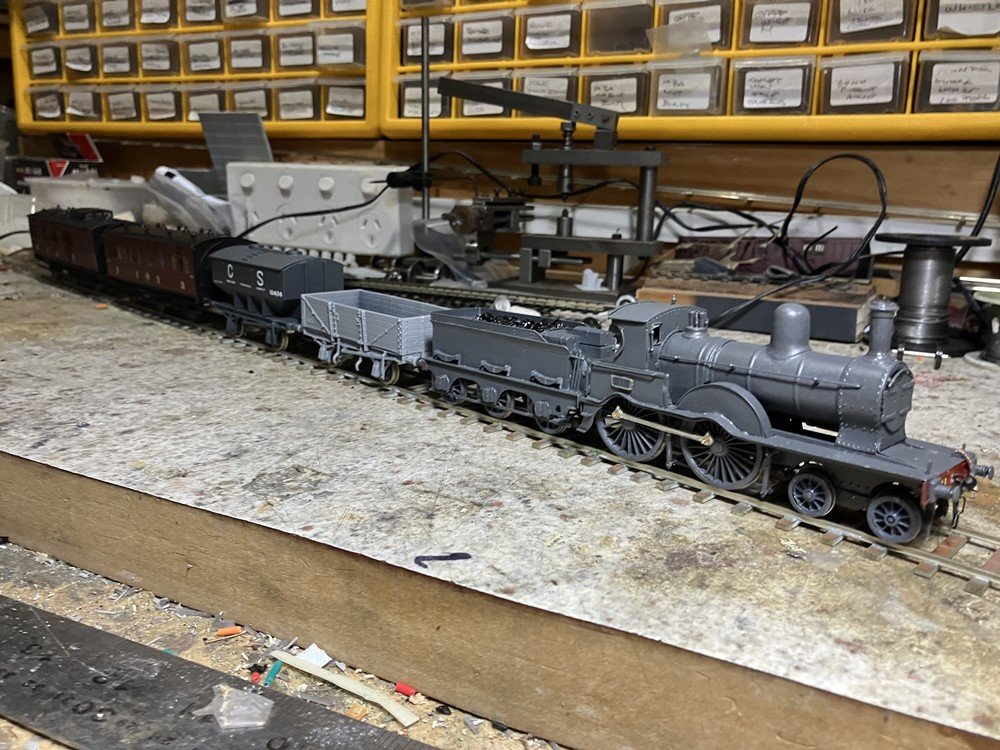
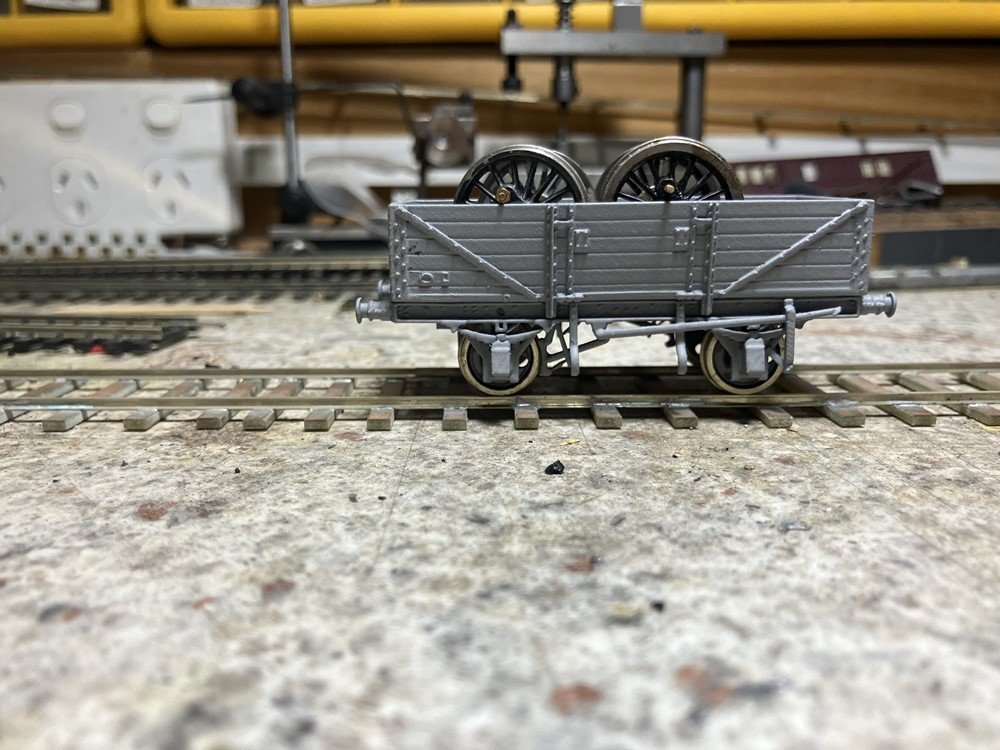
Something of a breakthrough No11 actually No1 substantially completed. The inspiration was a late 20s/early 30s photo of No 1 on the Transport of Delights website, which looks suspiciously like the lads were preparing for a high-speed run with thier racing machine. https://transportsofdelight.smugmug.com/RAILWAYS/IRISH-RAILWAYS/GREAT-SOUTHERN-RAILWAY-STEAM/i-H58MfCG/A Although I had a set of number plates etched several years ago, I have been unable to locate them and the loco is currently disguised as no11. Got to adjust the ride height/trim at the front end, but otherwise looking the part. The loco was assembled from the original test etch based on the 'official' GSW/GSR diagram with the origonal "3 ring" boiler with the dome placed centrally, rather than the later 2 ring boiler with offset dome in the photo. Head on view with correct (HMRS) transfer No, 3 link coupler to be replaced with screw, Markits vac pipe replaced with cast type fitted to No 93 which looks a lot neater. Tender now has a load of real Waikato coal collected about 15 years ago from the McDonald Mine Rd, Rotowaro "lake of glowing embers". Although the McDonald and other small mines in the area closed, two trainloads of Waikato coal are dispatched daily from the Rotowaro railhead to the Glenbrook Steel mill approx 85km distant. Coal was glued with pva office glue to a brass plate that sits on top of the tender ballast weight. Set up is based on a 1939 photo with 58 on a train at Mountmellick, I substituted a grain wagon for an ex GSW covered wagon. The wagons are unfitted (handbrake only, no vacuum pipe) so the question is whether mixed trains of the branch sometimes ran with the automatic brake on the coaches disconnected, or the loco is about to shunt the wagons to the year, having uncoupled from the train and turned after arrival. At one stage there were exemptions from the automatic braking regulations on short branches and Conniberry Junction-Mountmellick was fairly flat and hopefully the train Guard was awake. No1/No11 with a more 'regular' consist, I have another 4 GSW square wheelers in stock to assemble The open with wheels is based on a Railway Publishing Co photo of an almost new open with at Inchacore with a wheel load which inspired me in 2021 to produce a 3D model of this type of wagon. Cab backhead from original kit, tender floor spare from a 650 Class kit. Made a mess of painting the backhead, needs to be stripped down and re-painted. Nitty gritty stuff Motor sits in a bed of silicone on cast ballast weight glued to chassis. Brass wire pick up from loco chassis soldered to upper motor terminal, black insulated lead to tender chassis. Loco brake gear removed for paint touch at this stage. Coupling rods are from original test build to be replaced when I find replacement set! Slight binding while running in one direction at this stage, 2 of the crankpin bushes appear too short for comfort and may be contributing to the binding. Tender pick up lead, I was lucky to find a lead complete with eye among my stock of bits and bobs. Although still requiring some minor work completing No11/1 to this stage is something of a milestone, clearing space on the workbench to resume work on 229 with some added motivation to actually start work on the planned 21mm gauge layout.
-
I would imagine that the 3MM Society may take over Worsley Works 3mm designs potentially including the Irish 3mm etched parts. As David commented modellers like Mick tend to be less reliant on trade support and scratchbuild models to a high standard like Drew Donaldson andTony Miles. Several years ago I remember reading an article in (Model Railway Journal?) on a 3mm 5'3' gauge NR(I) U Class 4-4-0 Mike built for Ballyconnell Rd with the aid of Worsley Works parts, the mechanical design and build were almost identical to that pioneered by Tony Miles when he independently developed 4mm fine scale standards during the 1960s. Large motor with flywheel in tender driving a gearbox in the loco, split axle pick up in the tender, working inside valve gear in the loco. When I returned to Ireland in the mid 1990s, MRSI members scratchbuilt rolling stock in plasticard for use on the Loughrea (21mm gauge) and Greystones OO gauge layouts, including a train (approx 15) GSW cattle wagons for use on Loughrea, batch built locomotive bodies and a fleet of Craven coaches (using jigs and toolings) for use on Greystones. Scratchbuilt platsticard 201 and 141 class loco bodies became masters for resin bodies available from Marks Models long before MM released its 1st 201 and 141 Class diesels.
-
I have a pair of Midland tanks both 21mm gauge 553 assembled about 30 years ago with the original brass chassis and rods and the 556 completed about about 8 years ago with the replacement n/s chassis. At the time I was not happy with the rods supplied with the n/s chassis (deeply bellied profile and half etched outer layer) and hoped to use the brass rods included with the body & chassis fret, but found brass and n/s rods had different centres! Looking at MIL_PMB very recent bumping up of Horsetans "Tmd/ssm mgwr 'e"/gsr j26/ cie 551 0-6-0t" thread it also looks like I had a similar 'accident"to Alan while assembling the n/s rods and seem to have produced a replacement set (2 layers full thickness) prepared in etched brass. Wrecking and replacing the rods no doubt contributed to my 2+ year delay in completing the loco. I still have to sort out a replacement set of rods for a High Level HL 0-6-0ST I started while travelling to New Zealand over 20 years ago As far as I recall the TMD kit is supplied with parts to complete the loco in original pre-1912 form (flush riveted smokebox, tall cast Iron chimney, fancy smokebox door and original safety valve cover. The locos were re-boilered in 1912 retaining a flush riveted smokebox and tall chimney, a conventional smokebox door (with spoked hand wheel) and ross pop safety valves. Some locos incl 561,552,558* retained these features until at least 1939 before being rebuilt with riveted smokebox, Inchacore "built up" chimney and smokebox with "dart" hand levers. * photos Great Southern Railways Donal Murray 2006. One of the "Tramore" locos with extended cab and recessed cab steps may have retained its flush smokebox and tall cast Iron chimney into the 1950s I guess its a question of whether you/Patrick would be prepared to complete the loco in its original pre-1912 form with ornate livery or with minor modifications in post 1912 condition in simplified MGW or GSR livery or late GSR/CIE condition with the challenge of forming a riveted smokebox and finding a suitable chimney. Both 553 & 556 are in rebuilt form with riveted smokebox and Inchacore chimney, I cheated with 553 by using a riveted smokebox overlay from a TMD J15 kit and produced an etched riveted wrapper for 556.
-
At one stage CIE apparrenty considered acquiring and re-gauging BR Western Region "Blue Pullman' fleet. Perhaps Accurascale produce or even comissionn Bachmann to produce the "Blue Pullman" in various BR and might of been CIE/IE liveries
-
Hi Colin. I had totally forgotten Ballyconnell Road a noticeable example of Irish Broad Gauge fine scale modelling https://sites.google.com/site/3mmpublic/members-layouts/ballyconnell-road Interestingly while to 3mm/1:101.6 (British TT) the group selected (the correct) 15.75mm rather than OO (16.5) to model the Irish 5'3". Clearances between wheels/running gear and body work become critical when building locos/stock to the correct scale gauge ratio. Either the scale would have to be increased to a min of 3.14mm-ft and the bodywidth increased/distorted to model the Irish Broad gauge on 16.5mm/OO track. I guess the question for a manufacturer potentially considering Irish Outline 'broad gauge" stock is whether to produce the models to TT/120 scale allowing some use of common tooling with British Outline stock (MK2,3 coaches, Esso Tank wagons) or produce the models to 3mm/101.6 scale or even 3.14/1:103 scale significantly reducing market share. While there may be some demand for British Outline rtr stock from existing British TT/3mm modellers it has been very much a minority scale since Tri-ang ceased production of rtr TT over 60 years ago and TT120 more attractive to newer entrants to the hobby with the availability of both British and Continental Outline models to the same scale. Personally an 071 & MK2D or Mk3 coaches would be a good starter set for someone whoes memories of the railways were mainly the late 70s early-mid 80s. Then N (1:160) scale would be a nice addition to my collection on American N scale stock and look less toylike than British 1:148 N.
-
I don't know if anyone has modeled the Irish Broad Gauge in either 3mm (British TT) or TT/120 During the Brian McCann modelled the CDJR in 3mm on N gauge track with a model of Inver station and village which may have appeared on the Irish exhibition circuit during the 2000s. Brians main interest appears to have been modelling buildings and structures, he built an N gauge Waterford Line layout which featured a model of Bagnallstown station, the Blackwater and Suir Viaducts which appeared on the exhibition circuit during the late 70s followed by a OO gauge layout during the 80s-90s with a village scene featuring buildings from towns and villages in the South East. I guess the big question facing someone modelling the Irish Broad Gauge in TT is whether they select TT/120 and adapt a prototypical gauge of 13.33mm or British TT on 16.5mm track. Would modelling the Irish Broad gauge in TT/120 to a gauge of 13.3 actually worth the bother to the average modeller? The visual narrow gauge effect of modelling the Irish Broad Gauge to a gauge 6" narrower than the prototype are far less significant than the 12+" narrower in British TT or OO. Those modelling the Irish Broad gauge to TT/120 would need to essentially adapt/develop a new track gauge developed from TT/120 standards. Those adapting British TT (scale) with proprietary OO faced with using a track that the correct gauge but an incorrect larger scale distorting the proportions of the model railway. While a manufacturer/comissioner might potentially considering producing Irish outline locos & stock to TT/120, producing the models to British TT may have a potentially dampening effect on demand from TT/120 who might like an Irish outline train to the same scale as their existing British or Continental outline collections.
-
Going back a bit, I remember seeing Dodge trucks (2-3 axle) in Dublin during 60s/70s mainly tippers some flatbed. 300 Series assembled Kew 1957-65, same also cab used by Leyland & Albion. 2-3 3 axle tippers (probabably on hire to the Corpo) used to be regualrly parked overnight on the hardstanding outside the shops at "the top of the road" (St Agnes Rd) in Crumlin Village during the late 60s, I was more into trucks than trains at the time! 500 Model introduced 1964 Seemed to have been fairly rare in Ireland, though I remember seeing one with a bashed nose and grill possibly a Hacker's (owner driver) flatbed delivering to site during the late 70s Dodge trucks most likely imported possibly CKD by Rootes Group Irish subsidary in Santry, the car assembly plant closed in the early 80s with the redundant workers occupying the plant in protest. The Hillman car range was re-branded Talbot and there was a cat cry 'Seen your Talbot Avenger outside Mountjoy" mocking a recent TV/radio marketing campaign.
-
For RTR Irish Models - will 3D printing ever be as good as injection moulding?
Mayner replied to Noel's topic in Irish Models
There are a lot of variables in the 3D printing process, placing a bowed resin print in hot water may solve the problem, but a badly bowed/distorted print probabably best avoided. -
Looking at the photos the 'best in show" award is well deserved Alan. A BCDR layout! Hopefully Kilmore and its stock will inspire others to have a go at developing kit and scratchbuilding skills.
-
A campaign has started on You Tube to support local model shops
Mayner replied to Dawn Quest's topic in News
A lot of the boxshifters pushback seems to be aimed at harnessing the sense of frustration/anger at the loss of the traditional English "High Street" /way of life with its 'locally owned shops", pubs and bank branch, which like a lot of British traditional manufacturing industry had long ceased to exist. In a way calls to boycott Accurascale and direct sale by the manufacturers are not unlike the Luddites of the 18th Century trying to stop the Industrial Revolution by destroying the machines, with the added irony of a bunch of Irish enterpreneurs threatening the boxshifters livelyhood. Perhaps the certain British politicians potentially running on a platform of "Make British Model Railways Great again" imposing a 200% tarrif on Chinese imports and demanding that manufacturers/retailers re-patriate manufacture to the UK, it worked for Trump what could go wrong. I suppose we could blame Heath's Conservative and Callaghan's Labour governments of the 70s for the whole mess, allowing Airfix and Mainline to outsource manufacture to Hong Kong during the 70s undermining British manufacture. -
For RTR Irish Models - will 3D printing ever be as good as injection moulding?
Mayner replied to Noel's topic in Irish Models
There are a lot of variables in resin printing process that may contribute to bowing/distortion in the finished model. Most of my production printing was carried out by 3D printing/rapid manfacturing companies in New Zealand & China using full size (bottom up) machines in engineering resins with abs properties. Print programming/set up of model for curing Curiously there was an odd bow in one side though no other noticeable defects of the test prints for the GSR/Ranks Grain wagon perpared by our New Zealand supplier, the defect did not reappear on subsequent production prints. Possibly a programming error by the technician who set up the initial test print (too high a print speed/insufficient rest time between layers), a different technician set up the production prints and problem did not re-occur after I shifted production to China. Curing Resin prints will continue to cure/harden when expossed to UV light during the lifetime of the model which maay contribute to brittless/distortion. Theoretically painting is supposed to protect a model from UV. Potential solution. Most of my collection of 3D printed wagons (20+)appear stable after 4-5 years, though the axleguards on a small number of wagons have bowed slightly outwards with the wheelsets sometimes dropping out. I found that placing the model in hot but not boiling water relieves the built up stress/distortion in the resin allowing the model, the model should return to its original shape or can be formed to shape before it cools. Similarly chassis tended to distort while in transit from the factory to my workshop, I usually placed the chassis in hot water so that I could adjust the axle guards so that the wheelsets would roll freely before shipping a model. -
RM Web Heljan thread. Thanks for answering my question Westclarewander & Irishthump, I was wondering if you were simply agreeing with George or actually read the actual threads. There was little sign of anything really contentions when I read the thread after the George comment that the thread hand been locked and deleted, maybe the moderator got there and deleted the really interesting stuff before me! Westclarewanderer sometimes people come across as 'know it alls' even pedantic when they are deeply interested in a subject, indeed one of our member almost comes across as 'speaking infallibly" when it comes to Irish railway liveries and rolling stock and I love to search of discrepencies to challenge a view/belief and I can sometimes come across as a know it all myself. A 'top-feed" is a distinctive feature of several British steam loco classes and quite reasonable to criticise a manufacturer for not getting it right. Impact of shift to direct on-line sale by manufacturer/comissioner to customer. It looks to me that British Outline has reached saturation point with supply exceeding demand in a similar manner to the 1980s when it took several years after the manufacturers had ceased production for retailers to shift stock of Airfix/Mainline/GMR locos and stock. I was able to take advantage of the situation during the late 80s early 90s when I went on a brief binge of buying OO gauge Western Region locos and stock for a layout I never built! Direct sales potentially allows the manufacturer/comissioner to maintain a viable business potentially allowing manufacture to continue and new models to be released potentially at a lower price by cutting out the middle man as in many other businesses. Several years ago I bought my Large Scale stock direct from the manufacturer in the United States as buying the models through the Australian distributor would have been prohibitive. I am not gone on the "Independent Retailers" claims that direct sales and the end of the boxshifters will contribute to the death of the hobby with the end of exhibitions and clubs. In Ireland and this part of the World the hobby continues to trive despite an absence of large retailers (boxshifters) and large exhibitions (Warley, York, Glasgow, Bristol etc. I suspect a high proportion of locos and stock in Ireland and this part of the World are purchased direct from the manufacturer or overseas boxshifters. Hamilton where I live has a model railway club, the local model shop and Hobby City in Auckland (1-2 hr drive) focuses mainly on die cast and RC with model railways mainly entry level Hornby, model railways are more prominent at Bay Hobbies (2hrs drive) primarly American outline locos, stock and buildings and Hornby British outline. Not sure about the retail situation in the lower North or South Islands but one large mainly British outline retailer in Christchurch stocks Hornby possibly Bachmann None of the New Zealand based retailers appears to stock Heljan so Accurascale take over likely to have minimal impact on retailers with potentially lower prices at least in the short term for local modellers. Potentially I cannot see myself returning to British Outline and buying Heljan models at this stage, I have more on my plate than I can manage with Irish Outline broad, narrow gauge and OO, a large scale garden railway, an American Outline N gauge collection & partially built layout, EM British outline locos and stock and a 9mm scale (O gauge) New Zealand Railways tank loco! I culled my American On30, HO, British OO collections to concentrate on Irish Outline about 20 years ago! Conventions potentially replacing exhibitions Locally exhibitions tend to be low key with relatively low attendance (exhibitors wheeling out the same layouts and second hand stock), a significant difference to Ireland and the UK is that specialist modelling groups (American, New Zealand and Garden Railway modellers) hold regular regional "Meets" and "National Conventions' which normally include trade stands, modular and conventional layouts in a similar manner to Expo EM and Scale Forum and 'Layout Tours" to visit local layouts, my 3' gauge C&L layout Keadue and G gauge garden railway were included over 3 days in Layout Tours at the New Zealand National Convention held in Hamilton in 2014 and my garden railway when Hamilton hosted the 2012 garden railway convention. Conventions are mainly funded by registration fees paid by visitors/delegates before the meet/convention as opposed to members of the public turning up on the day, no layout barriers visitors/delegates primarily interested in model railways, held in a venue with lincensed bar and catering American Outline. I have modelled American outline since the mid-80s and also visited model shops and layouts while visiting the USA. The market is quite different from the UK with distinct sectors. O gauge largely remains High Rail 3 rail AC (almost tin plate track) dominated by Lionel. HO & N Bachmann is largely considered entry level not quite Hornby Railroad standard and has traditionally struggled to improve its reputation with significant quality problems (reliability, durability and finish) even in its premium 'Spectrum' range of models. Bachmanns On30 & Large Scale models introduced during the early 2000s became notorious for split final drive gears on its range of locomotives. Walthers possibly largest commissioner, importer, wholesaler and Direct Retail, HO & N, mainly imported from China. Atlas commissioner, importer, wholesale, direct retail. O,HO,N. Quality reputation. Initially offshored production to Rivirossi (Italy 70s), Roco 70s-80s Austria introduced centre motor flywheel drive locos, Kato (Japan 80s), China 90s- Athearn HO & N reasonably priced "Blue Box" almost CKD locos and stock 80s-90s--highly detailed Chinese RTR Heljan buildings/structures Heljan traditionally focused on and produced Continental/American building and structure kits in O, HO and N, but only an O Scale diesel depot currently listed. I wondered whether Accurascale potentially viewed the Heljan take over to expand their European and potentially North American market share. I have probably been going on a bit to long at this stage
-
Narrow Gauge in the Rockies not quite
Mayner replied to Mayner's topic in US / Canadian Railway Modelling
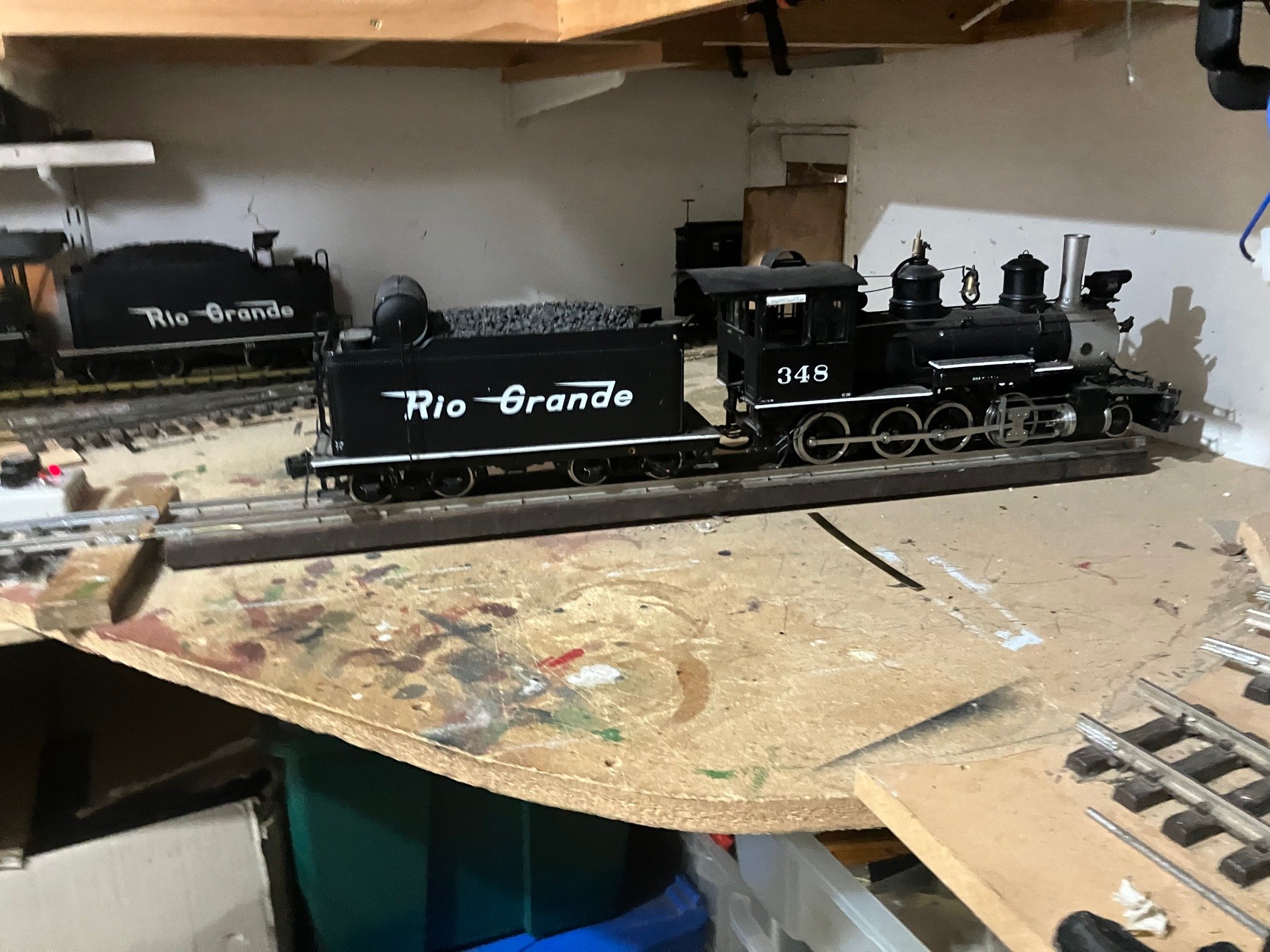
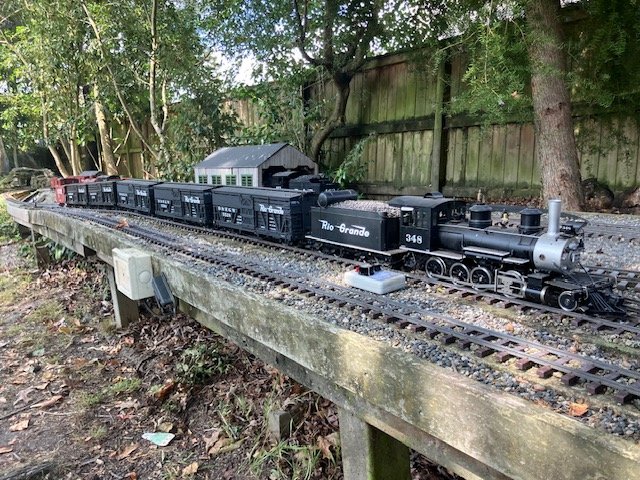
Decided to have a running session today Sunday while mowing the lawn, garden is beginning to look quite autumnal wtih a lot of leaf fall after a day of heavy rain on Friday with more promised tomorrow. An Emergency was declared in sub-tropical Northland where a months rain (approx 300mm) fell in one day resulting in flooding, I hoped at one stage to retire to Northland or the Corromandel to be near the sea, but turned out better to stay in Hamilton (more inland) less susceptible to stroms and earthquakes. Evening line up Jackson City awaiting departure for the RGS connection at Placerville (real place)/staging. #464 had earlier disgraced herself unable to haul her train (7 cars) up a 2%-1:50 grade although recently re-charged and had run back light to the staging to have her batteries fully-discharged before re-charging. Buildings now stored under cover for remainder of leaf fall. Although 348 normal limit is 4 cars and caboose decided to see how far up the 4% -1:25 she would progress as rail conditions appeared. For comparison 463 has just begun to climb a 2% grade. A seedling planted here 18 years ago hass grown into a mature tree and this area is now in almost permanent shade, grass and ssome box hedging in this area died off during the last couple of years. 348 and her train eventually stalled after clearing the most difficult curved section of the grade (possible recent drizzle moisture on the rails) 463 now helping and also hauling her train! Stock, general merchandise, 463 & 348 positioned for the next operation session, LGB Diesel 50 as fiddle/staging yard pilot. Level yard (shunting) neck added several years ago as running line decends 4%/1:25 grade. Simple but it works turntable is a piece of hardwood decking sitting on a couple of washers pivoted on a coach screw. Alignment is brass tube soldered to rail-web with a piece of brass wire as locking bolt. Battery charger is normally stored on shelf under baseboard and plugs into socket (usually) below loco tender. 464 NiMh are likely to be almost lifed expired at this stage (approx 4 years). probabably will be replaced with batteries bought 2 years ago for re-powering RGS 4-6-0 No 20 (in store for several years!) not as useful as 464. Drama is guaranteed with some form of misshap every running day
-
Wondering whether West Clare Wander and Irishthump actually read the RM Web treads on the Accurascale acquiring Heljan and or the "Independent Retailers" campaign, my impression from reading both threads is of a balanced discussion/sharing of opinion on the Accurascale take over of Heljan, pushback from the major boxshifters and its potential impact on the hobby in the UK. Majority view appears to be supportive of Accurascale acquisition of the Heljan British Outline range and critical of the major boxshifters in particular Rails for their treatment of Heljan and throwing a tantrum at Accurascale switching Heljan to a direct sales model. Not sure how this relates to 'know it alls telling everyone else what's really going on" or being a 'pretentious bunch", personally I found the RMweb mens mental health group friendly and supportive while I was going through a difficult time during the last few years, or maybe I have spent too much time as an Irish man living and working in the UK and further abroad and I have learned to appreciate people who 'speak their mind".
-
Nothing wiped, just a separate forum on the "Independent Retailers" campaign. No meltdowns no worse than this thread
-
Some interesting discussion on "Independent Retailers Campaign on RM web https://www.rmweb.co.uk/topic/199406-independent-retailers-campaign/ including comparing "Independent Retailers" press release to Amazon advising its customers to support independent book shops and perhaps more aptly King Canute trying to hold back the tide .
-
In a way it would make sense for Accurascale to acquire the model railway division of Hornby in order to achieve a dominant position in the British model railway market. Irish multi-nationals incl CRH, Kingspan, Smurfit Kappa, Kerry Group have become global players in building materials, packaging, food ingredients, so why not model railways? Back in the day Ray O'Rourke (an Irish subcontractor) bought Laing Construction (a major British loss making main contractor) for £1 in 2001 and transformed Laing O'Rourke into a profitable multi-national business, the largest privately owned construction company in the UK. No doubt Accurascale directors have seen a similar opportunity with a take over of Heljan.
-
Balancing a 4-4-0 getting a step nearer to getting No 1 running. I decided to cast weights in Cerrobend or woodsmetal rather than use sheet lead/tyre weights as I had some of the metal in stock after assembling several 2-4-0s & 4-4-0s several years ago. The tender weight had been cast in a rubber mold 5-6 years ago, the loco weights cast in a 3D resin printed mold as a (not very successful) experiment. The cylindrical mold intended to fit in the loco boiler barrel. the second rectangular weight profiled to fit under the motor. The molds were printed in a 'rapid resin' and both split horizontally as I filled the mold with molten (approx 70C) metal, but worked ok when I filled the mold in layers allow to partially solidify between layers. Perhaps I'll try a heat resistant (150C) resin when I get round to assembling my 60Class. Tender weight is supported on a piece of n/s soldered to a frame spacer, bolt is part of the live axle power pick up system Leading and centre axles are lightly sprung, I had to move the outer brake pull-rods out slightly to avoid shorting on the wheelsets. I still haven't decided on couplings for this loco, but I have a sheet of B&B couplings which I found effective in EM stashed away somewhere I printed the cylinderical weight undersized to fit in the boiler (I probabably use a silicone mastic), on previous locos I found it effective to literally pour the cerrobend into the boiler before I painted the loco! Everything seems to fit ok, next job is to fabricate the drawbar from a piece of copper clad sleeper (with the copper removed) and connect the motor to the loco & tender frames on the so called "American pick up system. My kit and scratch built Irish steam locos are strictly DC only!\ Real coal load to be glued to an offcut of brass sheet. Still have to fit firebox back head, cab floor and fall plate (non-conductive!)
- 405 replies
-
- 12
-

-
Narrow Gauge in the Rockies not quite
Mayner replied to Mayner's topic in US / Canadian Railway Modelling
Although today was Monday had a running session this afternoon, weather was fine with high winds and heavy rail forecast later this week. First train of the day was a mixed Merchandise Freight(goods train) to Jackson City behind K27 #463, followed by Motor #6 on p.w. maintenance, followed by C19 #348 on an empty Stock Special to Arbol. #463 had positioned her cars in the yard and caboose on the departure track before turning and retiring to the loco shed, probabably for the first time this year. Box cars placed by the Freight House (goods shed) gondolas and stock car by loading bank. Tank car placed for unloading, some day perhaps I may add/complete the detailing in this area. The base of the paint tin that had served as an oil tank in this area had reusted through several years ago. #463 waits on shed, originally built to accomodate smaller locos like 2-8-0s the shed is too short to accomodate 2-8-2 locos and thier tenders under cover. Track on the left was originally laid about 16 years ago using AMS flexible narrow gauge (American 3') track with brass rail on plastic ties (sleepers), loco yard was re-modelled about 4 years ago using Sunset Valley aluminium sleepered flexible track to accommodate larger locomotives. The tie strip on the AMS track has been largely replaced with Sunset Valley ties over the past 10-12 due to poor UV resistance of the origional ties, with a few sections with original ties remaining in shaded areas and yards. #348 arriving with the stock special no problems experienced with slipping after several days dry weather although 4 cars and caboose usually considered her maximum load. #348 prepares to run around her train after arrival at Arbole, although originally named arboles because of its 'miniature' connifers one appears to be a 'dwarf" species having grown to approx 5-6' after several years while others have not quite reached 4'. The main line in this area is ballasted with 6-8mm pebbles glued down with a dilute PVA concrete additive and seems to be holding well , although the bind has broken down on other sections. Stock special waiting departure with 346 running tender first. The brickwork is infilling between the timber piles that support the timber baseboard/track base in this area, which is basically PVC pond liner laid on 3/4" shuttering ply on treated 4X2 framing. The two domed objects in the background are supposed to be beehive kilns formed from a large plant pot that split in two by accident, the back story is that hopper wagons once ran on top of the kilns. Motor 6 is a Berlyn Brass model produced about 25 years ago picked up second hand from the States several years ago, beautifully detailed with opening cab doors, bonnet and tool box lids, just about capable of a top speed around a scale 15-20mph with a fully charged battery Just about mamaged a Goose Fest with both Motors #4 and #6 running, though #4 is not the most reliable at this stage. I replaced the original (used) battery pack last year with a home made pack of 8 AA batteries from the local electronic store but may be more effective to replace with a pair of proprietary 7.2v model racing car batteries similar to the locos. Jackson City now has DRG diesel #50 as yard switcher with a Bachmann 'Connie" 2-8-0 (my first large scale loco) now taking over Switching duties in the garage staging. #50 is my sole remaining G (approx 1:22.) scale loco noticeably smaller that the Accucraft 1:20.5 scale model of #50. Interestingly the LGB #50 is finished in an attractrive shade of grey while the prototype and Accucraft models are plain black! Not quite the last trains of the day Motors #4 and #6 retruning to staging, while 'Connie" waiths in the background to assist the stock train and a freight waits for #464 to return (following a re-charge) after earlier failing (low battery) while hauning the same freight. It was getting late and time to return the trains to the staging before dark.