-
Posts
16,485 -
Joined
-
Last visited
-
Days Won
408
Content Type
Profiles
Forums
Events
Gallery
Blogs
Everything posted by jhb171achill
-
I believe all volunteers to work on 90 need to be under 4ft in height, or ideally born “O” scale?
-
Interesting not-so-early Irish Railway photos
jhb171achill replied to Mol_PMB's topic in General Chat
29D was a highly unusual (and very obviously noticeable) survivor…. -
No, that’s a BR genny. There are two “Dutch” vans at Whitehead - the flat-sided ones.
-
It actually gives an excellent historical description and summary of the GNR’s constituent companies, like the D&DR, DBJR, INWR, L & E, PDOR, UR, etc.
-
Got my notification today. It'll be interesting to compare them with the two IFM ones I already have.
-
Of the seven, only three were scrapped. G616 is at Carrick, and on the DCDR there are G611, G613 and (in traffic) G617. Thus, we can get four of these numbers easily enough. The ITG has them listed as works numbers 57225-31 IN ORDER (G611-7). As an aside, the earlier trio, G601-3, were (again, in order) 56118-20.
-
Interesting not-so-early Irish Railway photos
jhb171achill replied to Mol_PMB's topic in General Chat
Possibly one of the 1900-series brake thirds of early CIE (immediately pre-laminate) days? Several later GSR and earlier CIE types had windows in the guard's end. It is seen shunting, obviously; next to this are two early repaints into black'n'tan - a laminate and a Park Royal. Three bogies was their maximum load for work like this. Overall, as shunters in a place like Kingsbridge or Westland Row, they were about as useful as a chocolate teapot! However, there is plenty of evidence they tried them on a number of types of work - even the Limerick - Foynes mixed, which must hold a record of some sort for distance travelled with a service train (and a mixed at that) with a small shunting engine..... The modeller will note, of course, there's a "prototype for everything"! -
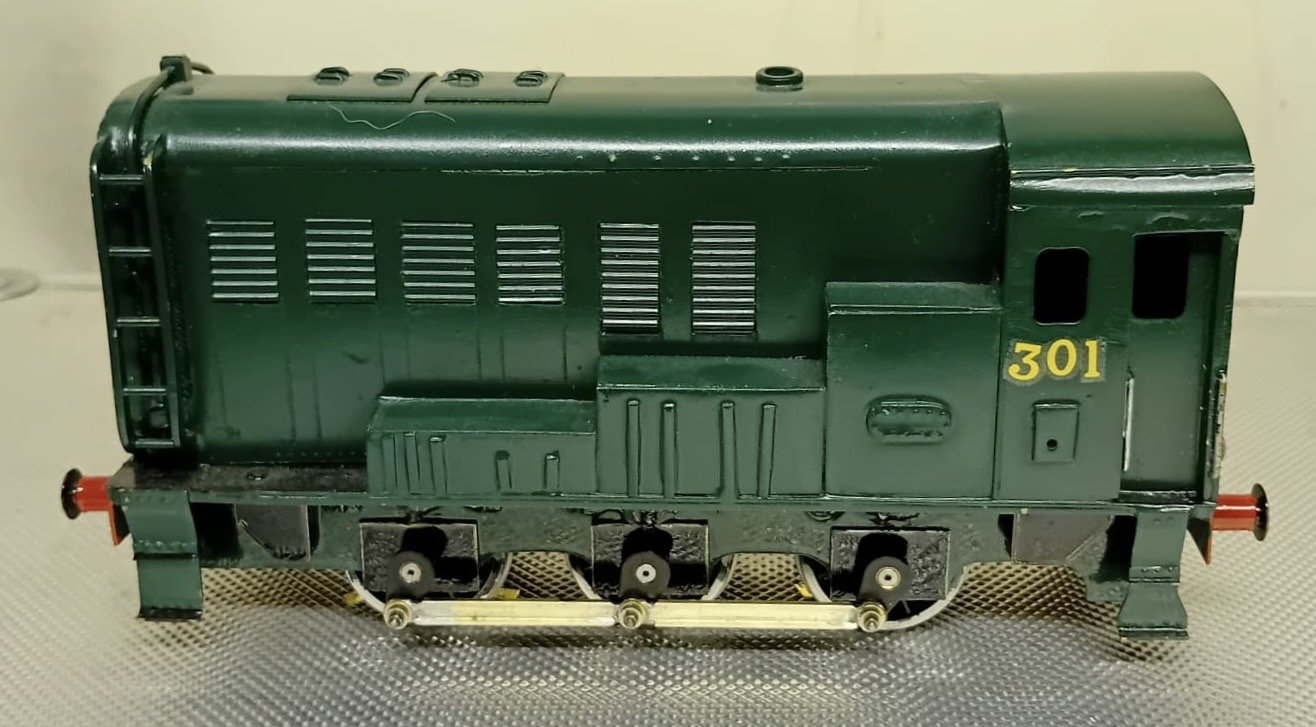
Personally, I think that would have looked way better than the yellow, orange and black they had originally - or, indeed, any livery they've worn since..... I'm tempted to get a cheap British 08 and repaint it like that as D303..... but I'd need to concoct an excuse as to why it ended up in a remote corner of Wisht Kerry, boy!
-
"Rails Through Wexford" Book Launch in Wexford Library
jhb171achill replied to Irishrailwayman's topic in What's On?
I'm quite certain, Mol, your talk on the railcars will be of reference-book quality, given the highly detailed research that I know you are doing! Definitely one to look forward to.- 46 replies
-
- 1
-
-
- book launch
- rails through wexford
- (and 4 more)
-
"Rails Through Wexford" Book Launch in Wexford Library
jhb171achill replied to Irishrailwayman's topic in What's On?
Very many thanks, WCW. Much appreciated. Barry’s photo collection is amazing. Our current work is particularly difficult, as both the volume and quality of his photos would comfortably fill five or six books on the same line, so filtering out what we want requires “rejecting” some equally amazing stuff…. We’ll see 70 class NIR railcars, a G class loco, and sugar beet - on the DSER! Amongst other things…. It’s been with the publisher for some two years now. It’s in their Q, I believe. I’m working on two new projects at the moment, too. Longer term.- 46 replies
-
- 2
-
-
-
- book launch
- rails through wexford
- (and 4 more)
-
"Rails Through Wexford" Book Launch in Wexford Library
jhb171achill replied to Irishrailwayman's topic in What's On?
Four so far. “Rails Through the West” dealt with Limerick - Athenry - Claremorris - Ballina - Sligo - Sligo Quay. “Rails Through North Kerry” was Castleisland - Tralee - Fenit - Newcastle West - Foynes - Croom Branch - Limerick. “Rails Through Tipperary” covered Limerick - Waterford, Thurles - Clonmel, Thurles sugar beet factory sidings, the main line Thurles back to Limerick Junction, the Nenagh Branch, Killaloe Branch and Cashel Branch. “Rails Through Wexford” covered the North Wexford & South Wexford lines, and the Wexford - Rosslare Harbour line. That’s the four. We are currently working on a fifth volume. Provisionally called “Rails to the South East”, it will cover both Harcourt Street and Amiens Street to Bray, including the Ballsbridge Showgrounds Siding, Bray - Wexford, the (many!) industrial sidings along the way including Enniscorthy and Shelton Abbey, and the lesser-known Woodenbridge Junction to Shillelagh branch. You may take this as the first public announcement that we’re working on anything at all, as both of us are heavily committed with all sorts of other things! We had actually intended to commence this one several years ago, but we’re currently meeting every three weeks or so to advance matters.- 46 replies
-
- 6
-
-
-
- book launch
- rails through wexford
- (and 4 more)
-
Interesting not-so-early Irish Railway photos
jhb171achill replied to Mol_PMB's topic in General Chat
Saw that archive a while back - excellent stuff. Vast majority non-railway, but quite a few like the above. Shows a lot of detail. As I'm always telling the young wans, this is back in the times when the railways were INTERESTING, as were INDIVIDUAL trains, as scarcely two vehicles were exactly the same in ANY train. -
A scratch-built “tin van” is worth the effort for that!
-
Yes, I forgot about that! The GNR lab would have had a lot to do with that too, and now that I think of it, I think I was told they also I tested something to do with the metal content of rails. The last time I had any sort of detailed conversation with the former works manager there, I was probably in my 20s, wish I’d paid more attention and asked more questions!
-
Absolutely. Inchicore and Broadstone did, and I’m sure the likes of the NCC did too.
-
Latterly, yes, but still grey I think in the early 1940s when these pics were taken. Actually, I’ve a spare copy of this book for sale. If anyone’s interested, €20 + postage anywhere. Local post rates for north, south & Britain. Binding is a bit shook, but this book is a hens teeth thing by now.
-
Paint was one thing; they were meticulous about proper adherence to guidelines on colour, not just on rolling stock, but buildings. They also tested and monitored chemicals used elsewhere, such as creosote for preserving sleepers.
-
See attached; from the GNR’s commemorative book, published then. Note the purpose-built turf wagon. The image of the Fintona tram is in its original dark maroon and white livery. Meanwhile a chemist in the lab gets paint pigments spot-on for the next paint batch order….
- 13 replies
-
- 10
-
-
-
-
Those oul colour slides from 1949 - ye need them scanned to stop further deterioration.... cheap oul film back in those days....
-
Nope, don't think so - certainly never a Park Royal.
-
No... I am pretty certain they never hauled any CIE coaches.
-
There are several Downpatrickers online here, Mol. I am certain you find everyone there, be they ITG or DCDR, to be most helpful.
-
Interesting not-so-early Irish Railway photos
jhb171achill replied to Mol_PMB's topic in General Chat
Correct - used for carriage-heating in the cold mornings. All stock still had steam heating till the late 1960s / early 70s. -
A further thought; even when modelling a small rural terminus, of the "fit-in-the-corner" type, it's always a good thing to try to imagine a scenario where two companies met, or where stock from several companies would all be seen. Primarily, the reason is that many of these out of the way places rarely had anything other than the very same six-wheel coaches that they had when they opened in the 1890s, and same locos. Take Kenmare; the very last train was hauled by a loco already over a decade in traffic before it opened, and which type almost monopolised the line for much of its life (J15). Likewise, until its last few years, trains were always standard GSWR six-wheelers. Thus, a strictly accurate model of many locations will have but one or two different types of everything! Much more variety, therefore, if the place (be it real or imagined) could conceivably have Midland stuff alongside GSWR stuff - which itself could be a combination of "original" Inchicore designs with also ex-WLWR stock. Go to the likes of Collooney and you've all three of the above, plus SLNCR stock (stop drooling, Galteemore!) and a lot of GNR goods stock and coaches on "pilgrimage" days. If we are in the Connemara area, your Maam village terminus might see GSWR stock (if the line came from, say, a junction at Ballyglunin or Tuam), GSR-ex-WLWR stock, like a G2 2.4.0, and Midland stuff too. Between the various designs of goods stock for all of these, plus locos and coaches, already you've a bewildering variety of prototypes/ Loughrea was on the Midland, obviously, but not far from Athenry. For some 20 years, two ex-WLWR G2 2.4.0s (291 & 293) were the regular engines on the line. Ballinrobe, on the other hand, despite proximity to "The Crewe of the West" at Claremorris, seems to have have had an exclusive diet of MGWR J18 0.6.0s for most of its life. Just some rambling thoughts. Personally I am a big fan of actual prototypes, with every detail as it was in real life, but (plausible) "might-have-beens" undeniably have a massively greater potential for the modeller.
- 69 replies
-
- 3
-
-
-
- o gauge layout
- irish outline
- (and 2 more)
.png.c363cdf5c3fb7955cd92a55eb6dbbae0.png)