.png.c363cdf5c3fb7955cd92a55eb6dbbae0.png)

jhb171achill
-
Posts
16,656 -
Joined
-
Last visited
-
Days Won
413
Content Type
Profiles
Forums
Events
Gallery
Blogs
Everything posted by jhb171achill
-
Cork, Blackrock & Passage pre-1900 (5'3" gauge)
jhb171achill replied to Mol_PMB's topic in General Chat
I’ve seen that pic before - for Irish railways it’s a very early one. You’re right about the carriages, but often wondered what that passenger brake / luggage van was like close up, or its history. Incidentally, re the idea of centre door and bench seating round each “half”, a couple of Schull coaches were like that, as is the original royal / director’s saloon half of coach F75 in the Isle of Man. The Donegal 5-wheel saloon in Cultra to an extent, too. I saw an old derelict 4-wheel coach in India in the 1970s which was like this - centre door and wooden board seating around the perimeter - but being 5’6” gauge, and with a much bigger loading gauge dimension than here, it had a bench down the middle too. -
EMD GM6 locos - an Irish what-if?
jhb171achill replied to Mol_PMB's topic in Continental European Modelling
Always thought this would be a good thing on a layout. They’d almost certainly have been designated “E”, thus would probably have been the E441 or E451 class. I got one of those old whitemetal MIR 121 bodies some time back either the (long term!) intention of shortening it and sticking it on top of some old 6-wheel power bogie to see what could be done. Those whitemetal bodies are extremely crude indeed by today’s standards, and would not compare well to an IRM 121 on a siding beside it; but, I thought, potentially an interesting exercise. -
Cork, Blackrock & Passage pre-1900 (5'3" gauge)
jhb171achill replied to Mol_PMB's topic in General Chat
Mighty stuff indeed. I had seen those pics before on the IRRS site (you need to be a member to view them; well worth the sub for that alone!). There is a Lawrence pic of a very early train arriving at Kenmare just after the branch opened. It can be viewed by anyone via the nli.ie website, select photographic collections, then Lawrence Collection, and use the search word "Kenmare". It shows coaches like 15A when in original 1870s condition, and in traffic. -
True; but in classic Father Ted mode, one might be nearer, and the other far away! Can't imagine what that thing could be if it's ON the wagon, but if it was, it's not quite straight, adding to me impression it's something behind the wagon, possibly beside it. If we knew exactly where it was, a look at the same location from another angle would settle it, as it might show that there is (or isn't!) something else there.
-
Quite a lot had the numberplate on the side, including ex-GNR cement vans (number would have "N" after it on the plate). I saw 77N at Thurles just about the time loose-coupled goods was ending. Can't help thinking it's something in the background, not on the wagon.....?
-
They took the roofs off them to save in rates - same reason many carriage sheds were demolished in the 1930s. In the case especially of the UTA, there was a belief that "railways were finished", as were steam engines - thus no point in looking after them. Staff morale back then was immersed in understandable negativity. Senior, after a career in the railway and seeing officialdom being very much against them, especially in the north where they couldn't run them down and close them quick enough - had a similarily resigned attitude, believing that by the time he'd retired, governments north and south alike would have closed the lot. It's what he had been led to believe by his various employers, and why he eventually left the railway for a boring, frustrating and humdrum remainder of his working life - in the civil service!
-
Standard CIE "H" van, dating from late 1950s era and in use probably until the mid 1970s. It retains the brown livery, so it must have been in use after 1970.
-
Executive Coach No. 7161
jhb171achill replied to Branchline121's topic in What's happening on the network?
Wheels / chassis still under it? -
The Achill Explorer - a Bustitution Railtour
jhb171achill commented on Niles's event in Community Calendar
There will be a small amount of railway books on sale on this tour, with profit to Táilte Tours. -
Executive Coach No. 7161
jhb171achill replied to Branchline121's topic in What's happening on the network?
Wow! Didn't know that was there.... what are they going to do with it? Tea shop, maybe? -
Cork, Blackrock & Passage pre-1900 (5'3" gauge)
jhb171achill replied to Mol_PMB's topic in General Chat
The poor service levels and connections wouldn't have helped either! -
Cork, Blackrock & Passage pre-1900 (5'3" gauge)
jhb171achill replied to Mol_PMB's topic in General Chat
Probably more than the unrealistically circuitous Kinsale branch that WAS built…. -
I was persuaded to give it a go by a friend who had been making “O” gauge brass kits for years. Likewise, I had filed brass and soldering under “ABSOLUTELY never”! My biggest regret now is that I didn’t start years ago. Some of the SSM Bredin kits aren’t available any more.
-
They’ll be consigned to your good self once painted, for weathering!
-
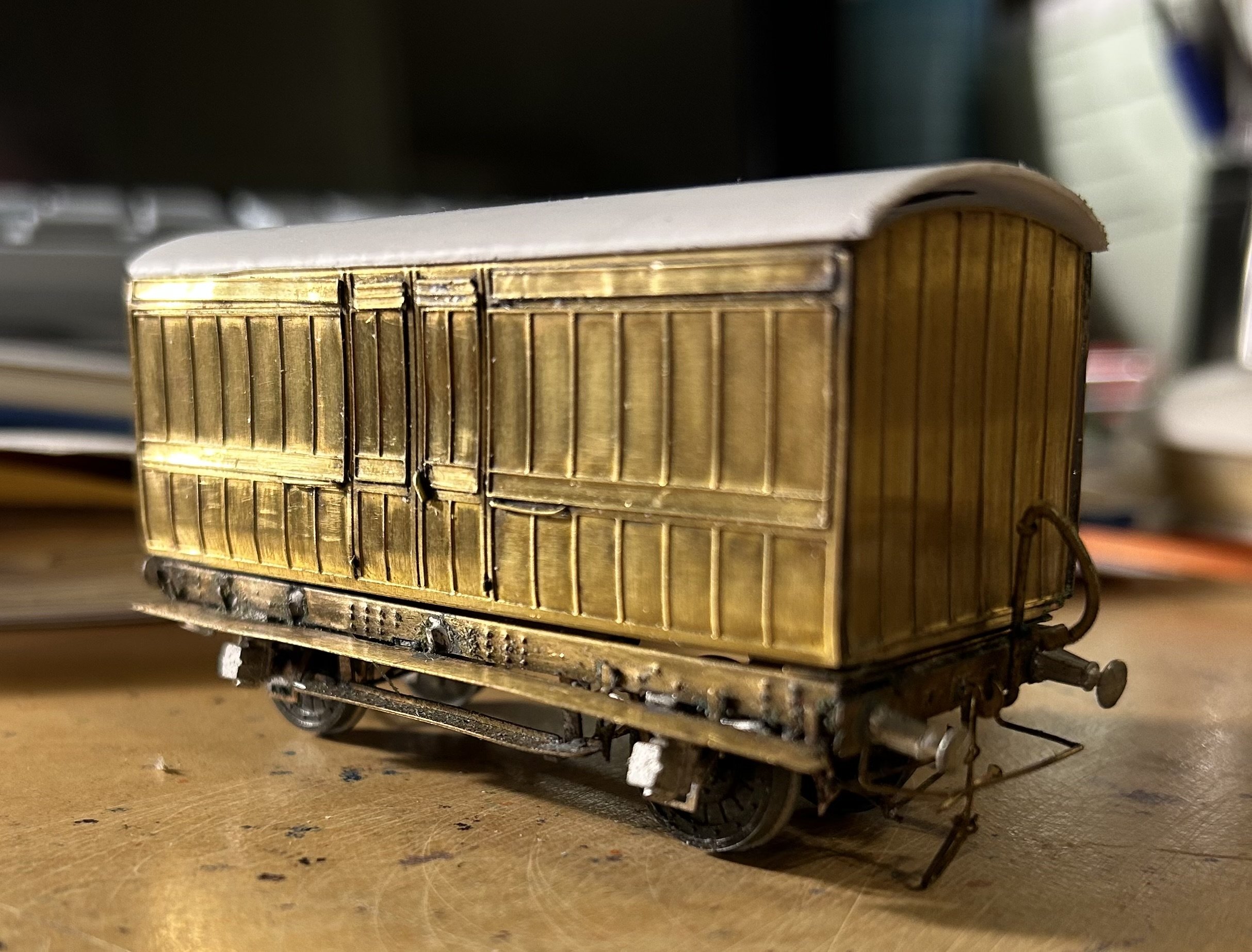
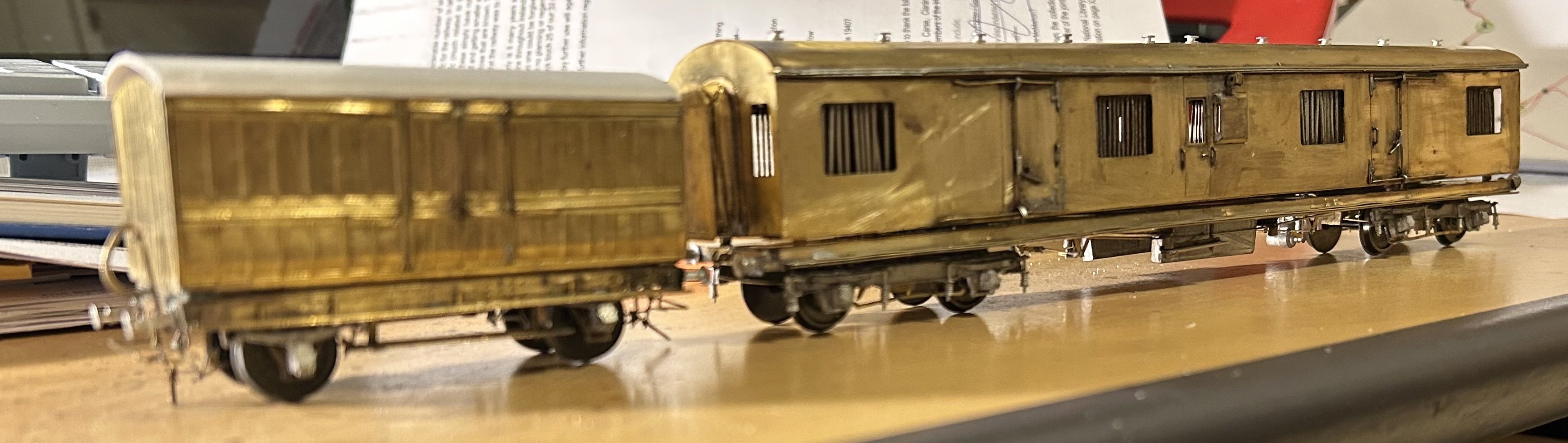
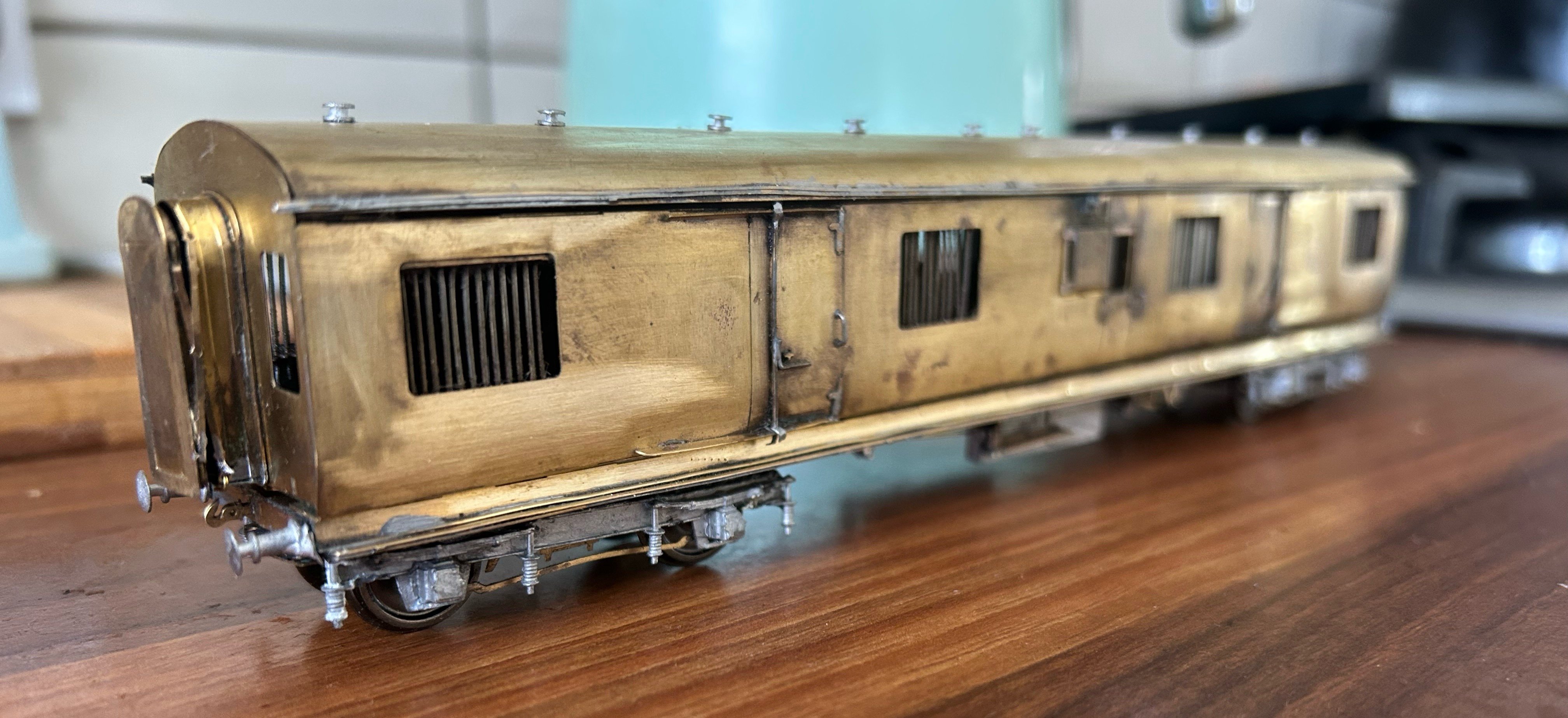
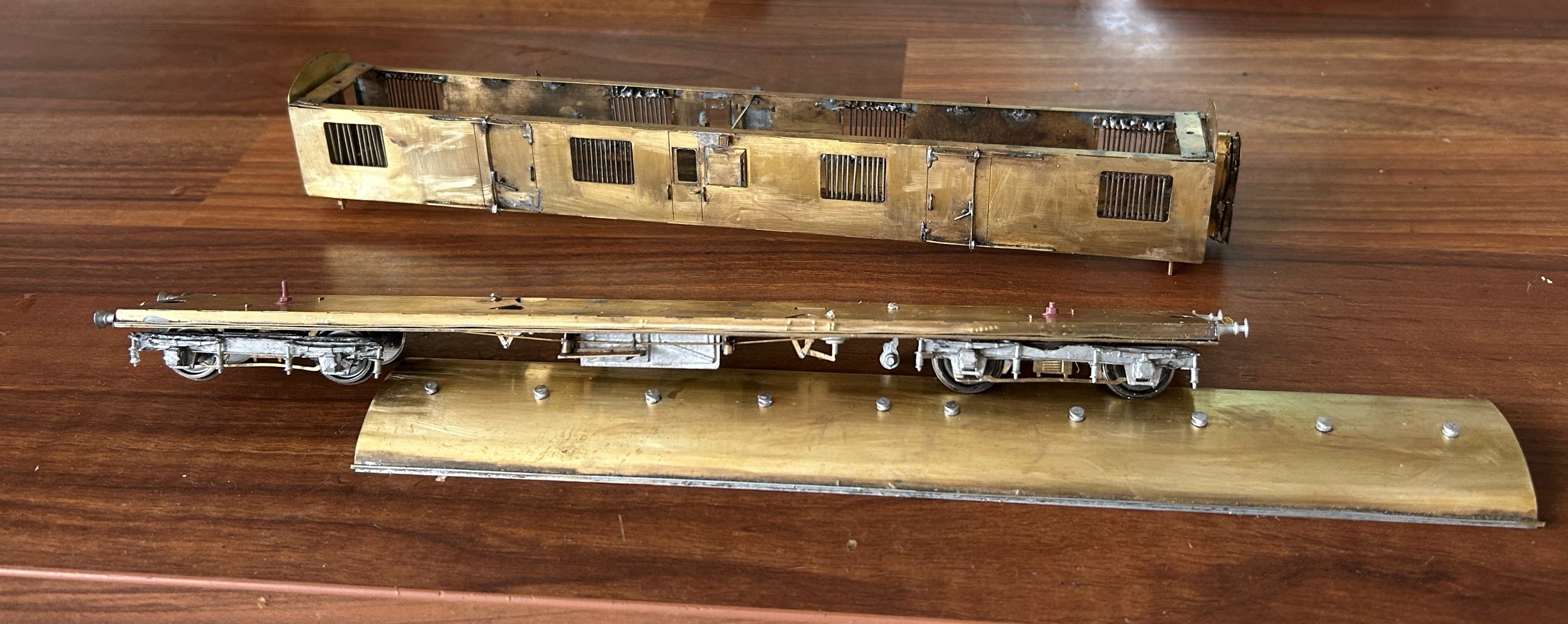
Ready for painting. As first attempts I’m happy enough, though many details don’t bear close inspection by any means. The small van is a Roxey LSWR model, but similar to vans the GSWR had many moons ago. The bogie is GSR van 2548. Glazing to go in once it’s painted. Right now the roofs and chassis aren’t attached to the bodies, pending painting, which is why the bodies look high.

-
Rare Books from The Syndicate (supporting Irish railway preservation)
jhb171achill replied to leslie10646's topic in Weblinks
Leslie - do you still have the copy of the 1897 MGWR timetable, and is it a public one or a WTT? -
Brass etches for Mol's GSWR 50ft GSWR third - ORDERING NOW!
jhb171achill replied to jhb171achill's topic in Irish Models
At some stage in departmental days, late 70s I think, 837 was also in what looked like standard wagon brown with black or dark grey roof. I have cine of it on a PW train. -
The Silverfox "C" actually looks well enough. The B101 they do is probably the only one likely to be available for some considerable time, though SSM might still have a few. I don't know what it is about the proportions or curves, but I've yet to see a TRULY convincing B101 model..... maybe IRM will put this to rights some day. If a Hunslet can sell out - a loco there were only ever three of, which didn't last all that long and which were almost completely confined to one route - there will hopefully be no argument against making a B101 model, even though they were very much "southern" engines - the only time you'd see them on the Midland was the weedspray, and I'm unaware of any heading up the GNR, certainly north of Drogheda anyway. For now, I'm awaiting the IRM announcement re a "C", and reserving thoughts on a B101 until or unless IRM make an announcement on one at some future stage.
-
Brass etches for Mol's GSWR 50ft GSWR third - ORDERING NOW!
jhb171achill replied to jhb171achill's topic in Irish Models
The livery on it now is GSWR, which is “crimson lake”, in reality an extremely dark brownish red, and off-white upper panels (which it may or may not have carried; carriages of that type were more often (lined) crimson lake all over, with the white mostly reserved for main line stock. GWR in Britain was mid brown and cream. Lining was completely different too. -
From left to right; two bogies, rest six-wheelers. As far as I can see they are all ex-GSWR. The roof profile just visible and no more in the distance is ex-DSER.
-
Brass etches for Mol's GSWR 50ft GSWR third - ORDERING NOW!
jhb171achill replied to jhb171achill's topic in Irish Models
Order placed. -
I’ve just to put the white-metal bits and pieces on the underneath of the chassis now and it’s ready for painting.
-
Irish Railway News ‘Enterprise Watch’
jhb171achill replied to IrishTrainScenes's topic in General Chat
8209 at Connolly shed this afternoon. -
IRM Latest! Goddess Is In The Making - GSR 800 Update
jhb171achill replied to Warbonnet's topic in News
Most interesting! -
I can take no credit for that - the wagon is one of Provincial Leslie’s, and weathering was done by my learned friend…..! That back scene, since replaced, was one of those free ones out of a magazine!