.png.c363cdf5c3fb7955cd92a55eb6dbbae0.png)


Mol_PMB
-
Posts
3,870 -
Joined
-
Last visited
-
Days Won
239
Content Type
Profiles
Forums
Events
Gallery
Blogs
Everything posted by Mol_PMB
-
Two emails have arrived in my inbox in the past week advertising some trips in Feb/March. I haven't seen them mentioned on here so I thought I'd just share the info. The RPSI is running a Dublin Connolly to Limerick trip on 28th February, Cravens stock with haulage as far as Thurles by 171, and then an 071 class on to Limerick: https://www.steamtrainsireland.com/whats-on/106/an-sairseal Four weeks later on 28th March, Tailte Tours is running a coach tour of the former West Cork lines with photo stops at key locations, a visit to the model railway village in Clonakilty, and the opportunity to spend all day listening to our very own @jhb171achill recount his tales: https://www.tailtetours.com/event-details/the-west-cork-wanderer-a-bus-substitution-railtour Just what I needed - something to look forward to! I'm planning to go on both trips and may see some of you there. Mol
-
"Voiding the Warranty" - Mol's experiments in 21mm gauge
Mol_PMB replied to Mol_PMB's topic in Irish Models
I spent yesterday in front of the computer finishing off artwork for transfers and etches. Not very exciting. Anyway, the decals are now being printed and will be in the post tomorrow, and I expect to get a price for the new etch tomorrow too. That etch is for alternative sides for the SSM 6-wheel coach kits - a full brake and a sleeping car, plus the new ends for the horsebox kit, and a few scenic odds and sods to fill the remaining space. So today, I've avoided staring at the screen all day and I've had the soldering iron out instead. I've still got two SSM 6-wheel GSWR all-third coach kits in the stash, and today I've built the underframe and 'bogies' of the kit I bought recently from @Georgeconna. This will become the underframe for the full brake. Having studied a lot of photos it is apparent that most of these full brakes had brake blocks on all wheelsets, and the arrangement of vacuum cylinders and gas tanks was different from the passenger coaches. So I'm implementing those changes, though I haven't yet installed the gas tank. While I wait for the etches to be made, I plan to assemble the other similar underframe which will go under the sleeping car. Again this will require a few modifications to suit the prototype.
-
With such a small loco, I think the steam effects generator will take up too much space for those features.
-
Photos indicate that the front skirts / obstacle deflectors were fitted from about 1971, and that most of the AEC's remaining in traffic after that got skirts. Some of them retained the skirts after conversion to push-pull intermediates or connector cars, even though they were formed in the middle of a train. Here's a link to an excellent photo by Jonathan Allen on Flickr dated 1971, showing a beskirted AEC:
-
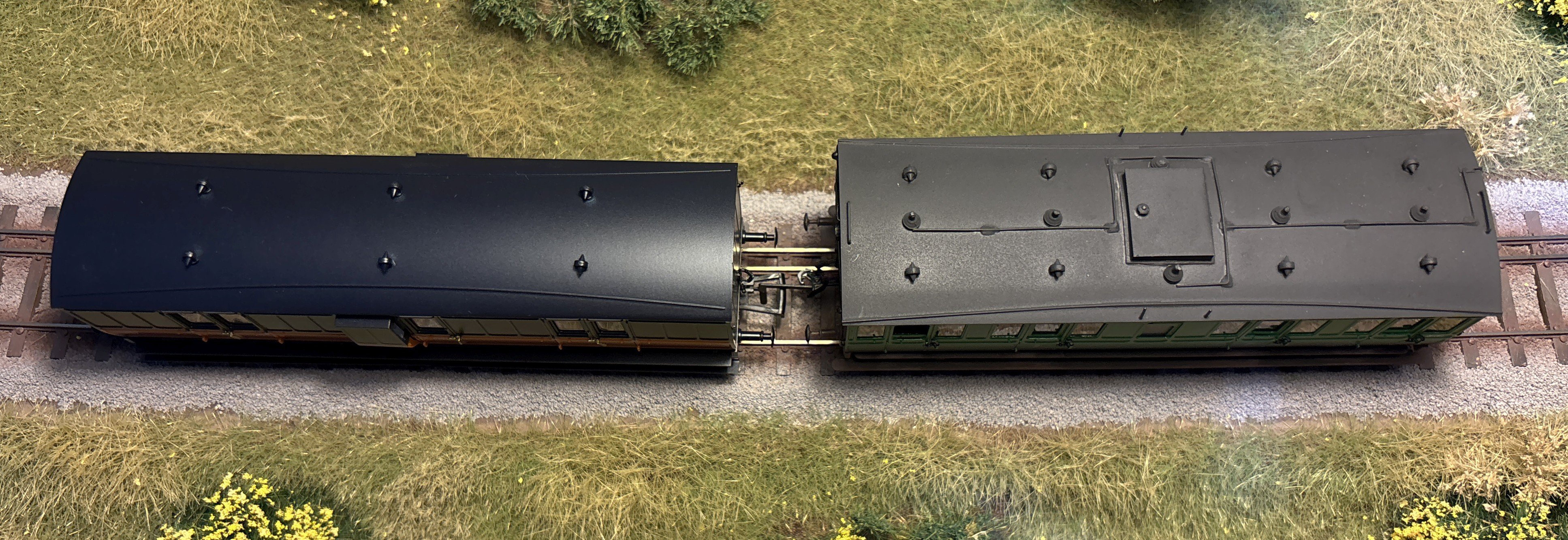
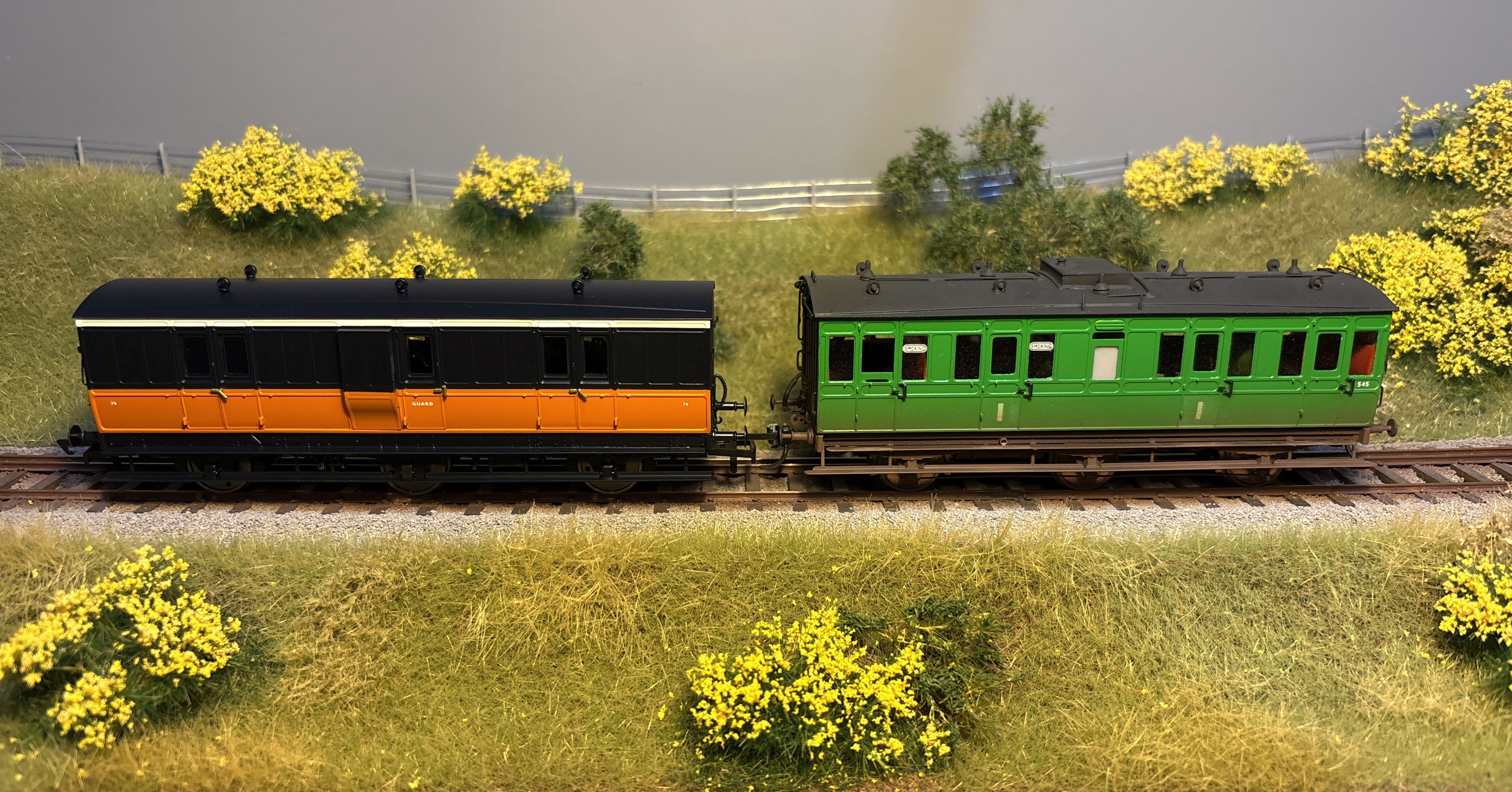
They're a fair match to the SSM models from the side, though the Genesis are 32' long compared to the 30' more common in Ireland: Looking from above the width difference is more obvious. I considered trying to regauge the Hattons coach (which would also need to be widened to accomodate that) but it's not really practical.
-
I picked up a BnT full brake (at a rather premium price when Rails sold off the the Hattons leftovers) but when I realised how hard it was to regauge, I wished I hadn’t! I’m going to make a green one based on the SSM kits instead.
-
The horsebox is taking shape, and with added details and modifications is starting to look a bit more Irish. These are rather cruel closeups, and also show some of the small compromises I've had to make in converting a GCR kit into a WLWR vehicle. I've also found that there are subtle differences between the individual vehicles in this class, perhaps unsurprising after 70 years in service. Particularly which panels have beading round them, and its exact positioning. Of course the photos only show parts of the vehicle so I may end up with a bit of a compromise between them. Never mind, there can't be many WLWR horsebox models out there! Adding all these surface details would have been perfect for a resistance soldering unit, but I'm doing it the old-school way and perhaps need a bit more cleaning up. Before I can go much further with this, I need to finish off the artwork for my custom etch, as that includes the new ends for this vehicle.
-
Would You Adam and Eve It? Genesis, From Accurascale
Mol_PMB replied to Warbonnet's topic in British Outline Modelling
I had wondered if there might be a generic lined lake/maroon livery that would suit a variety of railways including the GSR, but generic liveries have been ruled out by AS over on the RMweb thread. A true GSR livery remains possible but I imagine the potential market is small. -
Would You Adam and Eve It? Genesis, From Accurascale
Mol_PMB replied to Warbonnet's topic in British Outline Modelling
Interesting to see, after much speculation of who owned the tooling. The 'wrong-handed' outward-opening guard's doors on the revised full brake are unusual but perhaps correct for some early prototypes. -
"Voiding the Warranty" - Mol's experiments in 21mm gauge
Mol_PMB replied to Mol_PMB's topic in Irish Models
Thanks - I agree. The lime 2 is closest to the Railtec transfer and some of the photos, but JHB's avatar is less yellowish. This thread has some great closeups of the older CIE dark green livery including broad EdN lining and snails. https://irishrailwaymodeller.com/topic/6628-cie-green-paint/#comment-108574 All are a more bluish shade, but notably the snail doesn't match the lining, being a more intense green. If I change the background colour to something closer to CIE dark green, then the lime 2 still looks good for the snail, but the lining would be better in something paler and less yellowish. Sorry about the lack of a yellow snail - give me a chance to master the EdN ones first!
-
"Voiding the Warranty" - Mol's experiments in 21mm gauge
Mol_PMB replied to Mol_PMB's topic in Irish Models
David, you make some very good points. I've been thinking about the different items I want to print in EdN, for example here's the current draft of my artwork: There are several elements here for different types of vehicle: At the top, and with an outline, are a selection of transfer snails and numbers for A11 (I plan to redecorate my IRM A42 as A11). The height of the largest snail (top right, the size for loco tenders and some bogie carriages) is just less than 5mm. In the middle is lots of fine stuff for carriage and wagon numbers and lettering. On the right a selection of stencilled snails. These are for wagons, for example see the image below. At the bottom, scale 2" wide lining which is used as a waist line on many green locos and carriages. Of course, I don't necessarily have to do all of these in the same shade (though it adds cost to use different shades on the same sheet), and plenty of the photos in earlier posts show that the painted lining often faded to a different colour from the transfers (snails, class digits, numbers etc). I think it's important to get the lining colour plausible as it's a larger element of the livery on carriages. The fine numbers and lettering are probably fine enough that the exact shade won't be too obvious - they need to be 'not white' and have some element of green, but it would take a very close look to tell the difference. My existing 6-wheel coach has the number in white and you can hardly tell. Actually, none of the carriages I'm currently planning to build had the snail transfer, so arguably it's less important to get it right. For snails and class digits I can also use Railtec if that's the best option. But A11 needs numbers, snails and lining. The best colour photo of A11 in my chosen livery is on the back cover of Irish Traction in Colour' (Huntriss) Ernie's view of A45 also in clean condition is a good reference too: I forgot to mention wagons in the previous post and here's a colour view of an EdN stencilled snail on a goods van. The number is in EdN too. Like the EdN on tin vans, there is little contrast between the two colours. Again, thanks to Ernie. Anyway, I still can't decide!
-
"Voiding the Warranty" - Mol's experiments in 21mm gauge
Mol_PMB replied to Mol_PMB's topic in Irish Models
It's hard to find colour photos of grey locos with reasonably clean snails on the tender. Again from Ernie: And on tin vans, the EdN numbers had almost no contrast: -
"Voiding the Warranty" - Mol's experiments in 21mm gauge
Mol_PMB replied to Mol_PMB's topic in Irish Models
A bit of computer manipulation to give a better impression of what I think are the more promising options: And very crudely, what they might look like on a loco tender grey background: Or on a 'tin van':
-
Well Maggie's not going to get any coals for her fire from that contraption! But the model chassis seems a very promising start and if it runs well and goes round the curves then that's the most important thing.
-
"Voiding the Warranty" - Mol's experiments in 21mm gauge
Mol_PMB replied to Mol_PMB's topic in Irish Models
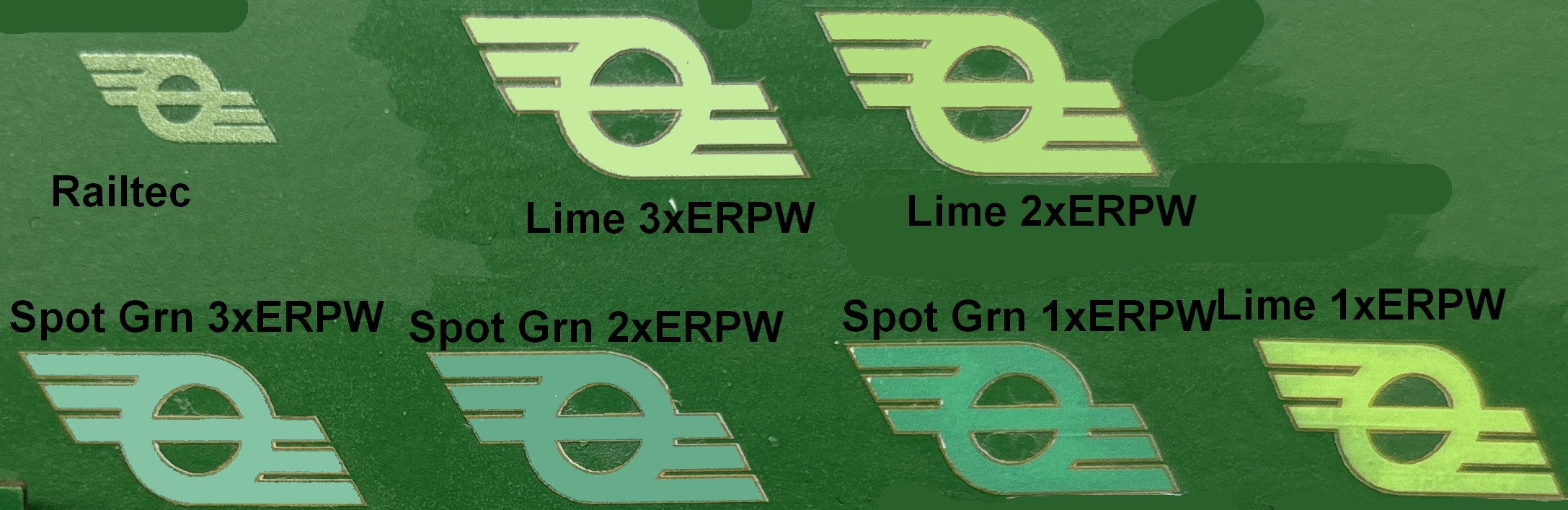
Right, it's time to inspect the latest avian molluscs. It's worth remembering that these look completely different on a green background compared to a white background. I'm presenting them on green because they are mostly going to go on green carriages or locos, and most of the prototype photos we have are also on a green background. The combinations are getting complicated to explain. The image below shows the first trials bottom left, and the latest trials on the right. In each case there's a Railtec snail (smaller) for comparison. The Precision Decals are printed in layers. In this case, they are: 1. White base layer. This ensures the transfer colour is the same regardless of the underlying paint. 2. Green layer. This can be chosen from: 'Green' (dark), 'Process Green' (bluish), 'Spot Green' (not as dark as green), or 'ER Lime' (pale yellowish). 3. Lightening layer. This can be chosen from: 'Opaque White' (moderately dense white layer), or 'ER Pastel White' (just gives a slight lightening of the colour). 4. Extra lightening layers. Repeats of 'ER Pastel White'. Each layer costs money, and more layers have more risk of poor adhesion of the ink, or potential misalignments. Some combinations of ink layers don't work reliably and give a patchy result. So there are tradeoffs. John printed the colours I asked for, but he also printed some extra options with different shades of green and more lightening layers of 'ER Pastel White'. Unfortunately, on some of these extras there was a misalignment error part-way through printing. Because these were bonus free extras, John didn't reprint them but he did send them. So it gives us more options to consider but some of them are misaligned. To get a true impression of the colour of those we need to look at the areas where the green and the white overlay, and ignore the other areas. Considering first the examples overlaid with Opaque White, we have the following: PG+OW - far bottom left, a very pale turquoise, not ideal Green+OW - top middle, this comes out rather greyish, not ideal. ER Lime +OW top right - I think this is the best of the OW overlays but perhaps a bit pale. Sadly the Spot Green +OW option seems to have been missed out (to be fair, I forgot to specify it and John didn't add it) Looking now at the examples overlaid with ER Pastel White, we have the following: Green + ERPW - middle left, this I think is too similar to the underlying green paint Process Green + ERPW - middle, too turquoise Spot Green + ERPW - just right of middle, OK but perhaps still too similar to the underlying green paint ER Lime + ERPW - middle right, I think this is too bright and yellow The far bottom row is the ones overlaid with ER Pastel White twice; unfortunately these are misaligned so it's a bit harder to judge the colours. Generally they are a paler version of the middle row. Green + 2xERPW - bottom left, this is heading towards grey again (like Green+OW). Process Green + 2xERPW - bottom middle, still turquoise Spot Green + 2xERPW - bottom just right of middle, this looks OK but a maybe bit dark still? ER Lime + 2xERPW - middle right, this looks OK and perhaps the closest to the Railtec colour? Then there are a couple of extras overlaid with ER Pastel White three times which I have put over to the right hand side - I trimmed these before applying to try and remove some of the distracting misaligned bits: Spot Green + 3xERPW - just right of middle, this looks quite good to me, the lightness is good but it's going a bit greyish. ER Lime + 3xERPW - middle right, this looks quite good to me, but is still a bit yellow and perhaps getting too pale. I would welcome other people's thoughts as everyone has slightly different colour vision. My gut feel is that the 'Green' goes too grey when lightened, and the 'Process Green' goes too blue. That leaves us with the 'Spot Green' or the 'ER Lime'. These two colours are quite different - ER Lime is yellowish, while 'Spot Green' is more towards the blue corner. Having picked one of these, how much paler do we make it with lightening layers? Here's JHB's avatar for reference, please note this is on a CIE dark green background whereas my samples are on my best impression of CIE light green. And from Ernie's albums on Flickr, a fine selection on light green carriages and locos: I'm beginning to wish I'd stuck with the Black and Tan era...
-
I’ve gone in the opposite direction, initially looking at the early 1980s and now focusing on the early 1960s. I still have an interest in 1970s and early 1980s though. But, I don’t have a BnT Ar class, so can’t help you here I’m afraid. In the past year I think I’ve seen almost all variants of the A class for same on either here, eBay or at Rails of Sheffield. They don’t come up very often but save a search and you’ll get notifications when they do.
-
5x MIR 4 Wheel Flat wagons c/w containers
Mol_PMB replied to flange lubricator's topic in For Sale or Wanted
That’s great, many thanks. I expect it will be possible for you to post them to my hotel in Ireland, if we can’t meet up. I’ll be in touch when my plans are firmed up a bit - so far I’ve only booked the Tailte trip. -
I think both 6107 and 6111 were retained for the Greystones shuttles after the rest were withdrawn. That gave a spare driving car so there was maintenance cover. Some of them got the skirt while they were still DMUs. I imagine there was an accident where one hit a herd of cows (or similar) and it caused a derailment and/or trashed the underframe equipment etc. Then someone decided that an obstacle deflector was a good idea. That lesson was learnt again in Scotland some years later, at Polmont.
-
"Voiding the Warranty" - Mol's experiments in 21mm gauge
Mol_PMB replied to Mol_PMB's topic in Irish Models
Yes, scaling them and adding door class numbers should be simple. In fact the trial ones are closer to 7mm scale already. I still need to apply them to a green painted panel and then choose the best colour option. -
5x MIR 4 Wheel Flat wagons c/w containers
Mol_PMB replied to flange lubricator's topic in For Sale or Wanted
If you can't find a buyer in Ireland, I'd be interested. I'll be over there next month. Paul -
In some ways they are similar (2 large windows) and I agree there's nothing better. But the Cravens cab front is much flatter, there's very little curvature in the horizontal plane and although the upper part is slightly angled back, there's no curvature in the vertical plane on the lower part. The front corner radii are much smaller than the AEC, and the bodyside profile is quite different too. The front's not 100% flat but this interior view shows how small the angle between the windscreens is: Inside a Class 105 DMU The side-on view above shows just how deep the curvature of an AEC front is.
-
"Voiding the Warranty" - Mol's experiments in 21mm gauge
Mol_PMB replied to Mol_PMB's topic in Irish Models
Two deliveries today - the trial transfers and a box of GNR van kits from Leslie! I've been thinking for a while that I'd like a long weekend break in Ireland again some time soon, and was wondering where and when to go, in the absence of any announced railtours. I was considering another trip to my preferred South-West corner of the country. Happily, Tailte Tours have just answered that for me with an opportunity to visit some places I've read about many times but never seen. -
Good thought. But I don't think there's anything the same: DMU Types
-
Very helpful - thanks! The side-on shots really do show the depth of the curvature on the cab front which I think is consistent with the drawings. In the IRRS Flickr Archive, there are a few useful ones showing the cab front shape from other angles, including how the windscreen panes are set into the curve; some of these are GNR AEC railcars but they seem to have been very similar to the CIE ones: KAM_GNR_AEC_Unknown_c1960s | [Photographer: Kevin A Murray] … | Flickr KAM_GNR_AEC_602_Banbridge_1956 | [Photographer: Kevin A Murr… | Flickr SoB_CIE_AEC_Glanmire_Rd_c1960s | [Photographer: Seán O’Brien… | Flickr PoB_CIE_AEC_PP_Inchicore_c1970s | [Photographer: Paddy O’Bri… | Flickr TJD_CIE_AEC_PP_6106_Connolly_c1987 | [Photographer: Tom J Do… | Flickr One thing that's wrong in many of the drawings is the side fairings to the bufferbeams which are shown as tapered in plan view - but in reality they were square. This photo from Jonathan Allen shows that quite clearly too (though the first KAM link above is even clearer):
-
6111 is the survivor at Downpatrick. I wonder how many people have been to measure it up? CIÉ AEC 6111 - Downpatrick and County Down Railway The drawing of a GNR AEC railcar (reproduced at a small scale in 'Diesel Dawn' (Flanagan) and no doubt surviving in original form somewhere) is another source of information and many of the details on this drawing are closer to what was built (windows, bogies etc). In my personal experience of building a model of a Swiss railcar with chamfered ends, I looked at the drawing and thought 'the angle can't possibly be that big' so reduced it a bit. And then after it was all built, the cab front looked too flat! I think I'm not the only one to fall into this trap - I've seen someone describe several of the Silver Fox models (locos as well as railcars) being 'hit in the face with a shovel' (or similar) to describe their overly flat fronts. On the AEC's, the windscreens were flat pieces of glass set into a compound-curved front panel, so they did have a significant angle between them. Some of the cab interior views (produced for driver training documentation) show this angle from the inside. I wouldn't rush to say that the angle on the AEC drawings is wrong - maybe slightly exaggerated as I think they were close to flush at their outer edges. In this respect the GNR drawing looks closer to reality. Unfortunately Flickr is down this morning so I can't illustrate the point. I ought to get on with work anyway!