.png.c363cdf5c3fb7955cd92a55eb6dbbae0.png)


Mayner
-
Posts
4,863 -
Joined
-
Last visited
-
Days Won
119
Content Type
Profiles
Forums
Events
Gallery
Blogs
Store
Community Map
Everything posted by Mayner
-

Irish equivalents of mainland British locos and rolling stock
Mayner replied to David Holman's topic in Irish Models
Most of the stock would have been custom built to an Irish specification even by builders and finance companies like Metropolitan & Bristol carriage and wagon. The solebars on 4 & 6 wheel stock would have been further apart and the headstocks and cross members would have been longer on account of the wider gauge, the GNR raan into problems re-gauge some ex LMS coaches during the 1940s Charles Roberts and other manufacturers supplied wagons similar to Slaters cylindrical tank wagon, the underframe may need modification for the wider gauge. The LMS supplied some ex-Mildland vans to the NCC but they appear to have been the steel underframed variety different to the Slaters kit version. -
Complete Green horn needs all the help i can get
Mayner replied to Finbarr's question in Questions & Answers
I dont want to add to the confusion but would recommend Peco rather than either Tillig or Bemo track for anyone having a go at the 3' Gauge. I have used a mixture of Bemo (Shinohara) & Tillig track on my narrow gauge layout. The Bemo track was made by Shinohara in Japan and may be an earlier to the current version with cast frogs, the main problem was the flexible track was fragile and expensive. -
Complete Green horn needs all the help i can get
Mayner replied to Finbarr's question in Questions & Answers
The Cork-Passage would be a good basis for a OO gauge commuter operation similar to the Cobh line either with the Bachmann railcars or Murphy Models 141s and Cravens. Cyril Freezers Minories track plan is fairly simple and would be ideal for a terminus like Albert St or Passage http://www.rmweb.co.uk/community/index.php?/topic/60091-00-minories-track-plan-wanted/page-2 . -
Brilliant kind of reminds me of Drumkeeran might even spur me on to finishing the village scene on my layout, every station needs a Railway Bar and builders yard/general merchant.
-
Complete Green horn needs all the help i can get
Mayner replied to Finbarr's question in Questions & Answers
Finbarr Good luck with your oddesy if you decide to go ahead with it with it it will keep you busy for many years. Track Peco HOm (12mm gauge) is fine for Irish 3' http://www.peco-uk.com/prodtype.asp?strParents=3309,3322&CAT_ID=3326&numRecordPosition=1 Track and rtr TT & HOm Tilling and Bemo are German companies that produce 12mm gauge track rtr locos and stock. Bemo produce mainly German and Swiss narrow gauge very nice very expensive and probably a good long term investment. Triang TT although discontinued about 50 years ago the locos and wagon chassis were often used under scratchbuilt bodies by Irish narrow gauge modellers and may appear from time to time on the second hand market. There is a TT society in the UK spare parts areb available and second hand prices have remained reasonable. Worsley Works Scratchbuilders Parts. Etched Locomotive Construction by Iain Rice is probably the best guide if you are thinking of having a go at using the Worsley works parts to build some of the locos and coaches. http://www.titfield.co.uk/WSM_LOCO.htm. Building Coaches the Comet Way http://www.cometmodels.co.uk/data/PDF/Building%20Coaches%20the%20Comet%20Way2.pdf will give you an idea of whats involved in building the Worsley Works coaches. Worsley only supply a basic body without roof and bogie frames Although I havent built one the chassis for the CBPR 2-4-2T appears to be designed like the real locomotives and may need modification to go round curves, I think builder in the New Irish Lines article modified the chassis to allow the axle under the bunker to pivot to get round curves. -
Complete Green horn needs all the help i can get
Mayner replied to Finbarr's question in Questions & Answers
Finbarr Gareth filled you in with some information while I was writing the last post. Peco, Tillig and Bemo do suitable narrow gauge track, a Tillig or Bemo loco and a few coaches (expensive) would get something running while building CBPR locos and stock or you might even get hooked on Swiss or German Metre gauge. The New Irish Lines archive contains some articles on buiding locos and stock from Worsley Works Parts, http://newirishlines.org/archive-2/, The Yahoo Irish 3' Gauge Group is a mine of information on modelling the Irish Narrow Gauge. Foxrock Models on e of the contributors to the yahoo group does a very nice resin and brass kits for the CBPR goods brake an open wagon -
Complete Green horn needs all the help i can get
Mayner replied to Finbarr's question in Questions & Answers
Hi Finbarr An accurate model based on the Crosshaven line would be a serious challenge for a beginner, I dont know if you have seen photos of the railway or know anything about its history, but it closed a long time ago and the track gauge was narrower than the Irish main line railways. It depends to a large degree what you want to get out of a model railway, really whether you prefer building things or running trains a model based on the narrow gauge line would involve a lot of work as the locos and stock would basically have to be built from scratch. Suitable track is available in 1:76 OO scale but the track would have to be handlaid in O scale bascially twice the size of OO. Worsley Works http://www.worsleyworks.co.uk/NG/NG_Irish_CBRPR.htm, supply sheetmetal (brass) parts for building the narrow gauge locos and coaches but require a lot of work and extra parts to build into a complete loco or coach. Alternatively if you want to get something running quickly there is no problem in building a layout in OO using ready to run stock Bachmann do an railcar in IE colours which is close enough to the trains used on the Cobh line, while Murphy Models and others supply a reasonable range of ready to run locos, coaches and wagons. -
There is a similar/possibly the same photo of the 8:10 Waterford-Dublin at Portarlington in Anthony Burges book "Chasing the Flying Snail", the railcar set has a 6 wheel van tackedd on at the end. The photo seems to have been taken in April 53 days after the direct Dublin-Waterford trains were dieselised, this was the first service to be dieselised and its possible that the first batch of modern CIE buffet cars may not have entered service.
-
Apart from the poncy logo and nonesence with UIC lettering, like the NIR 111 a plain colour scheme really suites these locos. All she needs is a set of whitemetal number plates with a large GSR road services logo in the centre of the hood. Definitely Darth Vaders or possibly the Emperors engine.

-
"On the cover of the Rolling Stone................" well done!
-
Marty Melvins collection of very noisey clips:banana: Check out 09.06 for 077s Antipotean Cousins http://www.youtube.com/watch?v=RbJ3o8XAcFQ
-
grey wagons, bauxite wagons, brake systems
Mayner replied to Sentinel281's question in Questions & Answers
Brian Flanigans Flicker site is a great refrence for CIE wagons including some oddites unfitted GSR vans in red oxide a modern fitted container flat in grey with a red swap body. Although some brake vans had vacuum brakes most loose coupled trains ran without a continuous brake the guard would keep the couplers stretched out and apply the brake using the hand brake in the van. -
What the real one sound like with a Quebec touch
-
Some passing stations had only one platform, Clara on the Athlone branch is a good example. The position of the signal box can vary but tend to be near the greatest concentration of pointwork. On the Midland, Northern and Southern they tended to be close to the end of the platform, while the South Eastern tended to build them into the foot bridge. There were some oddities the signal cabin in Fermoy was tucked into a blind corner at the back of the station.
-
Great stuff JHB The daily Irish North goods from Dundalk to Cavan & Monaghan was steam worked to the end probably with an ex-GNR loco with an A Class working the Dundalk-Carrickmacross goods probably as a fill in between other turns. Inny Junction Cavan seems to have been worked by the Mullingar Pilot, presumably the operating department did not fancy the idea of tying up an A Class for up to 20 hours on the Irish North, or possibly loosing a second loco if the first broke down The Irish North goods seems to have been an all day job probably with two loco crews, working down to Cavan in the early hours of the morning and fitted in a side trip from Clones to Monaghan in the afternoon theoretically returning to Dundalk some time before midnight. I always fancied an American style operating layout based on the West Cork with the main line and the two main branches. The Drimoleague Baltimore line was basically operated as two separate branches with most trains running to and from Skibbereen. It seems to have been a line where freight was considered more important than passenger traffic, while the main line was worked by the relatively modern standardish class of Bandon tanks, the branches seem to have been worked by cast off tank locos from the DSER, GSWR, MGWR and WLWR. Modernisation simplified things with an AEC railcar set on the main line and 3 C Class worrking goods and branch services, presumably a Bandon Tank or two was available for cattle and beet specials. Clonakilty lost its morning connection from Cork when the branch was dieselised in the late 50s, the mixed worked out from Clonakilty connected into the morning train to Cork, changed personality and worked back as a goods, working down the Courtmacsharry Branch as required before resuming mixed train operation connecting with both up and down evening main line trains. While a single AEC railcar set seems to have worked all main line passenger services, loco workings seemed odd while one C Class more or less captive on low milage Clonakilty/Courtmacsharry services, the other pair were kept busy on the two main line goods services and connecting goods/mixed trains working out of Drimiloleague and Skibbereen
-
There was a piece in 5'3" that its not expected to have No 4 out of service for long basically a boiler inspection and re-tube, she received a new firebox in the 1990s and had heavy mechanical work at her last overhaul. Interestingly 131 may be the next big restoration project rather than 171 as the RPSI have plate in stock for a new firebox. Hopefully a place can be found for at least a cosmetic restoration of 27 & 184 in the new museum.
-
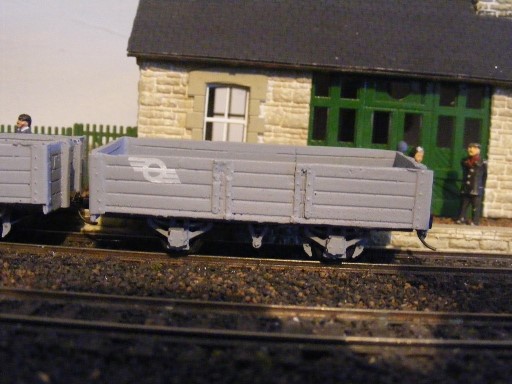
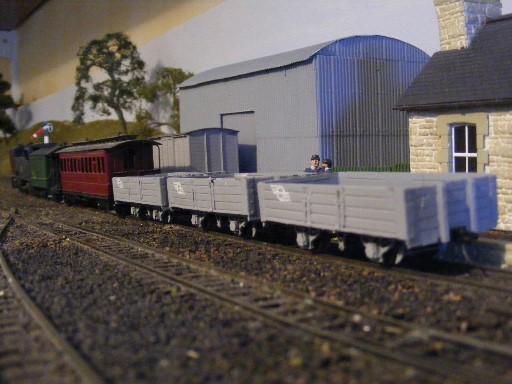
I managed to assemble and paint a number of the wagons over the Easter and fitted a few with couplers. I assembled the chassis for these wagons in a Guest House in Carrick while working in the area about 15 years ago and prepared the master for the body in 2010 slow even by my standards. Typical C&L 3T running in with an empty special for the Arigna mines. Assembled wagon resin body Backwoods Miniatures chassis, Kadee N Scale couplers, Blackham snail. needs running numbers, tare and loading, weathering & coal load. Mixed leaving town, no tail lamp or board. The C&L was ahead of the Broad Gauge lines from an early stage with American style bogie coaching stock and vacuum braked wagons there was no need for a brake van at the rear of mixed trains. I need to do another batch of bodies to complete the rake, the main problem has been air bubbles in the castings and the thin walls in the master, temperature and humidity are an important factor basically a dehumidifer and a constant 20-25° is needed in the workshop. I have a pair of ex-Clogher Valley opens to build in plasticard and a pair of ex T&D ballast wagons to build to use up the current stock of underframes.
-
Jacobs International Drawing showing connection into the Container Terminal as an extension of the Tara Mines siding but will give you a general idea of the set up of that area of the port http://www.dublinport.ie/fileadmin/user_upload/documents/MP_Travel_and_Transport_Links.pdf Besides containers and bulk cargo Cruise Ships also call at Alexandra Basin
-
It might be simpler to build a standard gauge ⅞ scale replica that could double as a Re-built Scott and run it in the UK Apart from the issue of getting the UFTM to part with the loco, raising the money to fund a restoration, overcoming the regulatory/engineering challenges, I think an Irish operator would struggle to cover running and maintenance costs for the restored loco. CIE struggled to find work for the 800s in the 1950s and the RPSI have struggled to find work suitable for the GNR Compound Merlin, while there may be some initial interest, it would be difficult to see an operator regulary filling 10-12 coach steam hauled excursion trains on the Cork and Belfast lines.
-
Some good photos of the revised layout on the Eiretrains Site http://eiretrains.com/Photo_Gallery/Railway%20Stations%20N/North%20Wall/slides/NorthWall_20100226_037_CC_JA.html The re-modelled yard was mainly used for marshalling trains, engineers traffic and wagon storage, I dont think containers was handled at East Wall after traffic was transferred to the Holyhead and Midland yards in the late 70s.
-
On some routes train crews are issued with gas masks and mines self rescue equipment. Watch what happens around 2.02 this tunnel is pressurised to make sure there is enough air for the locos. There was an incident in this tunnel a few years ago where a passenger train stalled and started slipping backwards although the crew and train manager thought they were moving forward:(. http://www.taic.org.nz/ReportsandSafetyRecs/RailReports/tabid/85/ctl/Detail/mid/483/InvNumber/2004-109/Page/9/language/en-NZ/Default.aspx?SkinSrc=[G]skins%2ftaicRail%2fskin_rail
-
I think there are several forces at work here, intense competition between Kadar(Bachmann) and Hornby for a valuable but saturated UK market and higher production and shipping costs from Asia and the Far East. Hornby & Bachmann appear to haave covered most Grouping and BR era models, with Heljan and other comissioners producing a large range of odd-bod models particulary early diesels. Hornby's production problems in China only seem to have arisen after Kadar took over Sanda Kan the company that manufactured the Hornby range. Kadar manufacture a wide range of products not just model trains, have a reputation of buying up distressed companies with a good name and market share like, Bachmann, Williams, Trix, Graham Farish. Hornby would be a good target for an acquisition by Kadar with a very strong brand name either for a re-branding exercise for Bachmann UK or to compliment the two ranges. In this part of the World model shops generally appear to be cutting back on the railway side of things, but most maintain a reasonable selection of the more basic Hornby models and sets for younger people entering the hobby, most of the more serious modellers tend to purchase form a small number of specialist suppliers or by mail order from the UK or States.
-
Dave The Ordnance Survey online map viewer is a useful tool, current tracklayouts can be viewed on Street Map & post 1900 layouts on the 25" Historic. Generally apart from some line and station closures track layouts & signalling remained relatively unchanged into the mid 70s, apart from the Cork and Belfast Line. Operating patterns were similar to the West Highland line in Scotland with a small number of loco hauled passenger trains and overnight goods or liner trains, apart from the main stations platform lengths tended to be short typically 4 coach length and train often over hung the platforms as train lengths increased from the 1970s onwards. I suppose the choice of a through station or terminus depends on whether you prefer operation or simply watching the trains go bye, while Cahirciveen is pretty compact with a fairly extensive layout hemmed into a tight space space, a suburban station like Dalkey or Malahide where trains terminated would offer a lot more in terms of operation than a rural terminus.
-
Just an add on to JHBs piece the UTA briefly divided its remaining lines into three more or less self contained regions, each with a main line and suburban colour scheme. The basic scheme is similar to the original NIR red and cream scheme, with red on the NCC, blue on the GNR and light green on the Bangor Line. Each region had a suburban variant with the coach or railcar painted in the main livery colour with a narrower cream band around window level.
-
The section of the top was based on an idea in RM Web to allow the air bubbles to collect at the top and break off, which did not quite work out in practice, probably becuse the neck was too thin. T he castings are surprisingly strong considering the wall thickness is less than .5mm in places. I will probably do a re-design on the next mould, which will be for a different variety of open, to allow the resin to be topped up and avoid the excess spilling down the side. The main modification will be to the master, I will aim for a minimum wall thickness of around 1mm with the master in plasticard with brass strapping.