GSWR 90
-
Posts
224 -
Joined
-
Last visited
-
Days Won
3
Content Type
Profiles
Forums
Events
Gallery
Blogs
Everything posted by GSWR 90
-
Ouch – I hope that isn't from experience!
-
So the Hunslets are being delivered – does anyone have any thoughts on them?
-
Thank you, no worries as I've pored over that IRRS article plenty of times!
-
Thanks very much for this. Which book is it from? I'd be interested in learning more about their work at CSÉ if it gives more details. I'm not sure why 613's plates are black and brown. Maybe a varnish that went funny? Here is a photo from the early 2010s, and they're very definitely black and silver: And here's a photo of it in the 1990s, in cream and black:

-
I hope IRM don't start making G class models. I would be financially ruined.
-
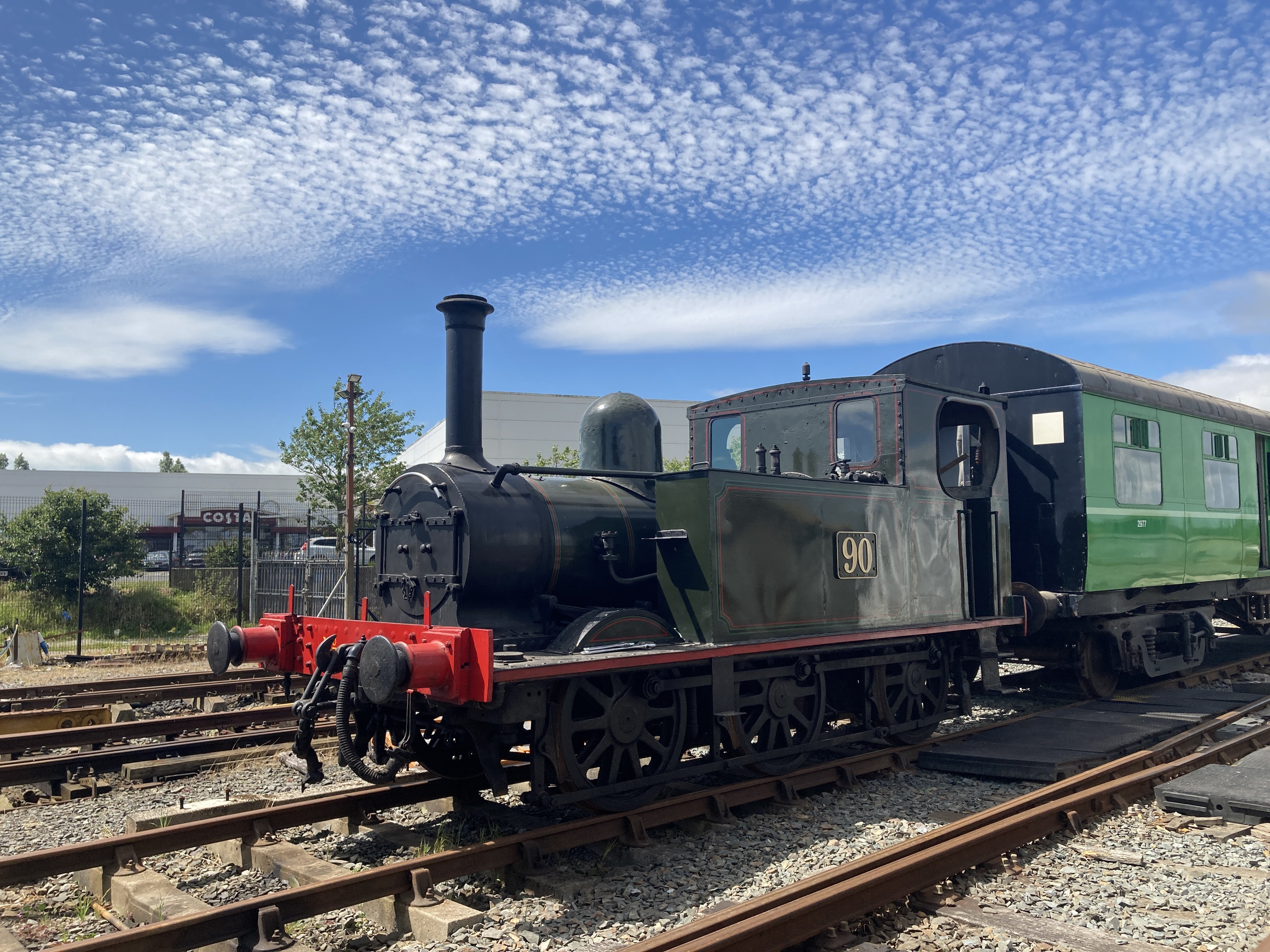
Contortionists wanted. Removing the cement so we can get at the bolts holding the smokebox to the frames. We’re also having a whack at the ones holding the steam pipe together. I have put together a No. 90 “mood board” so we can illustrate its history to our visitors
- 111 replies
-
- 13
-

-
Thanks – no, they are not in order, these plates are off 611, 613, and 617 respectively
-
Hi Paul. Yes, there are vague long-term plans to restore 6111 to as-built condition (without the engine of course) for use on passenger trains. It will hopefully be No. 2624 with composite passenger accommodation, and the cab would make a good guard’s van complete with windows for propelling and a nice view for passengers. That’s a long way away – they were withdrawn from service because they were literally falling apart in the 1980s (a passenger tried to open a door and it fell on top of him), and that was before it was left at Inchicore for 40 years! This is very much on the long finger, as there are much more pressing restoration projects underway, including a couple of other very long-term carriage projects and other carriages which would be much easier to get running again. Of course, there’s also another railcar currently being restored in the Workshop as well. It’s a lot of work (60+ carriages) for a relatively small organisation with limited resources, but in the event that we don’t get around to restoring the AEC in our lifetimes, the main thing is that it is now safe and its future is secured for future generations. I will send you a message re seeing it up-close.
-
Ireland's most glorious diesel loco, G613 at Heuston, 1962, from the O'Dea Collection. But what is it pulling? A carriage (no underfloor engine) with a window and lights at the end? Not a Bulleid AEC, not one of the Park Royals converted to driving trailers for the Waterford and Tramore – what is it?
-
Does anyone happen to have the Deutz works numbers for each G611 loco? Thanks
-
Live reaction from my savings account:
-
The dismemberment continues – the blastpipe and blower have been removed from inside the smokebox
- 111 replies
-
- 11
-
-
Does anybody know where these locomotives currently are?
-
90 appears to have briefly worked in Fenit – from "The Liberator", 18th June 1935
-
Thar she blows with the carriage portion. It has tumblehomes and a much nicer roof, vents, and doors than 90’s
-
I think this is from either the IRRS or Irish Railfan News, 1960: "At the end of January last CIÉ announced its intention of increasing the number of holiday camping coaches for the coming summer in view of the success achieved when introduced for the first time last season. Two camping coaches are being provided at both Galway and Tramore this year, in addition to those sited last year at Killarney and Dungarvan. The two coaches provided at Carrick-on-Shannon last season are being withdrawn and transferred to Galway - a more attractive location. Two new coaches are at present (April 1960) being fitted out in Inchicore works No.818 as HC7 and No.837 as HC8 - and when these are completed they will be moved to Tramore. CIÉ have also announced that charges for all camping coaches will be reduced in the off-peak periods while the obligation on those booking coaches to buy six return tickets from their homes to the site has been reduced this year to three return tickets. A special ticket costing £2:10:0 allowing unlimited travel in the area of the coach site is also provided this summer for those availing of the coaches. At the end of January last, English visitors alone had already booked for a total of 32 weeks holidays in the CIÉ camping coaches for the coming summer." 837 is currently at Maam Cross
-
There are perhaps more still around than you'd think!
-
BCDR railmotor No. 2 at Holywood. The locos were cut off and the carriages were used as autotrains. The carriage portion of No. 2 became No. 72 and is preserved at Downpatrick.
-
CSE Carlow No. 3 (Cockerill 3096/1926) seen in 1954, It was withdrawn in 1956. I always wondered why CSE bought vertical boiler Belgian locos, but I recently read that Carlow sugar factory was built under the guidance of a Belgian company so perhaps it was due to their influence. Note that one of the buffers has a curved edge, and the other is flat – standard practice in much of continental Europe to prevent buffers from locking.
-
Cómhlucht Siúicre Eireann Thurles No. 1 (now preserved at Downpatrick) in use as a stationary boiler, April 1963. CSE was quite a diverse operation, so it's hard to narrow down what the steam is being used for – in addition to refining beet, they made animal feed, lime for fertiliser, and agricultural machinery. In 1957, they bought Ireland's first stored-program computer for making calculations for refining sugar and paying beet farmers across the country
-
NCC Jinty No. 18 being delivered to Northern Ireland J15 No. 130 in use as a stationary boiler 461, then No. 15, in DSER days
-
A tale as old as time. Withdrawn locos that are kept for spare parts are sometimes called “Christmas trees” but I’m not sure how common that expression is.
-
As far as I can tell, 90 was withdrawn in October 1959 along with 100. 90 was reinstated for the IRRS railtour to Courtmacsherry in August 1960; it was still used until around October 1961. The IRRS then negotiated with CIÉ in late 1961-early 1962 to have it put on display. So since it was withdrawn twice, and the first time it was out of use for quite a while, it's very possible CIÉ genuinely wanted to get rid of it at some point – but the fact that the location is Fermoy implies that it was already on display by the time that letter was written.
-
This is the point that I’m making. The railway has been closed since 2019, and it’s pretty clear that the owner is no longer interested in running it. Why are you interested in donating to a railway that will never run again, but not to one of several other perfectly good railway groups? It’s easy to say “someone at Dromod should run a tiktok”, but running a railway during the week is hard work when it’s on top of a day job, family life, social life, and other obligations, and when it’s compounded by limited volunteer numbers. Heritage railways are not always run by “old heads” – Dromod has a healthy amount of young enthusiastic volunteers, but they simply don’t have the time to spend ages every week making a perfectly-curated TikTok account on top of their other responsibilities. Perhaps you could start volunteering with Dromod and offer to run their tiktok yourself? You said that you’d happily volunteer at Moyasta, which is four hours away from Meath, compared to Dromod, which is only an hour and a half away – even then, I’m sure if you asked them to send you videos you could generally do it remotely. If there’s one thing I’ve learned from railway preservation, it’s that you have to be the change you want to be!
- 89 replies
-
- 5
-

-
-
- west clare
- narrow gauge
- (and 2 more)
-
Agreed. If Downpatrick/the RPSI/Dromod/Stradbally/Fintown/Donegal/etc. had €1 for every time someone said “Somebody should do something”, they’d all be millionaires. If people want to make a difference and contribute to railway preservation in our country, they should donate to, or volunteer with, those groups.
- 89 replies
-
- 4
-
-
-
- west clare
- narrow gauge
- (and 2 more)