.png.c363cdf5c3fb7955cd92a55eb6dbbae0.png)

jhb171achill
-
Posts
16,656 -
Joined
-
Last visited
-
Days Won
413
Content Type
Profiles
Forums
Events
Gallery
Blogs
Everything posted by jhb171achill
-
Exactly. I’m aware of one that’s heading straight in that direction. Indeed. We all remember the BCDR museum “trust”!!!! Trust or no trust, the major difference between operations like the Festiniog or even its tiny Welsh Highland thing, is that even the smaller ones in Britain carry more people annually than DCDR & RPSI combined! We just don’t have the same market in this island, nor ever will.
- 89 replies
-
- 2
-

-

-
- west clare
- narrow gauge
- (and 2 more)
-
The practicalities of operating a viable preserved railway of any type in Ireland are stacked heavily against a "one-man" operation, especially in the (several) cases where the proprietors of such schemes refuse to forma a democratically-run society to operate it. This attracts volunteers. The proprietor of one such scheme has lost many good volunteers in recent years as he refuses to listen to advice given by volunteers, many of whom know a great deal more about the subject than the proprietor himself. This is not without precedent; such an issue sunk several other schemes in similar circumstances, and in others led to boardroom bust-ups which in turn put manners on the scheme. Another existing railway almost fell that way, but thankfully didn't. Operating a railway preservation scheme must be practical, and the first rule of practicality is money, and that depends on either a rich backer (who will eventually die. and then the scheme will fail), or - to be PERMANENTLY sustainable, a market. Finntown has local backing as it is a community group with some funding. Throwing money and resources at a remote rural scheme with few volunteers, no proper society to run it, just the whims of one man, and no market due to being in the outer boondocks is an utter waste of time; all such schemes will eventually fail when that key individual is in a nursing home. Several already have; the WCR, very sadly, is the next. I assisted them myself some years back in seeking funding for expansion. I sat down with Jackie and others to see what we could do, involving several fund-raising professionals as well. Alas, to no avail. Harsh reality, but there it is. Ireland is not central England. Anyone who dreams of a Severn Valley line in Ireland - anywhere - is, I am afraid, completely unrealistic.
- 89 replies
-
- 8
-
-
-
- west clare
- narrow gauge
- (and 2 more)
-
Clifton Flewitt wrote an excellent book on the line in the 1960s. no less; it remains the standard work on the line. Clifton, of course, will be well-known to many of the older generation here. He is probably the greatest authority on Dublin trams since the famous George Marshall Harriss, if not the greatest. I have a copy, so if anyone wants to know any info, post here and I'll look it up.
-
This has to be the best thread on this forum for years!
-
"Voiding the Warranty" - Mol's experiments in 21mm gauge
jhb171achill replied to Mol_PMB's topic in Irish Models
That’s just outstanding! -
Interesting not-so-early Irish Railway photos
jhb171achill replied to Mol_PMB's topic in General Chat
I only see one tender…… this pic of 461 was on an enthusiast trip, I think. If it’s the one I’m thinking of, the train was of green laminates. -
That signal needs to be replaced - it was never right in the first place!
-
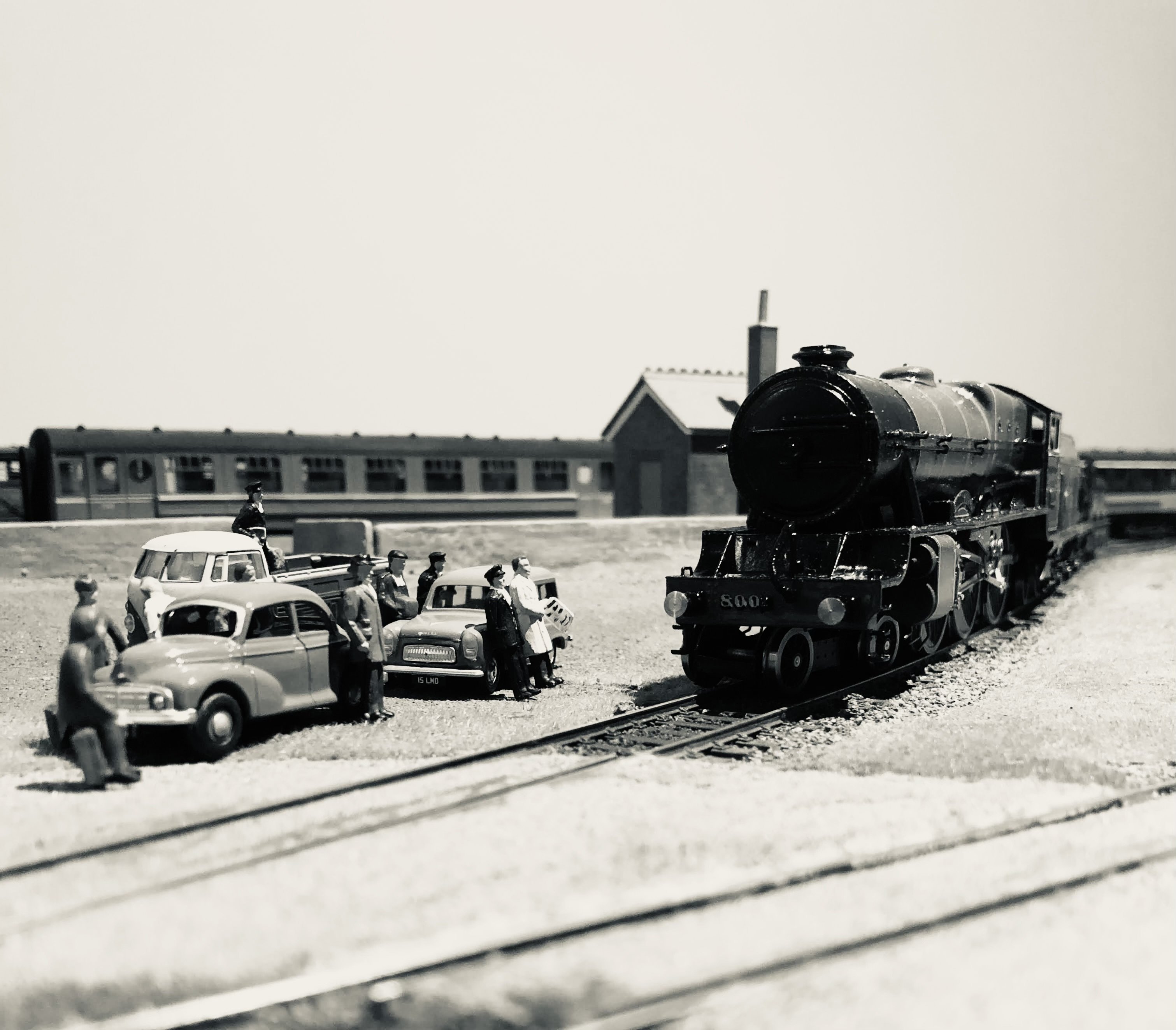
A little known fact is that shortly before No. 800 went to the Belfast Transport Museum, it was sent to Dugort Harbour for temporary storage, where naturally it derailed, blocking the goods yard. Locals turn out to witness the spectacle on a summer Saturday in 1963. The Castletown local about to depart in the background has fewer people than this aboard. Eventually rescued by a wheezing Crossley, it derails twice on its way back to Mallow. Harsh words are uttered in Cork, Mallow signal cabin and Inchicore….

-
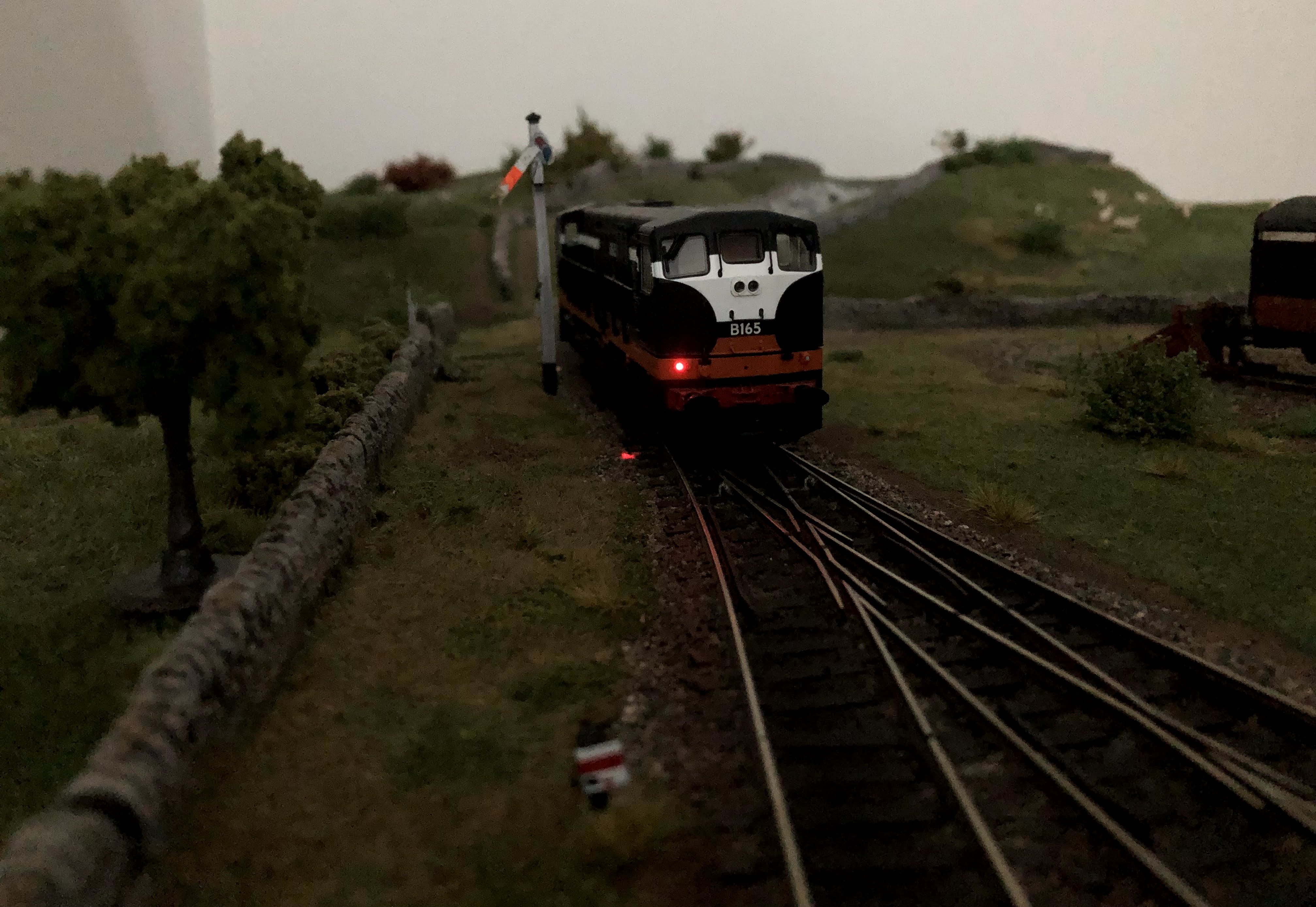
On a late summer evening in 1966, B165 leaves Dugort Harbour light, having earlier brought in a single fuel tanker for fuel for the adjacent CIE bus yard.
-
There’s at least one set with all-white logos too. I saw it at Heuston several times. The all-black logos at least were applied on purpose, possibly to several sets, due to a perception (probably incorrectly, to be fair) that green and orange on the logo might attract unwelcome attention going through Portadown.
-
Interesting to see the green ones flying off the shelves. Not too long ago, there seemed to be little interest amongst modellers in the "grey'n'green" era, and not a lot more in sixties "black'n'tan". Most or all Irish interest seemed to be concentrated on the modern "Supertrain / IE" era. I think this forum has to take credit for the spread of interest into past periods, in which there was far, far greater variety in trains here - whether locos, railcars, carriages or wagons. IRM, of course, must take credit for the "A" class locos, behind which there is now much to run, including green PRs. When the "A"s came out, there was very much less that could authentically run behind a silver, green or black one anyway. Likewise the late Paddy Murphy. Smaller manufacturers are also to be thanked for gradually chipping away at producing wagons of the pre-1970 era; Provincial Leslie, JM Design and latterly CK Prints have massively helped Irish railway modelling. JM, along with 00 Works, have of course also produced Irish steam locos. And a few kit makers as well - IFM, SSM, Worsley, etc. I have products from all of the above. Were it not for them, my layouting activities might have remained a dormant teen memory from half a century ago, or have been based on Austrian narrow gauge - I spent twenty years collecting OBB narrow gauge stuff and built up a large collection for a retirement layout. And then along came Murphy's 141s. The Austrian stuff all went, every bit, on fleabay, and the ideas for an Irish layout were born. Tis the old story - provide something a potential customer wants, and they will come running. We await the future with anticipation.
-
An absolute gentleman. I had known him, though never that well, for some 40 years. A huge loss to his club, and the hobby. Rest in peace, David, and my condolences to the family.
-
Now THAT looks more like it. I had thought at one stage of getting one of those and just repainting it. Is there room inside it, as it is, for a DCC chip?
-
Would it fit the print though?
-
Polloxfen's Mill is a perfect prototype of a mini shunting layout - one loco and a dozen goods vans does the trick! Something like that would also make a good "O" gauge starter project for someone with little space....
-
Yes, it seems they won’t reverse at Limerick, which means a (first!) non-stop service from LJ to Adare.
-
....and worth adding, that if you wanted more variety for the MGWR tank engines, any repainted by the MGWR between roughly 1918 and the GSR takeover got plain black, with red backgrounds to the numberplates.
-
That's looking great. Do we know at this stage what type of chassis / wheels / motor it's likely to fit? My Dugort Harbour layout is based in West Kerry, thus GSWR land, rather than anywhere in the west. (The real "Dugort" is a tiny village on Achill Island, and its "harbour" is tinier still!). I Reason - when the layout was conceived, nothing MGWR-ish was available. This, and a conversion of something to a J26 0.6.0T, and perhaps a 3D MGWR coach of some sort, could be a game-changer!
-
Absolutely amazing little "movie" of the line. If you're planning to finish the carriages in liveries, here are the details: 1st class coaches - dark blue with white lining. Possibly the roofs were white lead, which turned mid-grey with exposure to the elements. These were always marshalled at the Tramore end of the train. 3rd class coaches - maroon with a brownish tint (probably similar the GSWR livery) with blackk lining. Lettering and numbers were yellow with red shading. There were only two classes. Initially 1st & 2nd, though with the seconds of poorer standard than thirds on main lines, they soon renamed it 3rd. It is possible that the 1925 amalgamation all carriages were a dark brownish-red, but I have never been able to confirm this. From 1925, as elsewhere on the GSR, initially the standard "Guinness colour" extremely dark brownish maroon (almost black when heavily weathered) was applied to all coaching stock. This persisted later than elsewhere, doubtless due to isolation. When the former Claytons appeared as permanently coupled "pairs", they wore the recent chocolate and cream main line GSR livery, and seem to have held onto this until CIE times, when they were repainted lined dark green. Other stock was gradually repainted into standard GSR maroon, not always with crest or lining, though. From 1945 standard CIE green, of the original style with the dark green and full lining. The later lighter green appears only to have been applied to the railcars (if anything), though the extremely few (and extremely poor) colour pictures of these appear to show the dark green on railcar stock too. I do not believe that any loco-hauled passenger stock ever received the lighter green. Since the first two railcars arrived in 1954, this makes sense. Wagons would always have been dark grey. There weren't many, and the (only) 2 or 3 there by the 1950s were rarely used, and thus they rarely saw a paint brush. Thus, the "sails" and numbers would have been painted on it light green, over a dark grey background. As you've suggested, the ex-MGWR locos arrived in grey and remained that way, but the resident W & T locos had been repainted plain grey too, again as you suggest, not as pleasing on the eye as their W & T liveries! If you are ever in Malahide let me know in advance and I can get the W & T models of Fry's out for you to inspect in detail. Hope that helps. If I may - "Station" rather than "Train Station"!
-
Jack was a great character! Met him several times in the 70s when he was still driving.
-
When reopened, it was operated by the local authority. Surprise surprise, despite ignoring warnings initially, they found out that if a fully waged crew, as opposed to volunteers, ran such an operation, it would lose money; and thus, predictably, it did. Tralee town council were unprepared to put ratepayers' money towards it, so it foundered. Several local enthusiasts did their best to try to persuade them to allow a voluntary group to take over. The council refused, despite publicly making encouraging noises. One particular councillor seemed to be the problem, as is so ioften the case, but local authorities do tend these days to be strapped for cash, and there is greater than ever scrutiny of what they spend their money on (or don't) with the overall public good in mind. That bit is understandable. But refusing to let anyone else near it is not. It is irresponsible and criminal waste of the resources already invested in it. As of now, the loco is in bits, with a full rebuild required; you'd probably be looking at a bare minimum of half a million for that alone. The carriages are scrap, not that they were remotely appropriate in the first place. The track would need very major work, possibly replacement, at least in part. The river bridge may or may not still be serviceable. The "station" at the Blennerville end is atrocious, what there is of it; zero attempt at anything remotely appropriate to the line. My sources on the ground tell me that the local authority still haven't the remotest interest in funding it, and are equally uncooperative about allowing a volunteer group (if there was one) to take over. Overall, a text-book case of why local authorities or commercially-driven interests (such as the crowd that run a biscuit tin on wheels along a very rough stretch of track at the Giant's Causeway) in Ireland should not be let near such projects. This brings to mind the sustainability of railway preservation projects on this island, a massive subject in itself for another day. Suffice to say, nowhere on this island can, does, or ever will, support a Severn Valley or Festiniog type operation. We are lucky we have the DCDR, likely to be the only operating 5'3" gauge line ever, and even they received a considerable subsidy from their local authority for many years (but were and are obviously volunteer-run).
-
Once in a blue moon, especially towards the end when they looked shabbier than ever, you’d get a repaired door that was unpainted….. saw that once or twice…
-
OUTSTANDINGLY realistic! Exactly as they were, and I saw them almost daily.
-
This one…… history? Is it Irish?
-
That’s as good as anything. It certainly wasn’t brown, and the term used “golden brown” just doesn’t make sense. Nor was it pure orange, as such. It was an orange shade with a distinctly brownish tint, so “amber” or, unfortunately, “tan” were (and are) probably the most technically apt descriptions…..