Galteemore Posted April 9 Posted April 9 Exciting news of a new volume on MGWR locos. This will be a corker. Released next week : preorder from Transport Treasury 6 3 1
Galteemore Posted April 9 Author Posted April 9 9 minutes ago, Horsetan said: I wonder what that might have in the way of drawings? A fair number in the companion GSWR book, but these vary enormously in utility for modelling purposes - not all are dimensioned. @seagoebox will be able to advise!
Galteemore Posted April 9 Author Posted April 9 54 minutes ago, Mol_PMB said: Anyone know if this will be stocked by the RPSI? Prob direct sales 1
seagoebox Posted April 9 Posted April 9 4 hours ago, Galteemore said: A fair number in the companion GSWR book, but these vary enormously in utility for modelling purposes - not all are dimensioned. @seagoebox will be able to advise! 175 photos (incl. 5 in colour!) 48 drawings/ diagrams 6 maps 246 pages hardback 8 chapters, 7 appendices, bibliography & index (Very limited number of Locomotives of the GS&WR are also available from Transport Treasury as well ) 3 1
Mol_PMB Posted April 9 Posted April 9 Wonderful - I have ordered a copy and no doubt it will tell me what I’ve got wrong on the J26! 1
Mayner Posted April 10 Posted April 10 Although modelling the Midland in GSR/CIE days, I'll probably pass go on this one as there is likely to be a certain level of overlap with existing published information particularly Ernie Shepherds Midland Great Western Railway of Ireland Book, Clements & McMahon "Lomomotives of the GSR" and the same authors "GSR Locomotives Drawing Register" IRN Sept-2014. "GSR Locomotive Drawing Register" originally intended to be published as a companion volume to Locomotives of the GSR was issued with IRISH Railway News between Sept-2014 & Dec 2016. Availability of MGWR diagrams. GSR Locomotive Drawing Register Sept 2014 Issue---MGWR diagrams locos taken into GSR stock 1925. The Midland diagrams comprised a side (firemans) and end (front) end view only. The diagram includes an Lm (Standard Goods)Class 0-6-0 but not a K Class 2-4-0 with the classical 'flyway " cab a once distinctive feature of Atock 2-4-0 and 0-6-0 classes retained on some locos into the early-mid 1930s Midland Great Western Railway of Ireland Ernie Shepherd 1994 4mm diagrams of pre-1900 locos and stock. Shepherds "Midland Great Western Railway of Ireland includes 4mm scale drawings/diagrams of Hawthorne-Single (Class 13) 2-2-2 of 1862 (side view only) Class D 2-4-0 No36 "Empress of Austria" beyer Peacock 1881 (Rebuilt 1900 as 4-4-0 "Achill Bogies", Class E 0-6-0Tno110 (Bat) (print quality not great) Sharp Stewart & Lm 0-6-0 No135 Kitson 1891 (standard goods). Availability of Beyer Peacock General Arrangement drawing MGWR D Class 2-4-0 1881 (side view only) Manchester Museum of Technology possibly National Railway Museum. Historic sources the late Bob Clements and Padraig O'Cuimin I contacted both while sourcing information on Midland locos and stock during the 1980s. Both appeared to have copies of the MGWR loco diagram book, but not General Arrangement drawings. Bob provided me with a copy of a MGWR L Class 0-6-0 diagram, while Padraig provided copies of MGWR blue print diagrams of several loco classes otherwise identical to the MGWR diagrams in the Sept 2014 issue of the GSR Drawing Register. Interestingly the K Class 2-4-0 appears with Stirling but not flyaway cab in both blue print and black on white format. At one stage I considered producing a K Class kit with 'flyaway' cab option cutting and pasting the cab from a LM Standard Goods, but there were no takers for the origonal version of the Class with flyaway cab, but reasonable demand for both Stirling and late GSR/CIE versions of the class. 2 1
Mol_PMB Posted April 17 Posted April 17 Mine has just arrived, I've only had a very quick look through but it seems well detailed and illustrated. It's helpful for my current modelling project as it has a good photo of 559 in 1959. And when I get round to building 655 there's some information on tenders that looks like it will be useful. 3
jhb171achill Posted April 17 Posted April 17 I got mine yesterday. First impressions are that this is a truly excellent volume, as would be expected given the authors and their typically detailed and painstaking researtch, and research sources. I'm actually reading through it this afternoon. 3 1
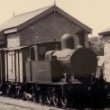
Mol_PMB Posted April 17 Posted April 17 (edited) Having a closer look at the section on tenders over lunch break. Tenders were routinely swapped between locos so to check the correct type of tender for your loco requires study of photos of the correct period. There are 126 tenders listed as passing to the GSR, which are of the following types (R and V are different but not distinguishable from the archive data): Q 2 R or V 36 S 21 T 14 W 23 YA 11 Z 18 # 1 Now I'm interested in the type attached to 655 in later life, which is what I had previously considered an MGWR 'standard', as shown in Ernie's photo here: However, now I have the new book I realise that tender types R, V and Z all look like this, but they are not the same... Type R has a 5'6"+5'6" wheelbase, 17'11" over headstocks, 1600 gallon tank. Type V has a 6'0"+6'0" wheelbase, 18'8" over headstocks, 1600 gallon tank. Type Z has a 6'0"+6'0" wheelbase, 18'8" over headstocks, 2000 gallon tank. So now I need to work out which variant is coupled to 655, and which variant is provided in the kit! Edited April 17 by Mol_PMB typo 3
Mayner Posted April 18 Posted April 18 The kit tender was based on information available at the time, a combination of a GSR diagram of a 650 Class and tender, (section or plan view unavailable) and available photographs. Decent photos of front end/interior of tenders were scarce! Kit tender wheelbase 6'+6'. Tank top/bottom of coal space appear - - - - on diagrams of earlier tenders without coal rails. Tank top/bottom of coal space possibly at bottom of flare in tank side/end on locos with coal rails, but unclear how that extra 400gal water was accommodeted on Class Z tenders 1 1
Mol_PMB Posted April 18 Posted April 18 Many thanks John, that’s most helpful. Even with the new book things aren’t entirely clear. 655 and some others of the class latterly had tenders with the back end of the tank flush with the headstock, and with slightly rounded back corners. These features are not apparent on the diagrams for type R, V or Z tenders. However, there is a photo of an earlier Beyer Peacock tender which appears to be a closer match in this area. Clearly all the tender types were modified to some extent at the front of the sides, and photos show much variety in shape here that may reflect individual rebuilds rather than a type R / V / Z characteristic. I shall need to spend more time looking at photos and working it out. 1
Colonel Posted April 18 Posted April 18 Mine arrived yesterday and it is a fine thing for which the authors should feel very proud of. 2 1
.png.c363cdf5c3fb7955cd92a55eb6dbbae0.png)
Recommended Posts
Create an account or sign in to comment
You need to be a member in order to leave a comment
Create an account
Sign up for a new account in our community. It's easy!
Register a new accountSign in
Already have an account? Sign in here.
Sign In Now