.png.c363cdf5c3fb7955cd92a55eb6dbbae0.png)


BSGSV
-
Posts
330 -
Joined
-
Last visited
Content Type
Profiles
Forums
Events
Gallery
Blogs
Everything posted by BSGSV
-
When CAWS was fitted to the locos in the early 1980's, the locomotive receivers were mounted on brackets under the bufferbeam, each end. As these were ahead of the lifeguards, they were prone to damage as they would be first to hit any ballast etc. sitting on the rails. The solution adopted after about 6-7 years, was to fit the the large metal framework supported from the bufferbeams, JHB's "fangs". None of the "C" class got the framework, and not all "A" class either, as some were already withdrawn. The headlights were fitted as part of the "transplant" project, as were the additional roof boxes beside the air vents, to accommodate the air intake/Roots blowers on the new engines, two on the "A", one on the "C". The "C" class also got larger radiators. Barry's book is indeed a pleasure, and I am looking forward to his and JHB's upcoming book on the North Kerry, as their last collaboration on the West contained a splendid collection of photographs and commentary.
-
JHB, that first picture is of Ardrahan, not Craughwell.
-
I'm not aware of any bogie vehicle that didn't have brake cylinders for each bogie.
-
remaining mechanical signal cabins in ireland
BSGSV replied to Junctionmad's question in Questions & Answers
Carrick-on-Suir and Tipperary are still working. Limerick Check still has its mechanical frame too. Clonsilla and Killonan might also be considered, given their gates arrangements. -
I'm afraid the only electricity involved is the light bulb to illuminate the dial at night! The cable from the housing on the axle end to the speedo is removable and come in different lengths for different loco types to avoid excessive slack having to be "lost".
-
According to Irish Railfans' News for Feb. 1971 B123 and B127 received red bufferbeams in 1961 and 1962 respectively. This was done by Grand Canal Street depot as the locos were rostered to work the Wexford Opera special. The cab height of the 121 is very noticeable if the door is stuck and you are hanging from the handrails trying to get in! The Hasler box shown in the picture above seems a bit more sophisticated than those fitted to 121's etc., which just appear to have gearing driving a cable leading to the speedo in the cab.
-
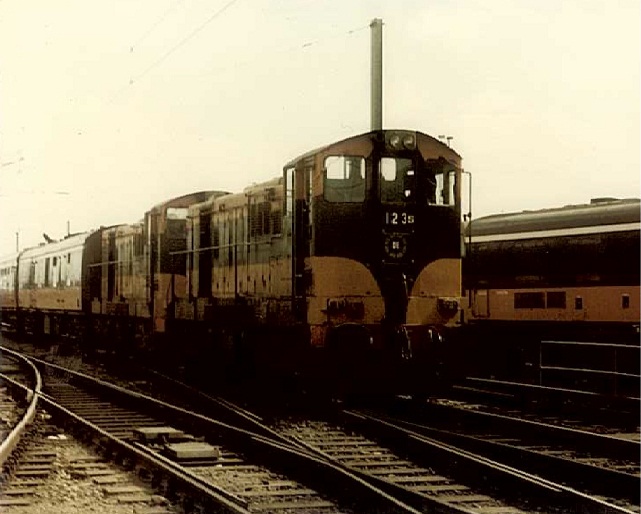
In addition to the multi-sockets and air pipes, the 121's were also fitted with the high-vacuum pipe for (AEC conversion) push-pull working. It can be seen to the left of the screw coupling. The later Mk.3 P/P saw door controls and an additional changeover switch fitted in the cab. On the subject of uni-directional 121's, a poor 1986 shot of the first Up Sligo arriving in Dublin. Locos are 123 and 129. When released, the locos went 129 nose leading to the shed.

-
The Bachmann model appears to be based on a Somerset & Dorset Joint Railway design (have a look at Midsomer Norton for example). The Ratio model is based on the McKenzie & Holland Type 3 design, which wasn't used that much in Ireland (see Goraghwood with a panelled brick base, or Macroom (C&MDR) in timber. The Gloucester Wagon Company/Railway Signal Company design, in its basic form, was used extensively in Ireland - but I haven't seen a model produced yet.
-
What were the last 5'3'' 4 wheel (passenger carrying) coaches?
BSGSV replied to minister_for_hardship's question in Questions & Answers
I don't like your quiz as the question is too hard! I'm not saying this is the last, but I do believe that, despite the caption, there's no middle wheels on this carriage. They may have been removed to make it easier to get around the curve, something done on the Isle of Wight too.
-
What were the last 5'3'' 4 wheel (passenger carrying) coaches?
BSGSV replied to minister_for_hardship's question in Questions & Answers
Can I just clarify, please? Is it passenger carrying only Irish standard gauge carriages you have in mind, or NPCCS as well? -
Operations at claremorris , signals, coal trains etc
BSGSV replied to Junctionmad's question in Questions & Answers
Irish railways generally didn't go overboard with such niceties as starting signal control, i.e. can't pull the starter unless a line clear has been received. On single lines, while many locations had a lock on the starting signal lever, released by a key from the ETS machine, itself released by co-operation to release a staff, it wasn't universal. Double track sections with Harper's were far from universally equipped with the equivalent. Given the busy nature of the service, it was a surprise to find so many cabins on the GNRI main line from Malahide to Drogheda, right to the end of mechanical working, relied on the signalman to follow procedures, rather than providing any additional safeguards for him. To clarify, what order did you expect signals to be cleared in? -
Operations at claremorris , signals, coal trains etc
BSGSV replied to Junctionmad's question in Questions & Answers
To be clear, the unusual thing about Claremorris is the lack of function description on the lever pull plates (e.g. "Down Advanced Starter to Westport", "No. 19 Points" and such like). The releases are, as expected, on the bottoms of (some) plates. As you say, 31 had no indication latterly of anything needing to be pulled before it, but all three routes from it needed a points lever reversed, otherwise the loco would end up on the ballast. So, I would have expected that to be indicated on the lever plate of 31, but it is not so. While it is common in Britain for each route from a shunt signal to be given a separate disc (stacked on top of one another, and disc reading top to bottom, route left to right), GSR/CIE tended to be cheaper, so the signalman and driver needed to be more on their toes. 31 would (I believe) have controlled a shunt movement to three routes (i.e. driver can proceed past the signal only as far as he can see the line to be clear or until he reaches the next stop signal in that direction). I agree with you that prior to removal, it would have been the appropriate signal to use for run-rounds - although the Homes 59/61 don't have a co-located disc. No. 27 crossover from the down line (No.2 platform road) - you may have been expected to proceed as far as 13 and 14 discs before getting a signal, or be handsignalled before that (as it was near the cabin). I suspect 38 was added to replace the previously hand signalled move from Platform 2 to the down sidings (via No. 26 crossover), probably more commonly used once diesel fuelling started down there. -
Operations at claremorris , signals, coal trains etc
BSGSV replied to Junctionmad's question in Questions & Answers
Being fresh this morning, I suspect Junctionmad and myself have been having a nice discussion but have had a diffierent idea of what some of the topics have been... One item/time period at a time might be useful to avoid this. The disc signal? http://irishrailwaymodeller.com/showthread.php/4476-One-for-the-Signalling-Nerds On the diagram the disc in question is worked by lever 31, at the Dublin end of Platform 1. Claremorris was interesting in that the lever pull plates had no descriptions of the functions at all, which is the only example I've can remember seeing. There were just the releases shown, and 31 seems to have been misleading. You would expect three routes - towards Tuam (with 54 reverse), towards Ballyhaunis (56 reverse) or the siding (57 traps reverse). So you would have thought the pull plate would show "54 or 56 or 57" at the bottom, to cover shunt moves in the particular direction. http://catalogue.nli.ie/Collection/vtls000148612/Home?lookfor=claremorris&submit=Apply Is an O'Dea photo of the diagram from 1960, and the disc in question is 52 (later used as the Advanced Starter). Other O'Dea photos show the lack of descriptions seems to have been an original feature. Sadly, the pulls on 52 aren't visible. One hopes it was better labelled than 31. -
Operations at claremorris , signals, coal trains etc
BSGSV replied to Junctionmad's question in Questions & Answers
But now the light engine is approaching rolling stock stabled on the track the loco is entering, so running signals would be inappropriate. Having looked at the 071 video, the siding formerly accessed by 56 crossover and the disc are gone. So there was little option but to pull the platform starter anyway! The pull plate on lever 31 (the disc) would tell us how it could have been used, if we ever see such a pic. -
Operations at claremorris , signals, coal trains etc
BSGSV replied to Junctionmad's question in Questions & Answers
Perhaps a way to think about it, is to consider what function the Advanced Starting signals performed, if you couldn't clear the preceding Platform Starter? Why have them at all, if so? I think you answered your own question though - the signalman controls the speed of the train by bringing it to, or nearly to, a stand, before clearing the preceding stop signal, and the driver understands by that, that the stop signal ahead is against him. While I would agree that there would be limited value in letting an Athlone bound train get to the Advanced Starter without line clear (the logistics of getting the staff out would be a nuisance), I would suspect in the days of sizable Pilgrimage traffic, that parking a train out there might be useful, or the equivalent at other points of the station layout. -
Operations at claremorris , signals, coal trains etc
BSGSV replied to Junctionmad's question in Questions & Answers
The levers associated with the advanced starters at the Westport/Sligo end, 16 and 17, were originally associated with the Ballinrobe branch and show up in O'Dea's photo of the diagram taken in 1960 (on the NLI site). So, post 1960 and a nice trawl through the weekly circulars in the IRRS library should deliver a date! It was perfectly in order to clear the platform starting signal, without the advanced starter being clear (the latter being the section signal). At Claremorris, this would allow a train bound for the Athlone direction (for example) to clear Platform 1, so allowing another train to enter the platform, even if line clear hadn't been obtained from Ballyhaunis/Castlerea. The disc was to control access to the siding (56 crossover normal, 57 traps reversed). For the shunt move being discussed, the loco could have been routed to either the Athlone or Tuam lines via the main arms on the end-of-platform bracket signal to run round, the advanced starters preventing the driver from rambling too far. Given there was a level crossing at the Tuam end of the station (with the advanced starter slotted with the gates), I would think there were never Limit of Shunt boards that end, as there was the Advanced Starter instead. -
Operations at claremorris , signals, coal trains etc
BSGSV replied to Junctionmad's question in Questions & Answers
Coal containers were emptied by grab I believe (but I could be wrong). I think you are confusing diagrams from different periods. The photo you put up of the diagram in latter days (in another thread) shows no limit of shunt boards. This is because there were latterly advanced starters on all routes, so the limit of shunts weren't required. -
Operations at claremorris , signals, coal trains etc
BSGSV replied to Junctionmad's question in Questions & Answers
The pair could have been going for juice? Are you sure there are LOS signs at Claremorris? The coal was in open top containers. The train was formerly coal and oil for Asahi, latterly only coal. Asahi closed in 1997. The 071 worked in on a liner, spent the day on the Ballina branch passenger and worked back to Dublin next night with the up liner. In the days when there were liners. -
I think CIE just followed the "standard" length for the first batch of compos in 1951. The change to 61' 6" was to allow the compos from then on to have four 1st and three 3rd class compartments, rather than three and four respectively.
-
2128 was a 60' coach, and so was shorter than the other conversions, which were 61' 6". Is there anything indicating this difference in drawings or lists?
-
I believe sanders operating in conjunction with emergency braking is fitted on current IE and NIR railcars and electric units. The A class was fitted with sanding originally, but the equipment was generally removed within a couple of years, if gauged by photos. To judge by some of Dan Renehan's writings, CIE management were dubious of the benefits of sanding on diesels, a view not necessarily shared by drivers.
-
Two of them still have the delivery notices in the windows, so I would say they are as they came from the factory. CIE's painters are applying the numbers, and the chalk is to keep the lines straight. Hardly applying numbers to undercoat and it seems too shiny anyway? Seeing all seven together, helps explain why the works numbers and CIE numbers don't keep in sequence.
-
.
-
I must say that I too was somewhat surprised when I read the IRN snippet the first time. Having been on the lookout since for the green roof, I can't say that I think I've seen too many in photos. Mind, I can't say I've seen too many black ones either! Mid to dark grey, depending on the wear, seems more common. A typical example: https://www.facebook.com/IrishTractionGroup#!/photo.php?fbid=852344341443770&set=gm.370422766444421&type=1&theater Note the second vehicle appears to be one of 2172-5 of 1961, a type which otherwise seem to be rarely photographed, possibly because first class was abolished on the Dublin Suburban not too many years later, and the carriages were later rebuilt as brake standards. But to my eyes it has a grey roof, as has the heating van.
-
What about green roofed CIE stock in the 1950's? A quote from January 1959 Irish Railfans News: "A number of diesel railcars which have recently been repainted have been noted with roofs painted black instead of the former shade of dark green which conformed with their side panelling. This trend has also appeared in repainted coaching stock as Buffet car 2420 and Compo 2145 are in traffic with black roofs". One of the two Tom Ferris colour books has a railcar which clearly has a green roof, but other stock is elusive enough to identify, especially in black and white photos!