Tullygrainey Posted April 11 Author Posted April 11 (edited) 45 minutes ago, Galteemore said: Alan - just admiring this again, but noticed one of the cab handrails is adrift? Makes it look as if rear bunker is askew…. You're right! Well spotted David. Didn't notice that. Because I made the various sections separable, I couldn't solder the bottom of the handrails into holes in the running plate. Instead they're bent at right angles near the bottom and soldered to the bunker floor. That one will need desoldered and moved in a bit at the bottom. Edited April 11 by Tullygrainey 1
Galteemore Posted April 11 Posted April 11 21 minutes ago, Tullygrainey said: You're right! Well spotted David. Didn't notice that. Because I made the various sections separable, I couldn't solder the bottom of the handrails into holes in the running plate. Instead they're bent at right angles near the bottom and soldered to the bunker floor. That one will need desoldered and moved in a bit at the bottom. No worries Alan. Let’s just say it resonated with something I’ve done myself 1
Tullygrainey Posted April 12 Author Posted April 12 18 hours ago, Galteemore said: No worries Alan. Let’s just say it resonated with something I’ve done myself Sorted now David. Only took three quarters of an hour First, while trying to adjust the bottom soldered joint the whole rail came adrift. Then predictably, it pinged off the tweezers straight into the maw of the carpet monster. Actually I think I also have a bench monster. So I had to make a new one. Another member of the 'little things sent to try us club' 5 2
Galteemore Posted April 12 Posted April 12 Excellent Alan. If it’s any consolation I’m facing similar struggles right now with the cab handrails on mine!!! 1
Tullygrainey Posted April 14 Author Posted April 14 (edited) More on the reclamation of the K's Midland Railways Kirtley kit about which I posted back on 11 February. I think at last I've got a viable loco chassis. The intention is to build it with live chassis, picking up one side on the loco and the other on the tender. To that end, the original wheels were cleaned up, then 3 loco wheels and 3 tender wheels were shorted using etched spiders from ScaleLink. For the loco wheels, the central square hole was reamed out to a tight fit on the 1/8'' plain axles. The legs are soldered to the back of the wheel rims. Chassis frames are in 16 thou nickel silver. No detail needed since they won't be seen on this outside framed loco. Hornblocks from High Level. RoadRunner Compact+ gearbox and iron core motor, also from High Level. Outside cranks with extended axles from Alan Gibson (Code 5000). Coupling rods are ex-Lanarkshire Models, now available from High Level (Fowler 4F, 8' + 8' 6"). Just noticed on the pic above that a couple of crankpin nuts on the far side are about to ping off into the ether! The wheels' centre holes are worn and it's been difficult to secure them on the axles. Superglue is doing the job at the moment. We'll see how long that lasts. IMG_4773.MOV Next job will be to arrange chassis mounts inside the K's whitemetal bodies. Alan Edited April 14 by Tullygrainey 8 2
Colonel Posted April 15 Posted April 15 Outside frame locos always look good with the cranks twirling. 1
Horsetan Posted April 15 Posted April 15 16 hours ago, Tullygrainey said: The wheels' centre holes are worn and it's been difficult to secure them on the axles. Superglue is doing the job at the moment. If you have any Loctite 603 (or even the older 601 if it hasn't gone off), that tends to set much harder than plain superglue. 2
Galteemore Posted April 15 Posted April 15 I love seeing old kits brought back to life. Looking great. 1 1
Tullygrainey Posted April 18 Author Posted April 18 Back to the SSM J26. Brakes 7mm brass rod for the top brake cross members slotted through pre-etched holes in the frames and short brass tubing spacers slipped over each to help position the brake hangers. Nothing soldered. The sheet of foam plastic packaging helps keep everything roughly in place. Brake hangers then added and more brass rods passed through the bottom of the hangers and through two brake pull rods. Moving the pull rod back and forward then allows all three brake hangers to move together and be positioned as close to the wheels as short circuit avoidance will allow. Each brake hanger is then soldered into place at the top. Once the first one is done, the whole arrangement begins to firm up. Then it's just a case of working round the various joints. One side soldered up and the other ready for the same procedure. All soldering done now. Cross rods trimmed back and filed. Pickups Deciding how to arrange pickups took a bit of thinking about. Space is tight and it was a challenge to avoid contact with the bodywork and the brake rigging. Pickups are 31 swg phosphor bronze wire soldered to small pieces of printed circuit board superglued to the chassis frames. These bear on the wheel flanges and are hooked at their ends to help keep them in place. I always find this job a trial and it usually takes a lot of fettling to get them working well. It's always a compromise between getting sufficient tension in the wires to maintain contact but not so much as to cause too much drag. First attempts with this one just about stalled the motor. It's still not quite right in the video below but getting there. IMG_4785.MOV Another bit of pcb between the frames just ahead of the motor allows the pickup wiring to come together and these and the motor terminals were connected to a 6pin DCC harness. Alan 9
Mol_PMB Posted April 18 Posted April 18 There are some very neat ideas there - I like the sheet of foam as well as the pickup location and shape. Excellent work, and I shall be inspired by those ideas when I get to that stage. 2 1
Tullygrainey Posted April 18 Author Posted April 18 (edited) Thanks Paul. Pickups are a pain no matter how you approach them which is why I’m exploring a live chassis approach with the old K’s Kirtley. But you can’t really do that with a tank engine. At least I’m not sure how you would. Edited April 18 by Tullygrainey
Mol_PMB Posted April 18 Posted April 18 17 minutes ago, Tullygrainey said: Thanks Paul. Pickups are a pain no matter how you approach them which is why I’m exploring a live chassis approach with the old K’s Kirtley. But you can’t really do that with a tank engine. At least I’m not sure how you would. With my broad gauge version I'm not sure I'll have room under the splashers to hook a wire over the top of the flanges. Once I've trial assembled some more parts I'll give it some more thought. My CSB springy wires also potentially block your copperclad block locations. Mine will be DCC and have a stay-alive fitted, but it still needs effective pickups! I wonder if I can fit something lower down bearing on the back of the wheels.
Tullygrainey Posted April 18 Author Posted April 18 23 minutes ago, Mol_PMB said: With my broad gauge version I'm not sure I'll have room under the splashers to hook a wire over the top of the flanges. Once I've trial assembled some more parts I'll give it some more thought. My CSB springy wires also potentially block your copperclad block locations. Mine will be DCC and have a stay-alive fitted, but it still needs effective pickups! I wonder if I can fit something lower down bearing on the back of the wheels. You might get away with contacts hooked over the flanges - depends how much deflection your CSB allows - but it would be tight. It's only the front axle that's a problem. There's plenty of room above the other two. You could consider having the hooks make contact with the wheels a bit further down from the top. There's slightly more room there. I considered going underneath with this one. You have the brake pull rods to contend with but it should be possible to work round them. As I said, a pain! 2 1
Colonel Posted April 19 Posted April 19 Add brake rigging to the list of pains when chassis building! The use of fine tubing to set things up is definitely one I'll be using. 2
Galteemore Posted April 19 Posted April 19 23 minutes ago, Colonel said: Add brake rigging to the list of pains when chassis building! The use of fine tubing to set things up is definitely one I'll be using. Me too !
Turin60 Posted April 19 Posted April 19 As a former service engineer may I make a hopefully helpful suggestion...rather than hiding the pick-ups away somewhere in the back of beyond at least have them (of whatever pattern) where you can get at them for cleaning without removing locomotive bodies and so on. Trust me life will be so much simpler. John Bruce. 4
Tullygrainey Posted April 19 Author Posted April 19 1 hour ago, Turin60 said: As a former service engineer may I make a hopefully helpful suggestion...rather than hiding the pick-ups away somewhere in the back of beyond at least have them (of whatever pattern) where you can get at them for cleaning without removing locomotive bodies and so on. Trust me life will be so much simpler. John Bruce. There’s always the desire to conceal them as much as possible for cosmetic reasons but from a practical point of view this makes sense. It’s also a good argument for placing them underneath the frames.
Mayner Posted April 19 Posted April 19 In the 4mm Engine Guy Williams (Pendon loco builder) recommended p/b wire soldered to glass fiber board, collecting on the 4mm engine. (White Swan & Guy Williams 1988) I seem to have hedged my bets with my pair of Midland Tanks 556 finished most recently uses longish pieces of pb wire soldered to a single piece of pcb board mounted under the central axle, the pb wire collecting on & slightly curved around the flange. Before soldering I bend the fixed end of the pb wire at 90º and drill a shallow hole in the PCB board to pin the pb to the board before soldering. Although the finish of 556s pick-up look fairly rough when viewed from below, pick ups appear ton be reasonably effective and unobtrusive at normal viewing angles on a loco modelled with full brake gear. 553 last rebuilt about 30 years ago uses a variation of 'top wiper pick up" with pb wire bearing on the wheel tyres soldered or bolted to short pieces of copper clad fixed vertically with superglue to the loco frames. I also seem to have used copper clad sleeper (presumably with insulated gaps) fixed traversely across the top of the frames on one of my narrow gauge locos. Top-wiper pick up seems to be effective and unobtrusive on tank locos with the pick ups & pcb strip largely concealed behind the tanks and valences. 2 1 2
Tullygrainey Posted April 20 Author Posted April 20 The Kirtley lives! IMG_4832.MOV My first attempt at a live chassis arrangement. Loco needs some proper body mounts and the tender needs attention to level it up but now I know it works, it'll be worth some more effort to make it look and go a bit better. Alan 11 1
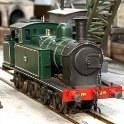
Tullygrainey Posted April 22 Author Posted April 22 The J26 is getting there. Basking in the sunshine after a good scrub.... ... and together in all its brass brassiness. Some Railtec rivets... ... and turned out in builder's photogenic grey. Roof will be fitted properly in due course. First runs under DCC at Loughan Quay.... IMG_4839.MOV ... and again on its home turf, Kirley Junction. J26.mp4 3 8
Mol_PMB Posted April 22 Posted April 22 Excellent! I have some catching up to do. I should probably have done the same with the rivets. What are you planning to use for the bufferbeam numbers? 1
Tullygrainey Posted April 22 Author Posted April 22 14 minutes ago, Mol_PMB said: Excellent! I have some catching up to do. I should probably have done the same with the rivets. What are you planning to use for the bufferbeam numbers? I'd need to consult the owner about that. Kieran will take over from here to do the paint, transfers and finishing so the final decision will be his. There are still a few things to sort before that, including cab detail and deciding on a home for the decoder. It's in the bunker at the moment but could conceivably fit in the boiler, though getting a stay-alive in there too might be a bit of a squeeze. Don't rush your build! The detail you're putting into it is worth spending time on. 1
Mol_PMB Posted April 22 Posted April 22 Thanks For the numbers on the tank the Railtec ones have the wrong font for my prototype. I may use custom transfers but I am considering laser-cutting a stencil and spraying them. I think that may help me replicate the very worn and faded numbers that 559 had. But the bufferbeam numbers are much more fancy with multicoloured shading. I was wondering if there’s something suitable commercially available, maybe intended for a GB railway?
Tullygrainey Posted April 22 Author Posted April 22 I used LSWR/SR ones too on my BCDR locos. Not strictly accurate but I'm content with them and nobody's pointed out an error yet! These are from HMRS Sheet 9. 7 1
Galteemore Posted April 23 Posted April 23 The J26 looks fabulous Alan. Look forward to seeing how Kieran finishes it off and what number it is. Inspired me to crack on with mine last night ! 1
Horsetan Posted April 23 Posted April 23 14 hours ago, Galteemore said: I’ve used LSWR\SR ones before That's quite close, although I think the GSR/CIE script was wider and taller, with more of a shadow. In some photos, the number appears to take up almost the full height of the buffer beam.
Mol_PMB Posted April 23 Posted April 23 17 minutes ago, Horsetan said: That's quite close, although I think the GSR/CIE script was wider and taller, with more of a shadow. In some photos, the number appears to take up almost the full height of the buffer beam. I've just had a look through the transfer sheets I have accumulated over many years, and found a 7mm scale example of this one: GNR & ECJS coach insignia (Special Vehicles need 1 sheet per vehicle side) transfer In 7mm scale the smaller numbers are 3.5mm high and the larger numbers are 4.2mm high (both including the shading). My J26 bufferbeam is 3.2mm high so they're a fraction too big, I might be better off with the 4mm scale equivalent. But the styling looks pretty good. I wonder if these might also be suitable for @16miller's CDR stock? They're not cheap... 2
Galteemore Posted April 23 Posted April 23 Interesting stuff @Mol_PMBand @Horsetan thanks. Just realised that from photographs of 558 I may only need to bother with tank side numbers as by late 50s she had no buffer beam nos! 2
Horsetan Posted April 23 Posted April 23 2 hours ago, Galteemore said: Interesting stuff @Mol_PMBand @Horsetan thanks. Just realised that from photographs of 558 I may only need to bother with tank side numbers as by late 50s she had no buffer beam nos! I think 560 still had it on the buffer beam up to withdrawal. 1
Galteemore Posted April 23 Posted April 23 11 minutes ago, Horsetan said: I think 560 still had it on the buffer beam up to withdrawal. Think so. It seems to have had some late career TLC
.png.c363cdf5c3fb7955cd92a55eb6dbbae0.png)
Recommended Posts
Create an account or sign in to comment
You need to be a member in order to leave a comment
Create an account
Sign up for a new account in our community. It's easy!
Register a new accountSign in
Already have an account? Sign in here.
Sign In Now