Galteemore Posted June 5 Posted June 5 Silly question Alan but are all the wheels back in the same locations as before painting? That may lie at the root of this
Horsetan Posted June 5 Posted June 5 17 minutes ago, Tullygrainey said: .... with the final drive grub screw loosened, it runs like a sewing machine in both directions.... Could it possibly be that tightening the grub screw knocks the axle slightly off-centre? If so, it may help to file a flat on the axle section where the grub screw makes contact or drill into the axle so that the grub screw can lock in without pushing the axle out of alignment 1
Tullygrainey Posted June 5 Author Posted June 5 4 minutes ago, Galteemore said: Silly question Alan but are all the wheels back in the same locations as before painting? That may lie at the root of this Not silly at all David. Yes they are. They were painted in situ though I've just now taken them off and re-fitted them. 2 minutes ago, Horsetan said: Could it possibly be that tightening the grub screw knocks the axle slightly off-centre? If so, it may help to file a flat on the axle section where the grub screw makes contact or drill into the axle so that the grub screw can lock in without pushing the axle out of alignment That's an interesting thought. Worth a try. I originally spacered the back axle so there was zero sideways movement. I've now taken the spacers out to allow it a bit more freedom. It seems to have improved things a bit.
Tullygrainey Posted June 5 Author Posted June 5 (edited) I think it’s been a catalogue of things, among them wheels out of true and a possible bent crankpin. Anyway it’s performing better now so I’m about to tiptoe quietly away for now. many thanks for the support lads Edited June 5 by Tullygrainey 4 1
Colonel Posted June 6 Posted June 6 When multiple things the like you've been dealing with of late, it's not hard to doubt yourself! There are so many variables in chassis building that I sometimes wonder why we bother. That said, your methodical approach usually pays dividends, while recent issues seem more to do with quality of actual components rather than construction. Hopefully, the cause with present itself after time on the shelf... 1
Tullygrainey Posted June 6 Author Posted June 6 1 hour ago, Colonel said: There are so many variables in chassis building that I sometimes wonder why we bother. Agree absolutely David and all of them interlinked so changing one thing affects other things and you're never quite sure what the root of the problem actually is. You can spend whole afternoons going round in circles. There always seems to be a low point when everything you try seems to make things slightly worse. Why do we do it? Well... there's the challenge - "I won't let this little brute beat me" but also the satisfaction of looking at a nicely finished, smooth running, hand-built gem and thinking "I did that!" It can be hard though to remember that when the little brute is fighting you tooth, nail, hornblock and coupling rod. My current little brute, Patrick's 4-4-0 PPs, has decided to behave itself again after a frank and prolonged exchange of views during which it was shown the big hammer. Smooth, slow running restored in both directions. Long may that continue. IMG_5172.MOV Now, where did I put the rest of it.... 3 1 2
Galteemore Posted June 6 Posted June 6 Excellent. My PP responded to threats of being used as a hammer. It’s been fairly good ever since. 4
Patrick Davey Posted June 6 Posted June 6 23 minutes ago, Galteemore said: Excellent. My PP responded to threats of being used as a hammer. It’s been fairly good ever since. I wish that approach was allowed in my day job..... 1 4
Galteemore Posted June 6 Posted June 6 5 minutes ago, Patrick Davey said: I wish that approach was allowed in my day job..... Take up the dulcimer and you’re laughing ! 3
Mol_PMB Posted June 6 Posted June 6 Hmm. Steam locos and hammers. There's got to be a Mallet pun to be had somewhere? 4
Galteemore Posted June 6 Posted June 6 3 minutes ago, Mol_PMB said: Hmm. Steam locos and hammers. There's got to be a Mallet pun to be had somewhere? Don’t start him off! 3
Patrick Davey Posted June 6 Posted June 6 (edited) Too grumpy for puns today. My PRs are due to arrive, I won't be there, which means they will disappear into the main Belfast sorting office, possibly never to be seen again....... UPDATE: apparently they have just been delivered! Edited June 6 by Patrick Davey 2 1
Tullygrainey Posted June 6 Author Posted June 6 Hope not Patrick. Maybe your postman will just leave it on the doorstep. I have a plant pot on my doorstep for mine to hide parcels behind. 1
Broithe Posted June 6 Posted June 6 31 minutes ago, Patrick Davey said: I wish that approach was allowed in my day job..... Many years ago, my first real job 'on my own' was to design a new valve system for a circuit breaker for a cement works in Malaysia. They needed to have the phases operable independently, rather than all three at once, which was normal. The mechanisms were hydraulic, powered by a nitrogen accumulator 'spring', to provide the high speed operation necessary. Our previous standard breakers were supposed to have two stored operations in the accumulator, but they couldn't really manage the second one, because of huge losses as the valves operated. I took the opportunity to introduce some small changes to my new valves, to reduce this problem. The valves were made and the bearing and sealing surfaces were ground. The were then to be blasted clean of debris, to keep the hydraulic system clean. The ground surfaces were to be protected during this phase, of course. But, they weren't. This was discovered when the system wouldn't pressurise, as the leakage rate past the rough surfaces was too great. We were always late with everything - usually overdue even before anything was actually built, much less tested successfully. We had a crisis meeting and I was told it had to work by 3pm that day or we would have to default to a bizarrely expensive replacement operation, using stuff that we already made. It was my view that we only needed to get it to pressurise, then a few operations would hammer the seats to seal properly. I considered trying to fit a few more pumps in parallel, to beat the leak, but we just didn't have the time. So, I took off the cap at the accessible end of the valves and beat them with a hammer - in an attempt to get it to seal well enough to pressuring and then hammer the seats with operations. At 1pm, I had it all back together and turned the pump on. The system pumped up! All the way to 320bar, with no apparent leaks. A few quick test operations before the Armageddon Meeting at 3pm and it all worked amazingly well - it had four stored operations from the same accumulator that the standard breakers couldn't really do two from. We only made two of these and they went off to Malaysia and worked faultlessly for decades, which our stuff generally didn't. This got me a reputation for being able to come up with unorthodox, but effective, techniques. Anyway, the point of all this rambling is that, about two months later, as we were shipping the breakers off to the East, it suddenly became apparent to me that I had hit the 'wrong end' of the valve, it was the other, inaccessible end, that was leaking as the pump tried to build up the system pressure. Either the simple shaking of the valves, or the small amount of 'hammer' they got from the spring driving them back onto the seats, was enough to create a seal better than the pump rate could beat, I don't know - but, it worked. We had other things to worry about by then, so I never bothered anybody with that information... 3 1
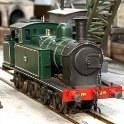
Killian Keane Posted June 6 Posted June 6 Always loved those old Kirtley goods engines, yours captures them beautifully 1
Patrick Davey Posted June 6 Posted June 6 Does anyone remember Crawford Howard's 'Diagonal Steam Trap'? 1 1
Galteemore Posted June 6 Posted June 6 1 hour ago, Patrick Davey said: Does anyone remember Crawford Howard's 'Diagonal Steam Trap'? 1 2
Tullygrainey Posted June 14 Author Posted June 14 Time for ThreePee to get a workout on the rails Clattering through some Peco three-way points without falling off... IMG_5205.mov ... and stretching its legs at Kirley Junction. Thanks Kieran. ThreePee at Kirley J.mov Scrubbed up and ready for primer.... .. et voilà! Nearly time to go to its owner Patrick @Patrick Davey for top coats. I'll refit the chassis after that's done. Alan 5 4
Patrick Davey Posted June 14 Posted June 14 Fabulous work Alan, am very grateful! Of course she will be finished in all-black livery but can anyone tell me what colour the inside of the cab walls should be? Ta
Galteemore Posted June 14 Posted June 14 (edited) Red or light brown. I went with red ! Edited June 14 by Galteemore 5 1
Patrick Davey Posted June 14 Posted June 14 The red looks the part! Cheers David And excellent inspiration for the cab interior - not as much room in the smaller scale but I'll have a go! 1
.png.c363cdf5c3fb7955cd92a55eb6dbbae0.png)
Recommended Posts
Create an account or sign in to comment
You need to be a member in order to leave a comment
Create an account
Sign up for a new account in our community. It's easy!
Register a new accountSign in
Already have an account? Sign in here.
Sign In Now