Jump to content

Mol_PMB

Members
  • Posts

    3,618
  • Joined

  • Last visited

  • Days Won

    219

Everything posted by Mol_PMB

  1. Superb! I like the similar properties but the way you have shown the individuality of the residents in the gardens and outbuildings. The placement of the buildings is very well done too as they help to conceal the corner of the room.
  2. While carriage construction at Inchicore was proceeding slowly owing to strikes and material shortages, construction of some new carriages to CIE design was contracted out to the GNR at Dundalk. The number of vehicles and the scope of work (complete carriages or components) was changed several times, but what emerged in 1952 was a fully-finished batch of 5 corridor thirds numbered 1351 to 1355. They were very similar to their predecessors from Inchicore, but with alterations to the interior finishes, and an enhancement to Inchicore's plain dark green livery, according to the IRRS Journal: The livery, still dark green, was much relieved by a narrow light green band along the waistline. I think these were the first coaches to be built new with fittings for operation with CIE's AEC railcars - through-wiring and jumpers plus an extra high-vacuum pipe for quicker brake release. Dundalk would have been familiar with these additions, as they had recently been modifying GNR stock to run with their own AECs. The light green (actually EdN) waist line also matched the railcars, although it could not be placed at exactly the same height owing to the different window geometry. Let's look back at that nice colour photo in Bantry to see one of these Dundalk-built corridor thirds. Note that it does not have '3' class digits or a snail - the livery is simply plain dark green plus a waist line. I cannot confirm the initial roof colour; I suspect the ends were black. There's just a hint of slightly different shades of green between the railcar and the intermediate, possibly different primer coats or paint batches. Remember, the railcars were painted in London and the carriage in Dundalk, so they may have had different paint suppliers from Inchicore. Here's a late 1950s photo from Trainiac on Flickr and also on the west Cork. By this time the nearer railcar has been repainted in a lighter shade of green, but the intermediate corridor third is still in original dark green with waist line: The delays in building carriages at Inchicore meant that new buffet cars were not available to run with the first railcars, and the catering department reluctantly had to use old wooden-bodied tea cars as a substitute. At first these weren't even through-wired and had to be hauled, which was considered very unsatisfactory as most people in the train (including the first class passengers) did not have access to refreshments. However, a small fleet of tea cars were quickly through-wired and piped, and photos indicate that most were repainted to match. The catering department still considered them very unsatisfactory and lobbied hard for a new fleet of buffet cars which would arrive in 1953/4. There still weren't enough and some of the old vehicles lasted a few more years on secondary duties. They were as follows: Tea car 838, converted in 1952 and used with 2600-3 on some of the first railcar services. Tea car 841, converted in 1952 and used with 2600-3 on some of the first railcar services. Tea car 843, converted Feb/March 1953 Tea car 343, converted Feb/March 1953 Tea car 350, converted Feb/March 1953 Tea car 74D, converted in mid-1953 In the IRRS Archives there's a whole box of corrrespondence from the 1950s about catering provision, especially on the railcar trains, here's just one page relevant to the tea cars: This photo from Irish Broad Gauge Carriages (Coakham) p16 shows 343 in a railcar set with matching livery, in April 1953. Incidentally this was not the only clerestory coach that ran with the railcars - I think there were three in total. This photo from Ernie shows 350 in a railcar set with matching livery, in August 1953: 838 seems to appear in more pictures than most, but this photo shows it fairly clearly; again it was finished in matching livery: 841 and 843 seem to have been camera-shy as railcar tea cars in the early 1950s. I have photos of them in later and earlier eras in different liveries. 74D appears to have been painted in a lighter green, a livery we will come to in due course. Other old catering cars were also converted for use with the railcars; these were mainly larger heavier dining cars that were less suitable for use in short, rather underpowered railcar trains. They don't appear often in photos of railcar sets in this era, and the photos I have found are not clear enough to show their livery. Inchicore's carriage construction programme restarted in 1953, focused on railcar intermediates, and my next post will consider those. However, there will be a complication because they started experimenting with shades of green. I'm still trying to get my head round this.
  3. I'm looking foward to some lovely greenies arriving We've got one of these to haul them: But hopefully an alternative is just over the horizon: Obviously a blue and red kettle would be inappropriate so I cropped it off for a closer look at those lovely carriages! Edit: I now wish I had scanned the whole page when I had that book and the scanner in front of me, so the GNR fans could have had their fix too
  4. The AEC Railcars While Inchicore was turning out new and old carriages in the plain dark green livery, the AEC Railcars were under construction in England. The underframes were produced by AEC and the bodies were added by Park Royal. Despite some opposition from the Irish government for some local content, they were entirely built and finished in England. The first 20 had been ordered in 1950, and a further 40 in 1951. Construction followed those previously built for GNR, and the design was very similar. The first two arrived in December 1951, followed by another two in early 1952. Deliveries then stopped for a year, largely owing to strike action at Inchicore and sympathetic strikes by dock-workers who refused to unload them in Dublin. The disputes were resolved at the end of 1952 and deliveries recommenced in January 1953, with all 60 delivered by June 1954. The order had been for 60 main line cars but CIE later changed their mind and Park Royal outshopped three types of vehicle: 2600-2647 'Main Line' with first and third class, tables, toilets, guard's van plus a heating boiler in even-numbered cars. 2648-2657 'Suburban' as above but without tables or toilets, having an extra bay of 4 seats instead of the toilet. 2658-2659 'Waterford & Tramore' with high-density bus-type seating throughout, 2658 having a heating boiler. In 'Diesel Dawn' (Flanagan), it is stated: All the CIE railcars were initially painted in dark green, but later received a lighter shade than hitherto which looked very smart. Photographs and memories (such as @Northroader's a few posts back) support the statement that all 60 were delivered in dark green. IRRS reports from 1951/2 describe the arrival of the railcars but do not mention their livery, perhaps further cicumstantial evidence that there was no change in colour worth mentioning. At the time of their order, the CIE livery would have been the late 1940s elaborately lined dark green, but by the time they were being built the plain dark green had replaced it. The dark green scheme applied to the railcars used the same colours but was intermediate in style between the elaborate and the plain schemes. I bought a slide on ebay which shows this original livery very nicely; elsewhere I have seen this credited to Colour Rail but I cannot find it on their website. West Cork fans will like this shot of 2637 at Bantry in May 1955. It had been in traffic about 8 months, so this is a great illustration of the original condition: The main colour is dark green, with a thin EdN line on the waist beading. Windows have shiny metal frames, and the buffer beam is red with black buffer shanks. On the sides, classes 1 and 3 are indicated by large EdN digits, and there is also a large snail transfer. Not obvious in this photo, the vehicle number was shown towards the right-hand end of each side as usual. The vehicle number was also shown on the end. As delivered from England, the number was immediately below the waist line as seen in the image above. Photos indicate that Inchicore practice was to place it lower down, so the position of this number on the front end can be a guide to whether the car has been repainted. Later still, a larger size numeral was used, but that will have to wait until we get to the very late 1950s. In the image above we can see that the solebars and skirts were also dark green, but not so obvious is that the bogies were painted silver. Here's a closer look at the bogies when new: The front ends were obviously green, but not so obvious in many images is that the intermediate ends were also green. This IRRS photo of the blunt end of a newly-delivered car shows the black buffers contrasting with the green end: https://www.flickr.com/photos/irishrailwayarchive/53506776108 This photo also shows a green intermediate end, as well as the extent of the silver paint on the bogies and underframe equipment: https://www.flickr.com/photos/irishrailwayarchive/53509287160 Here are some shots of the early trial runs: https://www.flickr.com/photos/irishrailwayarchive/53508838923 https://www.flickr.com/photos/irishswissernie/54308511828 By May 1952 the first 4 cars were in traffic on Dublin-Waterford services, and there are quite a lot of photos of the new toys. Just a few linked here: https://www.flickr.com/photos/irishrailwayarchive/53507783362 https://www.thetransportlibrary.co.uk/-/galleries/rail/lens-of-sutton-association/lens-of-sutton-association-irish-railways-part-2/-/medias/488ba1cc-ff73-4225-ab7b-933bc98bd438-cie-2600-twin-railcar-at-waterford-26-4-52-jn-faulkner https://www.thetransportlibrary.co.uk/-/galleries/rail/lens-of-sutton-association/lens-of-sutton-association-irish-railways-part-2/-/medias/5a0f0819-e9a0-4316-b97f-f87fd2378bd5-cie-2600-2601-twin-railcar-set-at-inchicore-05-04-52-rk-kir https://www.flickr.com/photos/irishrailwayarchive/53507047870 Once deliveries recommenced in 1953 the cars quickly spread across the network reaching the furthest extents of the system: So, what colour was the roof in this original railcar livery? I'm pretty sure that the roof dome above the cab was green, same as the cab end. The rest of the roof is more matt in appearance, and often appears a little lighter when new and clean. I wonder if it was originally light grey as on the GNR AEC railcars? Whatever it was originally, the roofs quickly became dirty dark grey as shown in the colour photo at the top of this post. But do have a closer look at the roof dome on that image - there are hints of green under the grime. The books say that all 60 railcars were delivered in dark green; we've seen 2600, 2609, 2637 so let's finish with 2659, last of the Park Royal built cars built specially for the W&T. Here it is in 1957 when it was 3 years old - this images appears in 'Irish Railways in the 1950s and 1960s' (McCormack) p125. As a contrast, the second vehicle in the train is 2657 which was modified at Inchicore to W&T specification in 1955 and repainted at the same time into a lighter green scheme. They're both a bit grubby but you can see a difference, though it's not entirely conclusive. I'm tended to support the view that the AECs were all dark green initially. I will deal with the later liveries of the AEC railcars as we get to them in the timeline. My next post will consider the intermediate coaches that were painted to match the railcars they ran with - some new and some old vehicles.
  5. An interlude from the liveries as I have been experimenting with paint samples again. The colours shown here are all enamels, and were sprayed over a light grey primer as follows: D1 Humbrol 3 Brunswick Green gloss D2 Precision P892 Tank Green dull (this is what I was sent when I ordered CIE dark green) D3 BS381C 226 Mid Brunswick Green gloss (custom enamel mix from onlinepaintshop.co.uk) D4 Revell SM363 satin D5 Revell SM364 satin (this is what we decided was the best match to CIE light green in an earlier thread) D6 BS381C 221 Brilliant Green gloss (custom enamel mix from onlinepaintshop.co.uk) D7 Railmatch SR Malachite Green gloss D8 BS381C 216 Eau-de-Nil gloss (custom enamel mix from onlinepaintshop.co.uk) The photos were taken ourdoors in May under bright late morning sunshine. It might have been better if I had varnished them all - I could still do that. First up, the darker shades D1 to D4 against a black background and a white background: Humbrol 3 is near-identical to BS381C 226 Mid Brunswick Green. The Precision colour is more bluish, while the Revell colour is more brownish. Pushing together three of them for another comparison, plus Eau-de-Nil on the left: Next, the lighter shades D5 to D8 against a black background and a white background. The Revell 364 is just a shade lighter than the Railmatch malachite, but very similar in tone. The BS381C 221 Brilliant Green is a slightly richer, warmer colour. Eau-de-Nil isn't meant to be comparable with these, but included for completeness. Pushing together the other three we get: Here's a comparison between EdN, light green, dark green and brilliant green, pushed together. It's amazing how much the background colour and automatic exposure adjustment of the phone camera makes a massive difference to the apparent shades. Of course, in photos of the real thing the lighting conditions, camera settings and film sensitivity also make big differences. I think the black background is more useful for colour comparison but the phone does tend to make the EdN look a bit luminous in the sunshine. So I've taken another photo of the samples indoors, with indirect lighting from natural light outside. And the same again under my layout lighting. For these photos I have added one more light green shade from my previous experiments: sample 7 is Revell SM360. Indirect daylight: Layout lighting: I'd say that both D1 (Humbrol 3) and D3 (BS381C 226) are good for CIE dark green when new. For the weathered faded look when it often turned a bit bluish, D2 (Precision P892) is useful. D8 (BS381C 216) is the Eau-de-Nil shade. Uses for the lighter greens will have to wait until this thread gets a bit further into the 1950s...
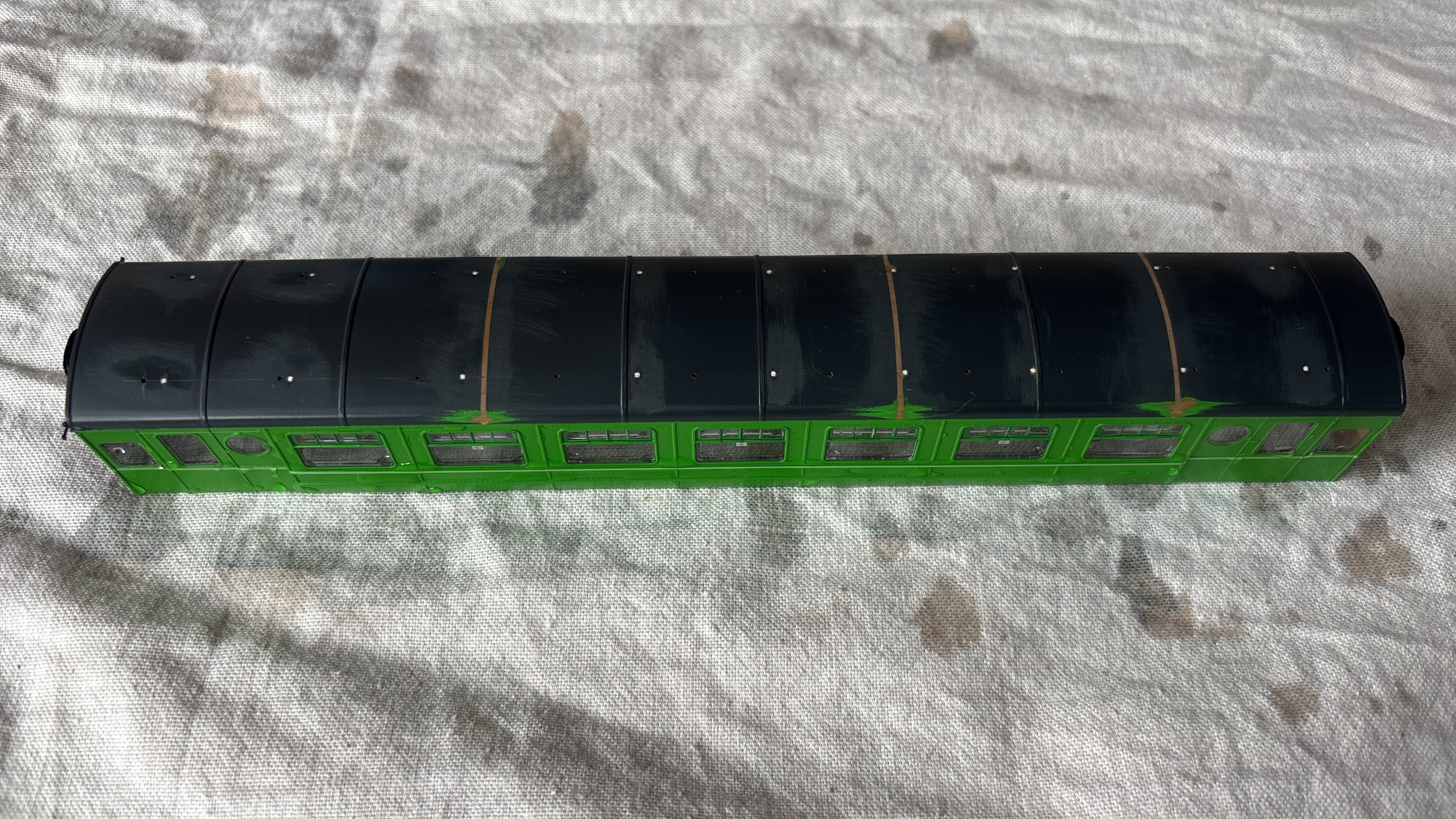
  6. Staying on the subject of the plain dark green livery on the new stock built in the '1950 programme' (actually 1950-1952) We've already seen that the livery of the first batch of compos was described as: They are painted dark green, with no lining or light green band, but relieved by bright aluminium strips round the windows. The roof is also green, with the exception of a narrow black strip in the centre. The livery of the next batch of thirds is not described in such detail and there is no explicit mention of the roof colour, although it looks the same as the body colour when viewed from the side. So this photo dated 9 May 1954 is interesting. In the foreground is one of the 1951 thirds in plain dark green livery, viewed from above. There is a clear demarkation in the paintwork on the roof, which might be the upper edge of the green paint: https://www.flickr.com/photos/irishrailwayarchive/53509198220 I'm not sure the middle part of the roof would qualify as a 'narrow black strip in the centre' - it's actually most of the width of the roof - but perhaps there was a change in the width of the strip between the compos and thirds? Roofs quickly got grubby, and good photos of clean roofs from elevated viewpoints are rare, which means that it's hard to be sure about the original roof colours. However, modellers could reasonably paint them a dirty darkish grey all over without worrying too much about how much was originally painted green.
  7. Very nice! When first built they had nets for catching the mailbags, which would be an interesting addition to the model.
  8. https://onlinepaintshop.co.uk/product/custom-spray-paint-tinted-400ml/
  9. Would you like the Spinach, Avocado or Celery flavour? 226 is Mid Brunswick Green (CIE dark green), 221 is Brilliant Green (as used on the Park Royals and Wedgehead railcars when new, we haven't got that far through the story yet) and 216 is Eau de Nil. They are custom enamel colours, matched to the BS381C colours, and in due course I'll try spraying them with the airbrush. Six 50ml pots plus postage cost a total of £50. The same firm can also provide them as rattlecans.
  10. Roof colours will continue to be an interesting topic as I proceed through the 1950s. For new-build stock, I think black roofs were introduced in 1958. So many of the colour photos of the green era are from around 1960 that our view is skewed towards that period, and we don't realise that things were different in the early and mid 1950s. Getting ahead of the timeline a bit, I don't think anyone could claim these mid-1950s roofs were black:
  11. Eventually all this research will get applied to some models, so I have ordered some paint:
  12. A superb detail! Really nicely modelled and great photos too. If only IE had put so much effort into keeping the baby GMs clean in their later years.
  13. I just stumbled across this album on Flickr which contains some nice Irish railway photos from 1955: John Wiltshire's Irish railway photographic collection 1955 | Flickr The bottom left image here features an interesting combination of a railbus, an incomplete main line Park Royal, and a Pullman!
  14. Excellent, many thanks, that's a great memory! At that time, most of the loco-hauled coaches were as you describe, the dark green with the wider bands of light green (officially eau-de-nil). The plain dark green was introduced in late 1950 / early 1951 and was only ever on a minority of stock, less than 20% of the fleet. The railcars were delivered in dark green with a thin waist line in eau-de-nil, just as you describe, and it looked very smart. That livery was also used on some of the carriages that were through-wired to run with the railcars, and it's the scheme I will describe next. I have a lovely colour photo of a railcar set in that livery, complete with matching intermediate coach. But I need to do a bit more research on the subject first. Later in 1953, CIE started experimenting with lighter shades of green, then a dalliance with unpainted aluminium for new stock, before returning to shades of green in 1958. We have all that to come...
  15. This is what happens when you stop building your models! What kit were you working on again?
  16. Carriages Repainted in Plain Dark Green Finally on the plain dark green theme, here are some examples of older carriages repainted in this scheme. IRRS Journal 9, Summer 1951, stated: All coaches are now being painted in one shade of dark green, and the class is shown on first class compartments only. These older vehicles retained their tarred canvas roofs in a near-black shade - no green roofs here. Otherwise the livery was as shown in my previous two posts; dark green sides with minimal lettering in EdN - just the running number, 1 on the first class doors, and 'GUARD' on his door. They had black ends and underframes. This photo was taken at Inchicore on 5th April 1952, and shows three coaches newly repainted in plain dark green: https://www.thetransportlibrary.co.uk/-/galleries/rail/lens-of-sutton-association/lens-of-sutton-association-irish-railways-part-2/-/medias/d694a9fe-c7f9-4823-9d78-e63ec4c947d9-cie-37m-6-wheel-birdcage-brake-third-coach-and-cie-185m-6-wheel This photo from Ernie dated 5th June 1956 shows several vans and carriages in the plain dark green scheme - no trace of lining or snails here: Seen in September 1956 is former CBSCR compo 54B nicely illustrating the 1 on the first class doors, but the former third class doors are blank: This IRRS image dated 1952 also shows the scheme nicely, on some freshly-painted 6-wheelers: https://www.flickr.com/photos/irishrailwayarchive/53509093359 This is one of the few photos I've found that clearly shows the GUARD lettering on this livery. Note that it is at a lower level than the running number. 12 April 1955 and a nice shot of plain dark green bogie luggage compo 39M on the CBSC: To better illustrate the scheme, some colour images. This photo dated June 1952 shows a carriage freshly repainted in plain daek green at Inchicore, this is Colour Rail IR581 and the image is linked from their website: This photo was sold on ebay, and is also Colour Rail IR329. It shows a pair of MGWR 6-wheelers in June 1953: This photo was also sold on ebay, and is Colour Rail IR393. It shows two plain dark green coaches at Skibbereen on 4th September 1954. We have already seen how this dark green paint often became darker in service: This photo from Ernie is dated 23th April 1956 and shows a couple of plain dark green coaches in the sunshine at Cork: Also from Ernie and dated June 1956, a work-worn plain dark green coach is visible on the left as a new A class shunts gas tanks. Note the 1 digits on the first class doors: In July 1956, this photo at Galway shows the contrast between the former MGWR TPO in plain dark green, and a factory-fresh Park Royal behind. Again this is a colour rail image, FIE05600, linked from their website. I'll come back to this image when we come to discuss the Park Royal livery. This IRRS photo dates from 1959, and unusually shows a plain dark green clerestory coach that has retained the livery long enough to receive '2' class digits where previously the doors had been unmarked: https://www.flickr.com/photos/irishrailwayarchive/53468874554 The plain dark green coaches seemed to linger longest around Cork, and @Westcorkrailway has already posted a few examples upthread. Here are a couple more from Ernie, showing how the aged and weathered plain dark green contrasted dramatically with the light greens of the late 1950s. The first one is dated April 1956 and the second one is circa 1960: However, many of the older plain dark green coaches had been withdrawn by the late 1950s, such as these two illustrated in 'Irish Railways in the 1950s and 1960s' (McCormack) p123; this is dated 1959: I'm sure that's plenty of images to illustrate the livery, but I'll finish with just one more from Ernie. This shows a 1930s GSR third repainted in plain dark green, and behind that a 1950s CIE compo which was built in plain dark green. The date is April 1955: The next chapter of the green livery story will involve the AEC railcars and I will need to do some more research, so please be patient.
  17. How it used to be: https://www.ebay.co.uk/itm/406935521065
  18. Any my very tenuous link to the GNR carriages represented R2D2, C3PO's companion in the films.
  19. Impressive layout, and the sweeping curves look good - hopefully you can still reach the middle? Note to others: although the images don't show in the post, they can be viewed when downloaded.
  20. Nice colour pic of the GSR liveried coach there too! Thank you.
  21. 1951/2 Narrow Gauge Stock Now, let's have a look at the narrow gauge stock. Here I can offer some colour images. IRRS Journal 8, Winter 1950/1, announced that: An order had been placed for four Walker rail cars, with Gardner engines, of the same type as those used on the County Donegal Joint Committee's Railway. These will be used for passenger traffic on the West Clare narrow gauge section. Delivery of them is expected to begin in the Spring. IRRS Journal 9, Summer 1951, had an update: Delivery is expected very shortly of the four Walker Diesel railcars for the W.C. section, and work is well advanced at Inchicore on the construction of bodies for them. Four trailers are being constructed at Inchicore for use with them: these consist of lengthened bus bodies mounted on old T.&D. carriage underframes. Here's an IRRS photo of one of the railcars under construction at Inchicore on 13 August 1951: https://www.flickr.com/photos/irishrailwayarchive/53509100124 IRRS Journal 10, Spring 1952: The four narrow gauge railcars have also been delivered and are numbered 286 to 289. Trailers for use with them have been built at Inchicore, and small luggage trailers at Limerick. At the time of writing, Nos. 286 and 287 have gone to the West Clare section, but are not yet in regular service. IRRS Journal 11, Autumn 1952: The narrow gauge Diesel cars (which have been renumbered 3386 to 3389) went into service on the West Clare section on March 17. Work is just starting on the new carriage bodies for the Cavan & Leitrim Section. Here's a photo from Ernie of a WCR railcar and trailer in use in 1953: Another view from Trainiac on Flickr: And a closer look at a trailer: https://www.flickr.com/photos/irishrailwayarchive/53499205990 Here's the C&L 'bus coach' when it was still pretty new and clean: https://www.flickr.com/photos/irishrailwayarchive/53510377667 So the bodies for the West Clare railcars and trailers, and the C&L 'bus coach' were built at Inchicore in 1951/2, at the same time as the main line coaches described in my previous post. It's no surprise that they received the same livery of plain dark green - this wasn't a local oddity but the standard CIE livery of that period. Because they were all third class, the only ornamentation was the vehicle number. One difference was that these vehicles also had green ends, probably because the body corners were curved and there wasn't a clear demarcation between the sides and ends. From the monochrome photos when these vehicles were new, we can clearly see that the roof was a similar tone to the sides and ends, so it may have been the same dark green. However, the roof domes appear a bit glossier than the rest of the roof. My impression is that most of the roof could have been either dark green or grey, but the roof domes were definitely dark green. Let's have a look at some colour images. On the front cover of 'Lost Lines Ireland' (Welbourn) we see this: 'Irish Railways in the 1950s and 1960s' (McCormack) p148 has this photo: This IRRS photo shows one of the WCR trailers in original livery in colour: https://www.flickr.com/photos/irishrailwayarchive/53570903805 And this photo from Ernie shows the C&L coach in colour: So, when originally delivered from Inchicore around 1951/52, this narrow gauge stock was painted in basically the same plain dark green livery as the contemporary main line stock described in the previous post. Some of the West Clare railcars and trailers later received repaints in lighter green, and by the closure of the line the stock had a piebald appearance. None more so than 3387 which had a light green power unit and a dark green saloon, as seen in this photo from Ernie.
  22. The 1950 Carriage Programme IRRS Journal 6, January 1950, noted: Materials are on order for 25 new coaches, which will be of a new type, for construction in 1950, and it is hoped ultimately to turn out 50 coaches per year. The board authorisation was for 25 composite coaches; what was actually constructed comprised the following: 6 composites 2124-2129 12 thirds 1339-1350 7 composites 2130-2136 All these vehicles had 7 compartments but the three batches were arranged differently. Whilst the ambition was to build these 25 coaches in 1950, followed by a further 50 in 1951, the reality was that it took until 1952 to deliver the initial 25 vehicles. The contemporary CIE annual reports state that the causes of delay were the difficulties in obtaining raw material, particularly steel, together with the effect of an Electricians’ strike at Inchicore. Because these were the first new coaches built at Inchicore since the 1930s, there was considerable interest in them in contemporary publications. There are useful descriptions and photos, although I have only found monochrome images of these vehicles in their original livery. IRRS Journal 8, Winter 1950/51, described the first of the new coaches in detail, including its livery and external details: They are painted dark green, with no lining or light green band, but relieved by bright aluminium strips round the windows. The roof is also green, with the exception of a narrow black strip in the centre. A new type of destination board is provided, which are placed above the end windows instead of along the top of the coach. These are in cast aluminium, with bright lettering on a blue background. Irish at one end of the coach and English at the other. ‘Irish Railways Since 1916’ (Baker) includes a publicity photo of the first batch of compos, dated March 1961 when they were brand new. This shows the plain dark green livery with no lining or snail, as described. The coach ends are clearly black. Reflected sunlight makes it hard to judge the roof colour but it is paler than black and the bodyside colour appears to continue above the cantrail onto the roof. ‘Rails around Cork and Kerry’ (Baker) p12 includes a closeup photo of compo 2125, illustrating the livery more clearly, as well as the destination board. This clearly shows the roof being the same colour as the bodyside, while the underframe and end fittings are black. ‘Irish Broad Gauge Carriages’ (Coakham) p43 shows compo 2124 in April 1952, when it had been in traffic for one year. The roof, ends and underframe are weathered, but the bodyside has been kept clean. The only lettering comprises the vehicle number and a 1 on the first class door. IRRS Journal 9, Summer 1951, includes the following paragraphs: Of the 25 new carriages mentioned in the last issue, about 23 should be in service by the time this journal appears, in spite of delay in the delivery of fittings. All coaches are now being painted in one shade of dark green, and the class is shown on first class compartments only. A few years later, Irish Railfans News 1.2, April 1955, described the coaches built in the early 1950s, including the sentence which describes a change in the construction and panelling of the roof which would permit it to be painted like the body panels: The roofs of the coaches are formed by a continuation of the side panelling, a departure from the pre-war practice of separate tarred roofs. D.Kennedy’s article ‘Modern CIE Coaching Stock’ in IRRS Journal 37, June 1965, was written some years later but is a comprehensive reference. The article describes the constructional and interior details. With regard to the livery of the first batch of composites, the article states: The livery was dark bottle green without bands or lining, but relieved by the bright aluminium window frames. The earlier CIE practice of putting the emblem on either side was discontinued, but there were light green numerals on the 1st class doors. With the introduction of these compos, a new type of destination-indicator was brought into use. These, cast-aluminium with polished letters on a red background, are mounted on the roof rails beside the entrance doors; they are in pairs, one in Irish and one in English, respectively in Gaelic and Roman scripts. Also introduced at this time were the description plates on the coach ends. These small plates, of cast aluminium, show the coach number; type, number of seats in each class; tare weight. Another small oval aluminium plate was affixed to the underframe to show the building date. These features can be seen on the photos included above. The subsequent two batches of coaches are described more briefly; for the third class coaches the livery description is: All the improvements incorporated in the compos. were included, and the livery was bottle-green. And for the final batch, there is a comment: Drab the bottle green may have been, but as late as 1957 some of the 1951 compos. were observed looking little the worse for their long absence from the paint-shop. ‘Irish Broad Gauge Carriages’ (Coakham) p40 shows one of the thirds when brand new, and in the same plain dark green livery. In this case, the only transfers on the exterior of the coach were its running number. In the 1950s, some of these coaches were used on the Belfast-Dublin-Cork Enterprise, and other premium expresses. In an era when the other rolling stock was ancient, they stand out in photos. ‘The Works’ (Ryan) includes this photo of two thirds in a Galway express: ‘Railways in Ireland 1834-1984’ (Doyle & Hirsch) p99 shows a third in a Cork express: Compos 2130-2136 had 4 first class compartments and 3 thirds (reversing the proportions of the earlier batch). ‘The Railways of Ireland Past and Present: Dublin’ (Baker) includes a couple of good photos of these vehicles in service on the DSER in the mid 1950s: From ‘Dublin Railways Past and Present (Baker) p115, this photo dated June 1956 shows one of the 1952 compos in a train on the Cork main line; the plain dark green stands out in comparison to the adjacent buffet car. (Note: the apparent line on the lower bodyside is a reflection of the adjacent rail) Ernie’s collection on Flickr includes this view of a compo in an excursion train leaving Cork for Youghal: There are many more photos of these carriages in the IRRS albums, but I think I've probably got enough in this thread to provide a comprehensive illustration of their livery. I believe that this 1950 plain dark green livery used the same dark green colour as the 1940s lined green scheme, i.e. BS381C 226 Mid Brunswick Green. In some photos it looks a little lighter, but I suspect that was influenced by the vehicles being newer and their flush sides more easily cleaned. It’s possible that different primers/undercoats used on the steel body influenced the topcoat compared to the older wooden-bodied coaches. Transfers were used for the running number digits and 1 class designations. On the 1940s lined green livery, the running numbers were in dark green on the EdN waistband. However, for the 1950 plain dark green livery the numbers were in EdN, with a 1/8” gold outline. The transfer drawing 26848 includes a special note about this colour change for the 1950/51 carriages and the railcars. I believe that the aluminium dimension plates and builders plates were red. In later years they certainly were. Most of these coaches retained their original livery for around 6-7 years, but were repainted in the late 1950s into lighter green schemes. P.S. Colour Rail image FIE4506, linked here from their website, shows one of the first batch of compos still in original livery on 28th July 1959: https://colourrail.co.uk/search/world-railways Next I will look at the narrow gauge stock which were painted in this scheme, followed by the older main line stock repainted in plain dark green.
  23. 1950 Plain Dark Green By the late 1940s it was clear that the formation of CIE as a company had not solved the financial problems of its predecessor the GSR. If the railway was to continue in any form long-term then significant investment was needed in new traction and rolling stock, and the railway need to become more efficient to reduce costs. In February 1949 it was decided that nationalisation was the proposed solution to the funding problem. but it took several years to implement and the new nationalised CIE board took charge on 1 June 1950. In the meantime, external consultants from England had been employed to recommend what the new investment should buy. The Milne report of 1948 proposed a fleet of diesel railcars for most passenger services and a batch of 50 new-build steam locos for freight (similar to what happened on the newly nationalised British Railways in the early 1950s). CIE’s own plan looked west to American technology, proposing complete and rapid dieselisation with a fleet of diesel-electric locomotives. Whichever route was followed, it was clear that the life-expired and disparate fleet had to be renewed. The Chief Mechanical Engineer’s role at CIE had been vacant since 1944 with responsibility shared between other staff. O.V.S. Bulleid, CME of the former Southern Railway, had been involved in the Milne report and on 1st October 1949 he was appointed ‘Consulting Mechanical Engineer’ to CIE at Inchicore. This was a holding position while the nationalised CIE board was formed, and in February 1951 he was confirmed as CME, a role he held until retirement in May 1958. Bulleid was to have a significant influence on rolling stock design and livery through the 1950s. [It is worth noting here that some published sources state that Bulleid came to Inchicore in 1954. That is incorrect. In 1950 memos are from J.J.Johnston, assistant CME, but after Bulleid’s formal appointment in early 1951 they are from O.V.S.Bulleid, CME.] In June 1950 the new CIE board was in place and the 1950 Transport Act had allocated £7 million of government funding. While they developed a longer-term strategy, the board quickly approved expenditure on small numbers of new carriages and diesel railcars. New rolling stock authorised by 25th October 1950 was as follows: Later in 1950, 4 narrow gauge diesel railcars were authorised, and in 1951 the order for main line railcars was increased to a total of 60. By March 1951, a total of £2.4 million had been committed to rolling stock renewal. The plans for carriages were to change significantly as we shall see in due course. The new board was tasked with modernising, improving efficiency and cutting costs. When planning budgets for the new rolling stock I can imagine questions being asked about the number of large transfers then being applied to every repainted carriage, and the skilled labour cost of painting the elaborate lining in 3 colours. The board probably also wanted to portray a modernised image to the travelling public. The new CME had come from the Southern Railway where the carriage livery was plain unlined green. I can’t say for sure, but it’s likely that these factors influenced a revision of the CIE carriage livery in 1950. I will present this livery as it was applied to: The first 25 new carriages built at Inchicore, nominally in the 1950 build programme Narrow gauge railcars and trailers, with bodies built at Inchicore Existing older main-line carriages repainted I’ll consider each of these groups in subsequent posts.
×
×
  • Create New...

Important Information

Terms of Use