.png.c363cdf5c3fb7955cd92a55eb6dbbae0.png)


Mol_PMB
-
Posts
3,870 -
Joined
-
Last visited
-
Days Won
239
Content Type
Profiles
Forums
Events
Gallery
Blogs
Everything posted by Mol_PMB
-
Superb presentation of the layout - I love the red and cream finish. Sorry I won't be there - I'll be in Cork next weekend instead.
-
Ah - an Optimist!
-
Either that or they got mixed up with that other historical product of Park Royal. After a few of these on 17th March who can blame them?
-
Agreed, it's been a while! Three of the 16 SKUs are now showing as sold out on the Accurascale website, though I didn't notice them go through the stage of 'only 10 remaining' that I recall on some other product lines in the past. Any photos of what was in that batch of boxes that you posted on 29th January?
-
When I was asked to build a kit for someone else I tried to work out how much I would charge based on: Number of hours it would take me (could easily be 50 hours - depends on the kit of course, and whether painting and finishing is included) Hourly rate (it's skilled work, so probably somewhat higher than minimum wage) multiplied by the number of hours Cost of materials I would use (solder, glue, paint, wheels, couplings, electricity, consumables like abrasives, maybe motor, gears etc., maybe DCC chip, LEDs for lighting etc., could easily total hundreds) People who do this for a living may have developed quicker, more efficient ways of building and painting models than I have. There's also a debate as to whether it's a 'straight' build of a good kit, or whether extra work or parts are required to achieve the desired standard of finished model. I quickly worked out that a price that seemed so high that I couldn't credibly ask it! So I declined to build the model. I can earn a much better rate in the day job and I want to keep the modelling as a hobby not a chore.
-
Ardglass Station, 17-03-26
Mol_PMB replied to Patrick Davey's topic in Photos & Videos of the Prototype
That would make a lovely terminus for a preserved railway... -
Weren't some of the GSWR 2-4-2T locos built for this line? Though it does seem that J15s were the preferred traction for most of the line's life. For the last few years it was mostly C class with a few railcar sets on special trains. Valentia Harbour is very modellable, and Mountain Stage has such an evocative name! Some of the sections through the hills would make a dramatic model in the landscape if one had the space.
-
Indeed, broadly twice the price of the 4mm scale Hunslets (assuming the price is DCC ready rather than full-fat sounds) is good value for a much larger loco. It also compares well to the 88DS in O gauge. C class would be a good choice in 7mm I think, they're pretty small and well suited to short branch line trains and shunting. Personally I'd buy four, maybe five C class in 4mm scale, but probably only one in 7mm scale. Collectors/completists may want to buy one of everything (and I'm very grateful they do!) but at twice the price during a time of generally higher living costs there may be a point where the quantities don't stack up. IRM/AS will be much better placed than me to know how the sales numbers work out. There must be some saving in producing a model of the same prototype in two different scales - Dapol have done this with some recent releases which may be an interesting comparator- for example the Hawthorn Leslie 0-4-0ST and the GWR 14xx.
-
Underframe artwork in progress, a few more bits still to do on this:

-
There are over 300 here in the IRRS Flickr archive, covering a variety of eras. The older ones mostly wouldn't have changed much until the 1970s (except where stations/lines closed of course) https://www.flickr.com/photos/irishrailwayarchive/albums/72157713849028667/ You'll need to be an IRRS member to see them. Old large-scale maps are a good source of info too.
-
Probably 20 years ago, this was as far as I got with converting an Atlas O SW1200RS to a 141 class. I've just dug it out and placed the bits on my MSC O gauge layout: The Flexicoil bogies on these SW1200RS models weren't exactly the same as the Irish baby GMs, but they were a lot closer than the other options. Actually, for an Irish loco that would suit my MSC layout, I think the A class, C class and B101 class were all shipped from Manchester docks:
-
Agreed. And the fact that an 071 isn't such a credible loco for a micro layout. By the time they were built, wagonload traffic and shunting was dying and certainly wasn't a task for the brand new express locos.
-
White spirit will clean enamel from brushes. For the spirit, ideally use a glass jar (with metal lid) that is wider than it is tall, to reduce the risk of it being knocked over. You can re-use the same spirit many times. Other options include enamel thinners (often more expensive, I use it for spraying enamels) or cellulose thinners (often contains more harmful ingredients). As with all chemicals, read the label and obey the warnings as many of these are bad for your health and highly flammable.
-
Together with the existing 88DS and a Bulleid corrugated open, I can foresee a flush of O gauge beet factory layouts! It would be nice to see an IRM G611 class in 4mm scale too.
-
I agree about the impressive shelf loco not necessarily being the optimum for a small layout. For myself, in O gauge I'd probably buy a smaller Irish loco if it was offered by IRM, and run it on my existing O gauge UK-outline layout. But I'd be looking for a shunter, C class or 141 - nothing bigger. I've already got an AS 88DS which would be the easy option for IRM. I probably wouldn't buy an express steam loco just to put on a shelf. However, I appreciate that sector of the market exists and may well have more purchasing power than I do.
-
Newly posted by Ernie, the leading coach here is one of the 50' brake open thirds described a few posts up. Work on the artwork for the full third is progressing gradually when I get the chance. The body sides and ends are nearly done, but I haven't started on the underframe or roof yet.
-
IRRS Journal 212 (Oct 2023) page 344. It's 801, pictured at Mallow in May 1962, '... having worked a trial train from Cork to evaluate the locomotive's performance following its boiler re-tubing. No. 801 latterly operated on the joint IRRS/SLS/RCTS railtour on 5 June 1962'. The train comprises a tin luggage van, a Park Royal, two older bogie coaches probably of GSWR origin, and a fifth vehicle which is indistinct but might be a 6-wheel van. So I'm not sure if that's of interest or not - it isn't the railtour itself perhaps too late for you anyway. There are other images of 801 in 1962 from the same photogapher here, but not the one at Mallow with a Park Royal: https://www.flickr.com/photos/irishrailwayarchive/albums/72177720314948147/
-
Some pages back, was someone looking for a photo of an 800 hauling a Park Royal? I have found one. So you can put away your Rule 1 and get buying!
-
Another one for the collection:
-
"Voiding the Warranty" - Mol's experiments in 21mm gauge
Mol_PMB replied to Mol_PMB's topic in Irish Models
This is where I’m up to with the sleeping car - glazing added and the main parts just posed together. I do have a spare copy of the etch with bodysides and roof for the full brake and the sleeping car, if anyone else would like to make one. You would need an SSM 6-wheel coach kit as a starting point to provide the underframe, ends and many smaller details.
-
I once did a Big big Hymek and Mk2 coach in Irish livery as a spoof, like you suggest. I don't have them any more. At one stage I tried modelling in 1:51 scale (about 6mm:ft) on 32mm gauge track, did a few wagons, a carriage and started a diesel. But it was a dead-end really, the non-standard scale was harder work than a non-standard gauge. Having said that, O scale does vary between countries (1:43.5, 1:45 and 1:48) and the 1:48 American scale wasn't far off what I was using. There are some very nice examples of proper 7mm scale Irish models on the forum, mostly from the steam era but not all.
-
Looks great - a huge improvement on factory-fresh paint! I particularly like the spillage on the flat surfaces. What techniques did you use?
-
"Voiding the Warranty" - Mol's experiments in 21mm gauge
Mol_PMB replied to Mol_PMB's topic in Irish Models
Thanks! Everything looks better in the sunshine too. I'm looking forward to the downsized Alphagraphix MGWR 5-wheel coaches to go with them - adding an MGWR third and brake third will make a great little train. Hopefully I'll get the sleeping car finished this weekend (apart from the interior details which need more research). -
"Voiding the Warranty" - Mol's experiments in 21mm gauge
Mol_PMB replied to Mol_PMB's topic in Irish Models
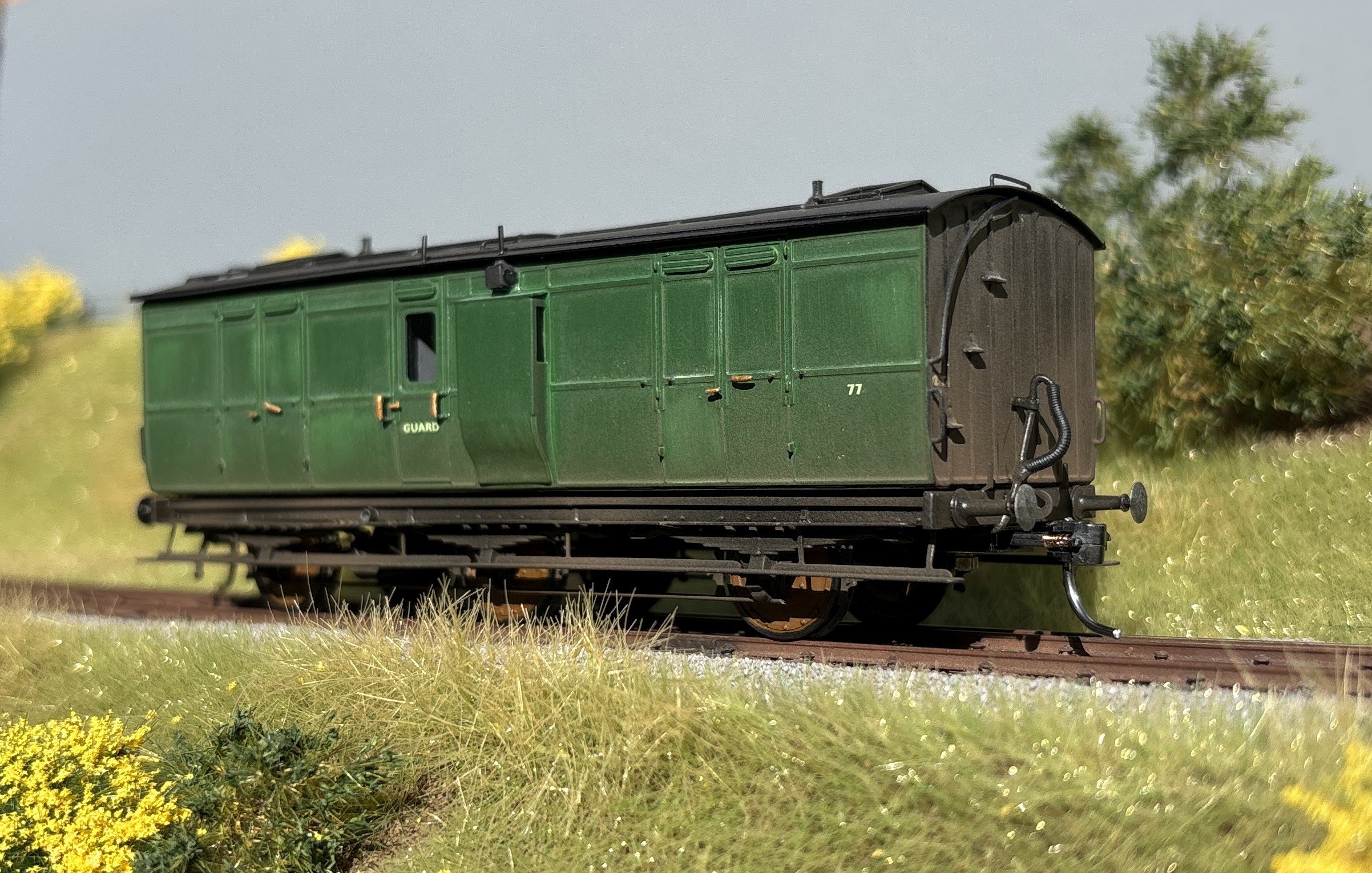
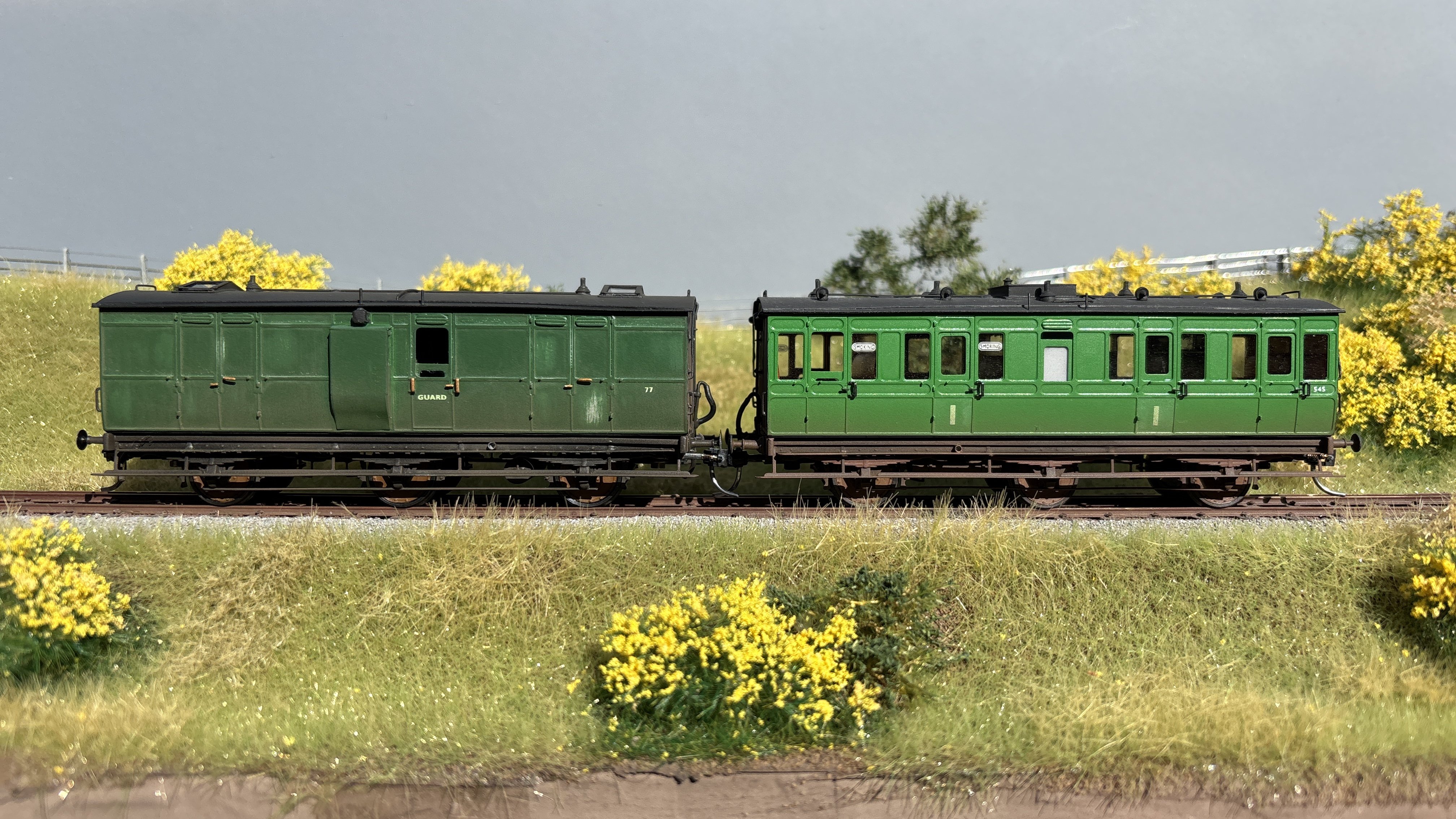
The full brake is now just about complete in tatty dark green livery. Seen here with the lav compo I built previously. This photo from Ernie shows a different type of coach but helped to inspire some of the worn areas of paint on the model, which is not quite so badly worn: The sleeping car isn't too far behind.
-
The model is now just about finished. It may benefit from a touch more weathering on the chassis and roof to better match the decrepit condition of the body paintwork. This is a vehicle at the end of its life around 1960 - last repainted in plain dark green in the early 1950s. New tin vans have replaced most of these and the few survivors are not worth a repaint as the branch lines they serve are about to close.
- 20 replies
-
- 18
-

-