.png.c363cdf5c3fb7955cd92a55eb6dbbae0.png)


Mol_PMB
-
Posts
3,870 -
Joined
-
Last visited
-
Days Won
239
Content Type
Profiles
Forums
Events
Gallery
Blogs
Everything posted by Mol_PMB
-
Never you mind, lad! And if anyone asks about a consignment of beer that went missing in County Down last week, you know nothing!
-
Very nice! The Ratio coach kits are now part of the Parkside / Peco range and are still readily available, though you will probably need to get from a GB supplier. As well as the LNWR ones they do some Midland and GWR coach kits. I think SSM do the Irish Shell decals - that Oxford Rail tank wagon looks spot-on.
-
how much would it take to fix up the tralee to blenervile
Mol_PMB replied to irishrailways52's topic in General Chat
In happier times - the one occasion I travelled on the line: -
FDM printed roofs for Worsley Works Laminate Coaches
Mol_PMB replied to Mayner's topic in Irish Models
As well as the bogies, the entire underframe from the Park Royals would be very useful, as it was used under many other types of carriage. The distinctive triangulated framing, including and solebars that are not straight but have several kinks in them, is often simplified in the existing models and kits. -
"Voiding the Warranty" - Mol's experiments in 21mm gauge
Mol_PMB replied to Mol_PMB's topic in Irish Models
I had difficulty with those old jars but succeeded with some heat. I think I put half an inch of boiling water in a dish and then put a jar upside down into that so that the cap was heated. Then dried it off and it was possible (though still stiff) to remove. On the other hand if a vacuum is the problem then immersing the while jar in boiling water for a few minutes should help. Be careful and don’t sue me for scalds or paint splatters! -
Murphy 073: https://ebay.us/m/7iVCZj
-
"Voiding the Warranty" - Mol's experiments in 21mm gauge
Mol_PMB replied to Mol_PMB's topic in Irish Models
Agreed, they call it Brunswick Green. But that same name is used for many other sorts of green, often with a much more brownish shade. And I'm not sure that all Humbrol shades have been consistent over the years either. Here's a shot of the full brake body under layout lighting and compared to the A class in light green: The plain green livery really was very plain, there are only 6 small decals on the whole vehicle (one on each end too). And it's prototypically correct that they don't line up! I think I'm going to do the horsebox in the same dark green, that will at least have a snail to decorate it. It would be interesting to compare this shade to the IRM loco or Hattons coaches produced in dark green, but I'm happy with it for now. For my modelling period it's a livery that would be at least 6 years old and quite worn/weathered. That stage is yet to come on the model.
-
"Voiding the Warranty" - Mol's experiments in 21mm gauge
Mol_PMB replied to Mol_PMB's topic in Irish Models
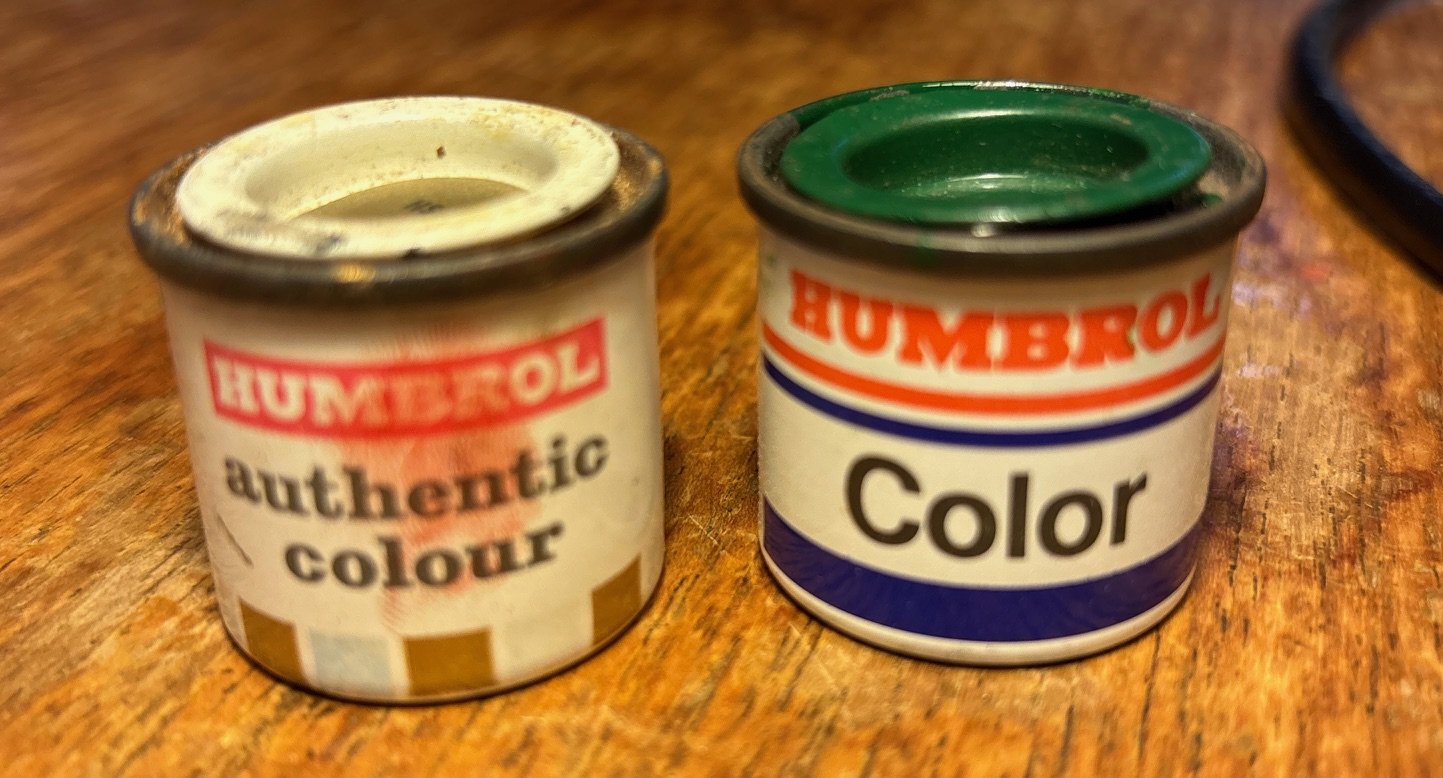
Thanks! Much less science applied to choosing the paint this time, it was a case of looking in the paint drawer and picking something that looked about right, then seeing if there was still liquid inside. Having been modelling for 40-odd years I've got quite a stash, many untouched for decades and in variable condition. I recently discovered this website which helps me work out how old some of these paints are: https://robdebie.home.xs4all.nl/models/humbrol.htm So, to answer your question, the green is Humbrol 3, dating from the early 1990s. I thinned it slightly for spraying with enamel thinners. However, the brass for the door handles is Humbrol HS230, dating from the late 1970s - this must have been old stock even when I bought it as a kid! I had used a bit of each back in the 1980s, but they were both still in excellent condition when shaken and stirred. In my experience the newer Humbrol paints are much more likely to skin or solidify in the tin. I reckon the green isn't too far off the colour you get when the prototype is well-lit: In my view it's nicer than the MIR / Precision CIE green colour which is much duller and more blue, perhaps 'weathered paint on a dull day' appearance.
-
That's very nice indeed and useful to show the different stages of construction, detailing and painting. Good work!
- 69 replies
-
- 2
-

-

-
- o gauge layout
- irish outline
- (and 2 more)
-
"Voiding the Warranty" - Mol's experiments in 21mm gauge
Mol_PMB replied to Mol_PMB's topic in Irish Models
The last couple of weeks have been busy, with a few days in Ireland and busy times at work with several days travelling to see clients. Not much time for modelling. But I've been at home this weekend and have been tackling the backlog of half-finished projects. The two 6-wheelers are now well progressed in the paintshop. The roofs, underframes and bogies are complete, primed and painted in black, ready for weathering to commence. The full brake body, with little interior detail to worry about, has progressed straight to topcoat paint. It is finished in a representation of early 1950s unlined dark green livery. I had the eau-de-nil transfers for this printed already. This closeup shows a few wrinkles in the paint, but hopefully once it's matt-varnished and weathered these won't be so obvious: The sleeping car body is lagging behind a bit because the visible parts of the interior need to be painted before the exterior. Most of the droplights and windows were frosted, but the central part had clear windows on one side so I need a representation of the interior there. The vehicle I'm modelling had more of its windows frosted than most sleeping cars, and looking at photos of other similar coaches I've worked out a plausible interior layout. Referring to the model image above, my guess is that three former compartments were bunkrooms, two at the left-hand end and one at the right-hand end. You can see parts of the upper bunks on the right-hand coach in this photo: https://www.flickr.com/photos/irishrailwayarchive/53511443501/ And in the nearest compartment here: https://www.flickr.com/photos/irishrailwayarchive/54251290821/ I think these bunk rooms were connected by an internal corridor on the opposite side with a horizontally-planked partition that can be seen through the open door here: https://www.flickr.com/photos/irishrailwayarchive/53507984227/ And through the windows at the near end here: https://www.flickr.com/photos/irishswissernie/5961249977/ Between the bunkrooms I assume there was a central messing area which would probably have had a table, benches, perhaps a kitchen counter with sink and gas hob? That is plausible when compared to the photos, but does not leave much space for a toilet/washroom. These vehicles had 3 roof-mounted water tanks which suggests there was more use for water than just a sink in the kitchen. I don't suppose @Westcorkrailway knows a man with any gen on the interior layout? Next, I now have the components needed to complete the horsebox and that has progressed some more, with the ends and W-irons fitted. Again, a cruel closeup. Plenty more to do on this, but it's starting to look the part. The last items on my custom etch were some scenic items for the Quartertown Mill layout. I had tried making a weighbridge with the laser-cutter which was OK, but I decided to modify the artwork and try it as an etch, which is much better. Also I did some cosmetic point levers of they type that are set flush into the ground, and some grids for the grain hoppers to discharge into. These are all now being painted, but seen here in raw metal:
- 822 replies
-
- 12
-

-
Not a model but a slide of an unusual UTA vehicle - anyone know what the origins of this CCT were? https://www.ebay.co.uk/itm/397685364784
-
Many thanks Ernie! Some wonderful shots showing the variety of wagons in use in 1960. There are several GNR, GSR and GSWR wagons and vans visible, it's not all IRM Bulleids.
-
I’m sure grey vans would be a valid option too: https://ebay.us/m/XfX3JW One of several nice CDR images on ebay at the moment, here’s another: https://ebay.us/m/rZMBVp But not railcar 8 I’m afraid.
-
Looking superb already!
-
One was parked outside Fairview depot last weekend, fully visible from passing trains but not from the lineside.
-
The baseboard and framework look super now they're painted, and the locos are right at home. I have fond memories of those baby GMs! 071s do come up occasionally on eBay, not always at stupid prices. I hope you've got your eye on this one (be quick!): https://www.ebay.co.uk/itm/168197149458 We'll have to wait and see whether there is a future batch of 071s.
-
New arrivals! Very pleased to see some of my comments addressed including the end details and the Morton brake clutch. Thank you IRM! I’ll try to get some better pics later.
-
Attached, a list of links references to over 200 G class photos. There are many more out there no doubt, I see I haven't trawled my library or the NLI for this list (though I did do so when preparing the livery matrix), but these are the ones I've listed so far. Also you'll have seen these, no doubt: https://catalogue.nli.ie/Record/vtls000305876 https://catalogue.nli.ie/Record/vtls000305875 The G617s were painted BnT with large numbers (no roundels, the roundel hadn't been invented yet) before entering service. G611, G614, G615 and G616 were later painted black without the tan band, and had a roundel on the cabside with a small number below. There were differences in the exact position of the roundel. G614 was withdrawn much earlier than the others. G612, G613 and G617 seem to have kept their original livery throughout their lives. They didn't have roundels added later (NB some E class did, on this livery). G_class_photolist.xlsx
-
I can easily knock up some etch artwork. In fact I think I have already drafted out a couple of Irish W iron types. I do need to clear the decks a bit first though as I have a bit of a backlog of projects on the go.
- 40 replies
-
- 4
-
-

-
- ready to run
- cie
- (and 4 more)
-
I tried to buy some of the 21mm gauge W irons from Des last year. When they turned up they were normal OO gauge ones which weren't anything like wide enough for 21mm. I could have bought them much more cheaply and quickly from other sources. Sigh. At least they turned up eventually, unlike my more recent order paid for in January which I must chase (again).
-
Stunning! Just shows what a lot of skill and a bit of time can achieve. You now need to add an extra lever and interlocking in the signalbox so that the turntable cannot be used when a train is signalled on the adjacent line…
-
I have updated versions of all of the livery matrices at home, as I keep adding to them as I find more photos. When I get a chance later this week I'll post a more complete version. I also have a spreadsheet with links/references to many photos of the class. Note that one source says that G602 was green, but this is disproven by photos showing it still in silver in summer 1963. Some sources say all three G601s were green, I can't disprove G601 but I'm fairly sure it went straight from silver to black like G602 did. In general, large numbers near the middle of the cabside of a shunter (or the middle of the bodyside of a main line loco) are a pre-roundel livery. Small numbers at the bottom of the bodyside would normally be used with a roundel. As ever, there were a few exceptions.
-
It’s complicated and I’m away from home at present so don’t have access to my records. I did a G class livery matrix which is somewhere on this forum. Looking at the bigger picture: BnT without roundel from late 1961. On A/B101/B113/C class locos the tan band was deep. 141s and shunters always had a shallow band. Then black, around 1963, a few early locos without roundel but most with. 141s later gained roundels as did 181s. Late 1960s, some black main line locos got yellow ends. Late 1960s A and C class rebuilds, BnT with roundel. The first few locos rebuilt had a roundel with a deep tan band, but most had the shallow tan band. many locos missed out one or more liveries.
-
After watching it I had an offer of 400 on this. Still not interested despite being fresh off an excellent RPSI railtour.
-
FDM printed roofs for Worsley Works Laminate Coaches
Mol_PMB replied to Mayner's topic in Irish Models
I’m interested. I think I’d want to see what the surface finish is like, and the smoothness of the curved surface, before committing to more than one. Also I note that the rib arrangement was different on each coach type, so an option without ribs might be useful. This would also make it much easier to sand down any surface imperfections.