.png.c363cdf5c3fb7955cd92a55eb6dbbae0.png)


Mol_PMB
-
Posts
3,869 -
Joined
-
Last visited
-
Days Won
239
Content Type
Profiles
Forums
Events
Gallery
Blogs
Everything posted by Mol_PMB
-
There's a fairly decent dimensioned diagram of the GSR railcars in the IRRS archive, which I have a scan of. They were numbers 354, 355, 356, 357, all built in 1927. 355 and 356 seem to have survived to at least 1942, but had been withdrawn by 1950. The other two went earlier. They were similar to the contemporary Diagram 88 LNER vehicles, but I think the Heljan model represents a slightly later variant - Diagram 96/97.
-
I just noticed this over on RMweb: Frying Tonight: LNER ‘Chip Vans’ Sentinel Cammell Railcars Join The Heljan 00 Range - Heljan - RMweb I wonder if we might see a GSR version? They had 4 similar Sentinel railcars, though they weren't identical.
-
I've just had a look through the transfer sheets I have accumulated over many years, and found a 7mm scale example of this one: GNR & ECJS coach insignia (Special Vehicles need 1 sheet per vehicle side) transfer In 7mm scale the smaller numbers are 3.5mm high and the larger numbers are 4.2mm high (both including the shading). My J26 bufferbeam is 3.2mm high so they're a fraction too big, I might be better off with the 4mm scale equivalent. But the styling looks pretty good. I wonder if these might also be suitable for @16miller's CDR stock? They're not cheap...

-
Photographic Website Updates
Mol_PMB replied to thewanderer's topic in Photos & Videos of the Prototype
The developments at Galway are very impressive - many thanks for recording this and sharing the photos. -
That looks excellent and I agree with your interior arrangement in the coach portion - very plausible.
-
Thanks For the numbers on the tank the Railtec ones have the wrong font for my prototype. I may use custom transfers but I am considering laser-cutting a stencil and spraying them. I think that may help me replicate the very worn and faded numbers that 559 had. But the bufferbeam numbers are much more fancy with multicoloured shading. I was wondering if there’s something suitable commercially available, maybe intended for a GB railway?
-
Excellent! I have some catching up to do. I should probably have done the same with the rivets. What are you planning to use for the bufferbeam numbers?
-
Satellite cameras not quite so sharp back then!
-
The contemporary Sprinters were a good train for both commuter and rural services and are still earning their keep on such duties. I've no complaints about a class 150, I was on one yesterday and probably will be again this evening and tomorrow. Even the prototypes are still in service - here's my snap of 150002 at Huddersfield on Monday this week, now 42 years old: But the 142s were just dreadful. In their early years they had a host of mechanical problems and the 'cheap' advantage was soon lost when they needed new engines, transmissions, doors etc... None of that solved the cheapness of the passenger accommodation with 2+3 seating crammed into a narrow bodyshell with no legroom, single-glazed windows with inadequate insulation, heating and ventilation, not enough doors, terrible ride quality, and just simply not big enough. An effort at heating was made by piping the engine coolant circuit up to the roof pod, but it used to leak and the floor would sometimes be a puddle of blue coolant. It soaked into the seats too, which wasn't always obvious on the dark blue moquette - until you sat down. The roofs leaked and they often had a horrible musty smell with moss or mould growing inside. Once I even saw an 8" high seedling flourishing in an inaccessible damp corner inside the vehicle! In the later years internal repairs usually involved gaffer tape, cable ties and if you were lucky, self-tapping screws inserted with a hammer. The only people who liked them were the Newton Heath fitters, officially because they were so basic that there wasn't much to go wrong. But the real reason was because they could rearrange the seat squabs into a bed and sleep through the night shift. I'm sure that had nothing to do with their deteriorating condition. I see that AS have mis-spelt 'Horrors' in the thread title.
-
I will concede that. One of the many bad features of the 142s for commuter services was that they simply weren't big enough, and were usually badly overcrowded to the point of leaving people behind to wait for 30 or 60 minutes for the next one. And I gather the same was often true on the CIE suburban services in the dark days pre-DART. When they were that full, 142s stopped being 'bouncy castles' because they were hard down on their bumpstops and every irregularity in the track was transmitted directly into the bodyshell. Personally I don't have the mental scars of the 1970s push-pulls and with the benefit of my rose-tinted spectacles I'd be delighted to buy models of AEC railcars and C class locos!
-
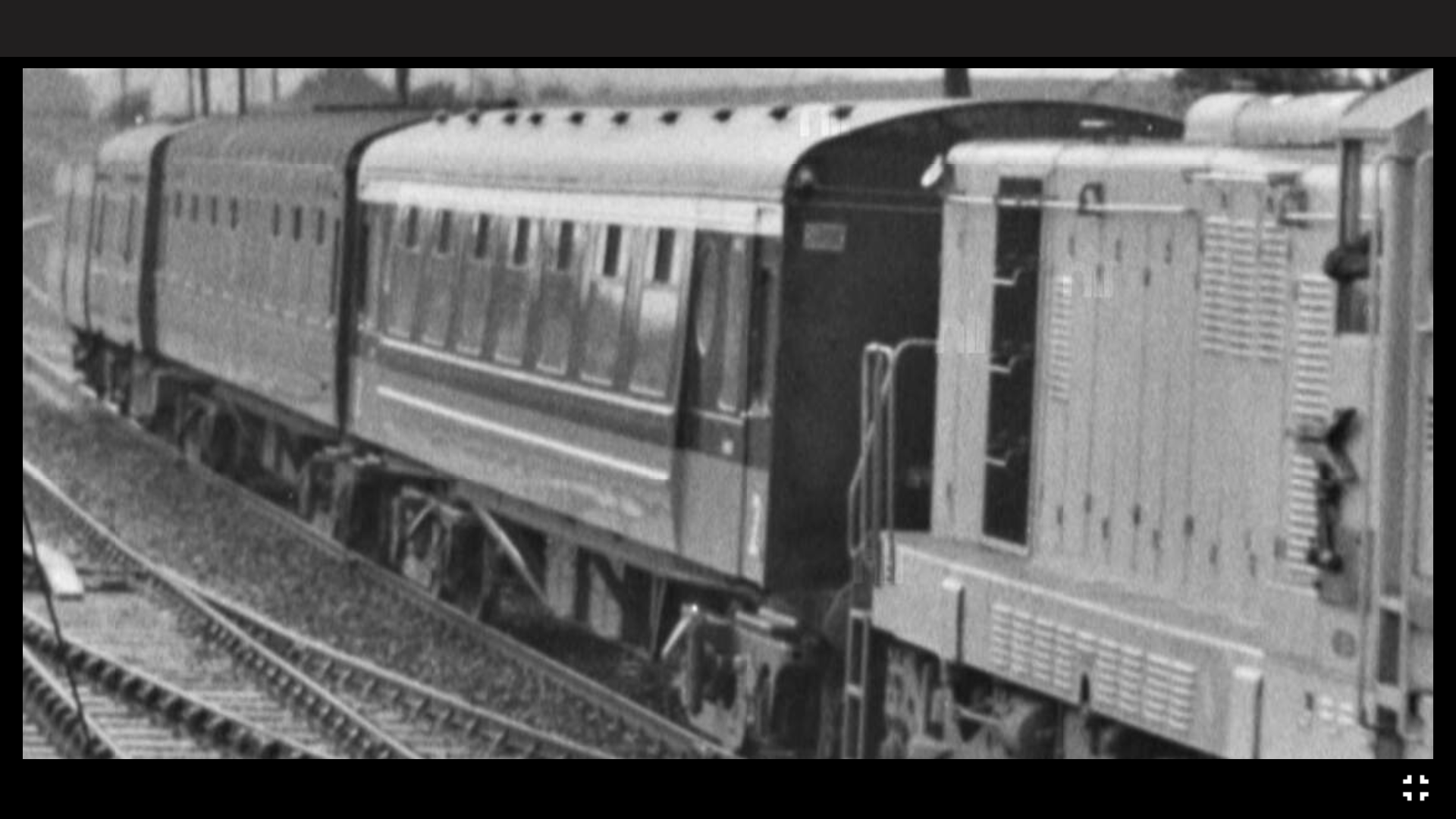
Agree with John. In the green era there were often one or two Park Royals in a train but mixed with other types. This was partly because Park Royals were only a small fraction of the overall fleet, but also because the majority had no toilets, there were none with first class, and to provide facilities for the guard they needed to run with a luggage and/or heating van or an alternative brake vehicle. This photo from Ernie dated 1955 shows three Park Royals in a suburban train at Bray. But there's also a CIE-built composite, and behind the water crane is, I think, a GSWR 50' arc-roof brake third. On the very back, a fitted goods van of some sort. Here are some other suburban trains in the green era, also from Ernie's archive, which include one or more Park Royals:
-
Early Black and Tan Livery (late 1961, early 1962)
Mol_PMB replied to Mol_PMB's topic in General Chat
An interesting paragraph from the October 1961 edition of Irish Railfans News: Colour Scheme CIÉ’s quest for more attractive colour schemes, which has been manifest on both city and provincial road vehicles during the past year, has now extended to the railways. Already several vehicles have been painted in a new and startling livery and to date the following have been noted: Loco A8, Coaches 1340 and 1403, HV 3104, and LVs 2761 and 2764. The basic colours are black (roof, uppers and bogies) and golden brown (lower panelling) with a 6” white line just above window level. On the loco front this line is carried up to a point and the brown is carried down in a “V”. The brown band is from the bottom of the waist panel to about 6’ from rail level but has no line dividing it from the black above. CIÉ states that the special train to Killarney for the President on October 23 will bear the new colours but this, it is learned, will be a railcar set including a buffet and Saloon 351 - the Cardinal’s coach of June 20, again repainted. At the time of writing the final arrangements for the special are not quite clear but it appears that it will form part of the 18:55 to Tralee as far as Mallow if not for the entire down journey. Although CIÉ announce that the Presidential train will be the first to bear the new colours the individual vehicles mentioned above are already in traffic. This is from the RPSI online versions which I think have been scanned using character recognition software. I haven't seen the original print but I think there's the chance of some misidentified numerals here. In this thread we've already had photos of 351, 1340 and 1403, but the first loco in this livery was A6 (A8 was still silver in 1962). We have a photo of tin van 2754 in early BnT, possibly 2764 listed above is another OCR error. The following issue, January 1962, includes further references to the new livery, in two separate paragraphs: The conversion of AEC railcars to “powered intermediates” is almost complete. Three of these - 2614, 2617, 2656 - are to be renumbered 2666-2668 to conform with the numbers of the other “powered intermediates”: 2660-2665. 2668 has been in traffic since October 23 in the new livery and bearing her new number. Although still in Inchicore Works, the railbus (2508) is scheduled for scrapping. It now appears that the brown, black and white livery described in our last issue has been adopted as standard, as several coaching vehicles have appeared so painted. These vary from main line coaches, the President’s train, several older wooden panelled coaches (including ‘secondary’ stock), ex GNR railcar C608N (painted in the Dundalk Engineering Works), heating vans, luggage vans and even six-wheel van No.18! On October 23, the President of Ireland travelled by the 18:45 train service to Killarney, en route for Kenmare. In honour of the occasion, the Kerry portion of the regular 18:45 train was marshalled that evening as a separate train running in a path 10 minutes behind the 18:45 as far as Mallow. To accommodate the Presidential party the State Coach No.351 (last used to convey Cardinal Agagianian from Dublin to Cork and back on June 20 during the Patrician Year celebrations) was included in the train and was completely repainted in the new CIÉ livery of black, golden brown and white. Indeed, the entire train was adorned in the new livery and was made up as follows: composite railcar 2628, powered intermediate railcar 2661, buffet 2419, powered intermediate railcar 2668, State Coach 351, diner 2402 and compo railcar 2609. The same set, forming the 08:00 ex Tralee brought the Presidential party back from Killarney to Dublin on October 25. President de Valera again journeyed by rail on November 8, when his party travelled from Dublin to Cork on the 18:45. The train set on this occasion was identical to that provided for the earlier journey to Killarney; the railcar train being hauled by loco B123. We've seen photos of 18, 351, 2609, 2628, 2661, and two other powered intermediates upthread (one of the latter presumably 2668), but it's interesting to see that 2402 and 2409 also gained this livery, as well as C608N. The April 1962 edition notes A31 and A6, the same two locos illustrated upthread: Loco A31 has appeared in service in the new CIÉ colours of black and brown, similar to A6, but almost simultaneously A16 has been reported repainted in the former silver livery! There is also mention of the livery being applied to more coaching stock and railcars, but I think by this time the dimensions had been changed to the 'standard' BnT rather than the early variant which this thread focuses on. Although complete, none of the new composites (2176-79) has yet appeared in traffic. 268N - the renovated ex GNR diner - is expected to go into service on the 09:15 Dublin-Belfast on April 2 although, as it is fitted to work with AEC railcars only this presupposes the substitution of such cars for the BUT set at present on this turn. The principle alteration in 268N is the fitting of a new modern cocktail bar. An increasing number of coaches has appeared in the new black and brown livery which has extended to ex GNR railcars, ex GNR coaches as well as four-wheel vans and most varieties of CIÉ coaching stock including quite a number of passenger coaches on the “secondary” coaching list. -
I'd rather drink Meths than Leyland National spirit. The buses were bad enough, but the Pacers - Ugh! Those of you that moan about commuting on 450s or 29000s don't know how good you had it - the 142s were truly dreadful and I couldn't wait to see them destroyed. Out of principle I won't visit a heritage railway that has one. Needless to say I won't be troubling Accurascale's order book on this project.
-
Early Black and Tan Livery (late 1961, early 1962)
Mol_PMB replied to Mol_PMB's topic in General Chat
October 7th, 1961, and a very early example of a Park Royal in the new livery, in the NLI archive: Holdings: Up 12 noon GN, Curragh, Co. Kildare. :: Library Catalog As well as the tan band being shallower, the white band was deeper and covers the top of the window frames. Although we can't read the number, its position on the black background is clear.
-
A super neat job! The model looks excellent in close-up as well as the wider view.
-
"Voiding the Warranty" - Mol's experiments in 21mm gauge
Mol_PMB replied to Mol_PMB's topic in Irish Models
Thanks! I’m sure your larger one will look even better when it’s detailed up. -
In the context of Irish railways, 40 is a large batch! There were a total of 50 Park Royals. None were built with brake compartments, a few had them added i the 1980s. The most suitable brake vehicle would be one or more 4-wheel tin vans (which have been available in kit form and a basic RTR).
-
A few items possibly of interest: A class, £200 BIN: https://ebay.us/m/gKuVzH H vans, £75 BIN: https://ebay.us/m/JyThiI Chris Dyer ‘ICR’ (Turbostar repaint): https://ebay.us/m/6gcDtx
-
Lovely! Your miniature humans must be looking forward to pay day! That tiny lathe looks like a useful tool. I have a reasonable hobby milling machine but no lathe, and I keep wondering about getting a small lathe, but perhaps not quite that small. Interesting to hear about your experiences with it.
-
Well the orange and black livery (with one white line) as on those two models was introduced in 1962 and was not superseded until the late 1980s (with the addition of an extra white line). So that fixes the livery you need for the early 1970s. Also, you can rule out the coaches which have had a body rebuild (losing their round windows and their asbestos) as that didn't happen until the 1980s. Until the 1970s, Park Royals would have had their lights powered by a dynamo and batteries. Around 1970 'Train Line' lighting was first introduced, with the bogie steam heat vans also having generators for lighting, and electrical connections down the train. Dynamos and battery boxes were removed from the coaches, and a TL suffix was added to the number. This modification took a decade to spread across the fleet. Long distance main line trains had priority for the TL-fitted bogie steam heat vans (Dutch vans introduced in 1969 and BR vans in 1972) while secondary services carried on with the 4-wheel steam heat vans and unmodified carriages until the late 1970s when a further batch of bogie steam heat vans were converted from old coaches. So for your "early/mid 1970s branch line" I'd say you need an unmodified carriage, still with dynamo and battery boxes, no TL suffix.
-
"Voiding the Warranty" - Mol's experiments in 21mm gauge
Mol_PMB replied to Mol_PMB's topic in Irish Models
Many thanks, that's a good tip. 557 and 560 had tall Ross Pops, but my prototype 559 had short ones. In fact I think there were several types used on the class, and their appearance also varied according to which type of bonnet was fitted. Having made the fittings for the vacuum ejector exhaust pipe from bits of rod, tube and M1 brass washers, I think I could have a go at making a couple of short safety valves the same way. -
"Voiding the Warranty" - Mol's experiments in 21mm gauge
Mol_PMB replied to Mol_PMB's topic in Irish Models
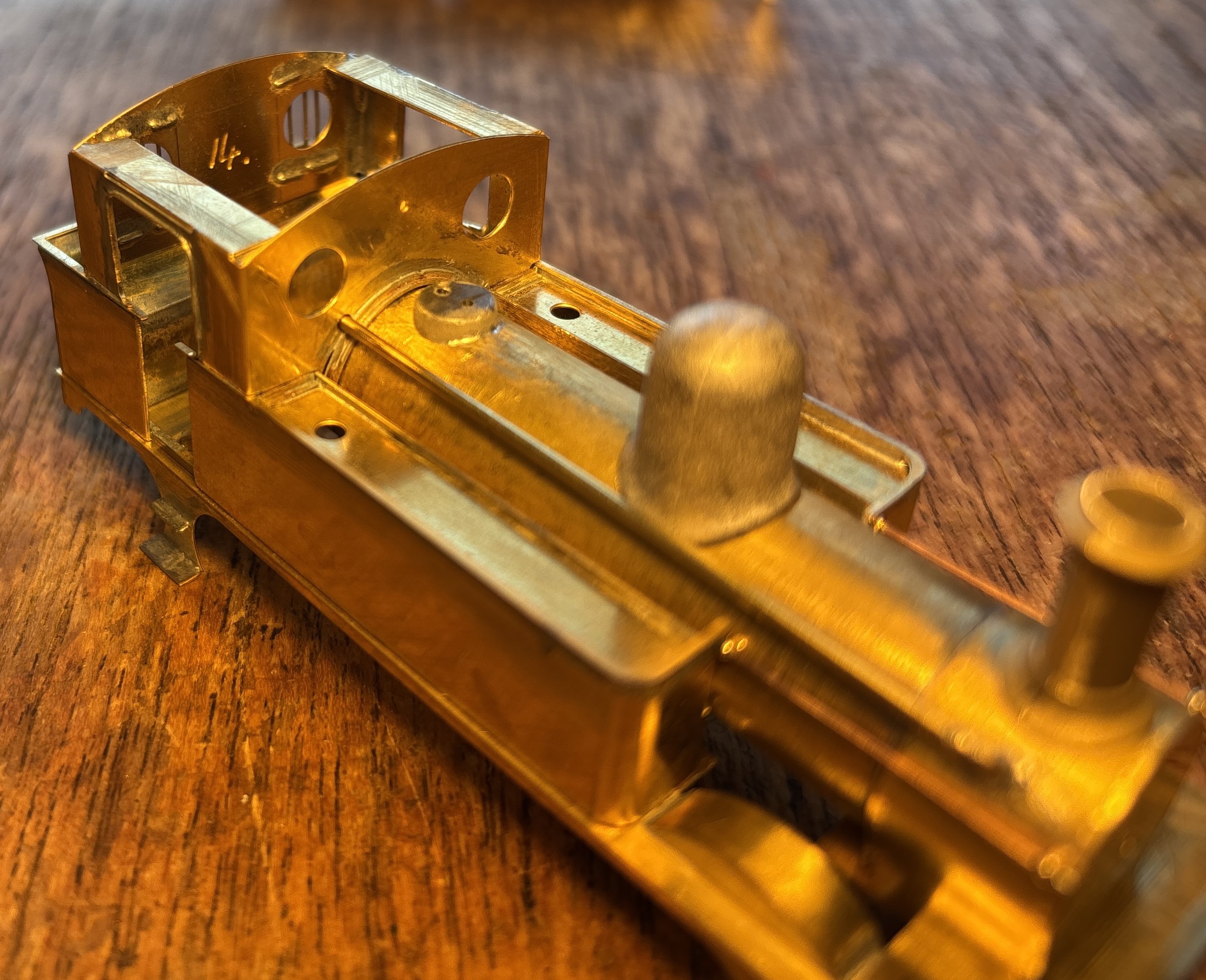
Slow progress today but I’m gradually populating the details. I need to get some short Ross Pop safety valves for this loco, but can’t find any for sale. Might have to make my own from bits of brass rod, tube and tiny washers. I have a couple of sets of Markits tall ones, but I want to save those for the G2 and J15 for which they are correct. I have a very busy week ahead so there won’t be much modelling time.
- 822 replies
-
- 16
-

-

-
You’d better build a bigger shelf!
-
Some Park Royals in green in Dublin suburban trains, thanks to Ernie: Join the campaign for an IRM C class and AEC Railcar