.png.c363cdf5c3fb7955cd92a55eb6dbbae0.png)


Mayner
-
Posts
4,877 -
Joined
-
Last visited
-
Days Won
119
Content Type
Profiles
Forums
Events
Gallery
Everything posted by Mayner
-
The engineers equipment makes an unusual model, I like the look of that drilling rig. The scrap containers were very heavily weathered to a browny black colourprobably a combination of road dirt and brake dust. It might be worth while looking through back issues of the IRRS Journal from that era for equipment used in the electrification. CIE was acutely short of coaches at the time, s mainly loose coupled corrugated opens and the odd 1/2 height container wagon used or spoil. Ready mixed concrete agitator on bogie wagon used to transport concrete to work site for signal and mast bases, short trains made up of 4w open and closed containers to transport tools and equipment, MK1 4w container flats fitted with Haib crane for erecting signal posts. I lost most of my very grainy photos from the electrification. Loose coupled train made up of unconverted beet wagons and 4w container flats with half height containers seem to used to carry spoil, most ended up dumped a Liffey Junction. Atlas "Rubber Duck" excavators widely used, CIE Priestman crane on Lomac hired in Ruston or NCK crawler cranes for lifing in point and crossing work, baby Metrovicks n engineers trains.

-
Not exactly the smallest station on the line some good photos of the line in the Waterford Museum collection http://www.waterfordmuseum.ie/exhibit/web/BasicImageSearch/offset/15/location/_3_25_14_/ Apart from the trice-weekly Boat Trains traffic seems to have been very light, the route was indirect compared with the road for Cork-Fermoy and Cork-Waterford traffic. Like most cross country lines CIE didn't exactly encourage traffic with a single one train a day stopping service, goods traffic over the centre section between Fermoy & Dungarvan seems to have been fairly light. Fermoy and Lismore seem to have the look of an abandoned railway about them with few wagons to be seen in photos of the yards. Possibly would have been different had the route survived into the 70s with Cork Waterford Bell Traffic and Tivoli-Ballinacourty Oil-Magnesite, possibly export container traffic from Waterford Co-Op Dungarvan to Waterford or Dublin Port. A layout based on the line would make a wonderful scenic model with its combination of mountain backdrops compact station layouts and signature viaducts including Fermoy Capaquinn , Abbeyside Causeway, Ballyvoyle, Strabally, Kilmacthomas and numerous level crossings.
-
Different Country indeed porter wheeling passengers luggage in backround. The Supertrain publicity from the early 70s included hostess in more contemporary dress,dig those chequer board platforms and purple orange trains
-
What no Cork Examiner "The Paper" on the Cork expresses boy? For he late 60s era you will need airline seating and orange mini-skirted hostesses with beehive hairdoos :oin the Superstandards.
-
Good to hear that you are still beavering away and exploring the world of CAD & 3D design. The real fun begins in exporting from Turbocad to the photo engraver or 3D printing formats. I would not panic too much about lead or the soldering, from an occupational health perspective our exposure from hobby use are likely to be very low and unlikely to result n harm, in terms of heath effects there is little difference between soldering, using solvents to weld plastic and spray mist from painting. Good hygiene and adequate ventilation are probably the most important, with reasonably priced spray booths and extractor fans for soldering on the market.
-
While Inchacore built 1st 1145 &1146 were the 1st to be fitted with double glazing, the credit for air conditioning goes to the GSR at least one of the 1937 "Bredin" Composites was fitted with "Stones air conditioning plant". Presumably the intake air was fed through a refrigeration unit to adjust the temperature & humidiiy similar in principal to a heat pump and vented through the roof & window vents
-
Preview 1953 Corridor 3rd shrunk drawn in late 1950s green style to provide some contrast. The 61'6" coaches shrink down nicely to fit the Dapol body shell without distorting the overall proportions as the sides of the Dapol coaches scale out marginally lower than the Irish coaches. Half etching the sides leaves hinges, doorstops, widow frames and panel joints in relief, the builder can mark the outline of the doors using a square and a scriber. I have also drawn up a jig for cutting out window openings, & drilling out for door handles and grab rails.
-
I am looking at finalising the brass work for the flats later this month, then its a matter of sorting out some castings probably for release in early-mid 2015. While the lead time and turn round on the etching side of things is quite rapid, lead time form pattern making to the finished castings are much longer and less predictable.
-
A narrow gauge railway was used for hauling out targets to the Curragh Camp rifle range. Does anyone know if it still exists?
-
Cravens originally had a reputation of being very rough riding compared to older stock. The coaches were very light and the B4 bogies used under the Cravens did not ride as well as a Commonwealth. At one sage a Craven was fitted with DB pattern bogies and additional weights to see if it would make ay difference. I like your description sausage slowly unravelling. Circular fluorescents used to up-grade the lighting from traditional light bulbs in a lot of the pre-Craven stock including Park Royals and Laminates. Not sure what lighting the Cravens had at first, had strip lighting when I started exploring the main lines in the mid 70s.
-
I noticed the price difference too, as I write this a pair of Maroon coaches should be winging their way south for evaluation. Possibly looking at a set of test etchings mid-September. The big decision at this point is whether to reproduce the window frames and cover slips over the panel joints in relief by half etching the sides similar to the Worsley Works Park-Royals or to engrave the outline similar to my Tin Van kits. It should be possible to buy the basic bits for a layout coach for around £30, with say another £10 for detailing (interior, castings, roof pipework, ventilators etc.
-
I noticed the price difference too, as I write this a pair of Maroon coaches should be winging their way south for evaluation. Possibly looking at a set of test etchings mid-September. The big decision at this point is whether to reproduce the window frames and cover slips over the panel joints in relief by half etching the sides similar to the Worsley Works Park-Royals or to engrave the outline similar to my Tin Van kits. It should be possible to buy the basic bits for a layout coach for around £30, with say another £10 for detailing (interior, castings, roof pipework, ventilators etc.
-
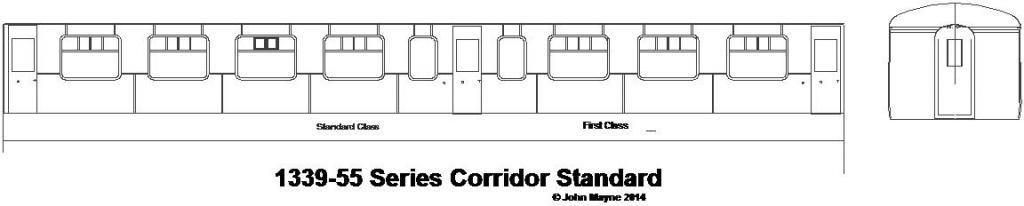
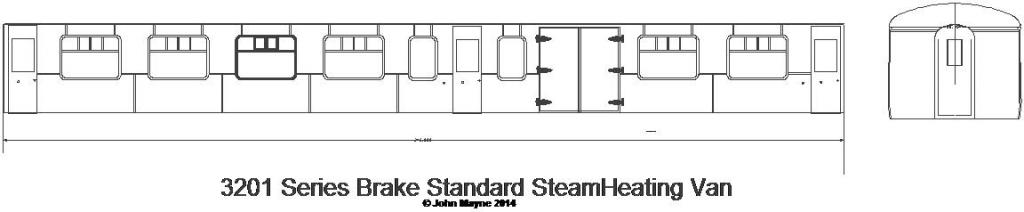
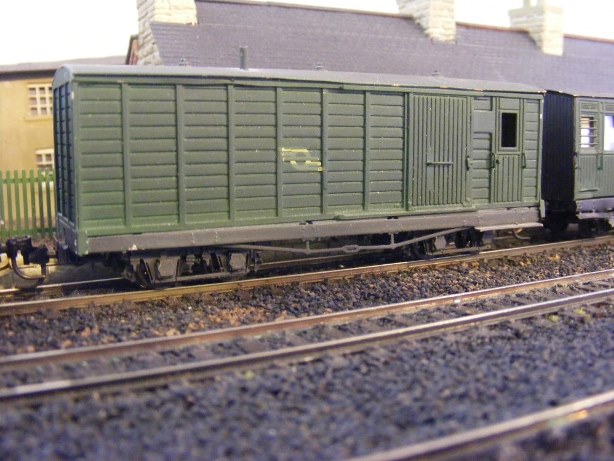
Just to whet the appetite a bit: 1339-55 Series Thirds 3201 Series BSGSV BSGV Thanks for that excellent summary of early CIE coaching stock. While there are issues with length and end profile I saw the re-introduction of the Stanier 60' coach in combination with overlays as a relatively painless and inexpensive way for modellers who might want to try their hand at kitbashing to add a bit of variety to their roster. Older stock was common on Dublin inner and outer suburban services up until the commissioning of the DART & Park Royal, Laminate and Craven stock with TL lighting were cascaded off the Intercity routes following the introduction of the MK3s. A typical outer suburban working to Drogheda or Dundalk would have been made up of 3-4 non TL fitted coaches and a brake standard steam heating van hauled by a B201
-
In a way the T&D is best supported of the Irish Lines with John Campbells large scale models a largish range of small size kits. I am not sure if the Branchlines locos and coaches are still available, while the 2-6-0T could be trick to build, the coaches were fairly straight forward and build into excellent models in 4 & 7mm http://www.rmweb.co.uk/community/index.php?/topic/35253-dlts-ng-workbench-ww1-baldwin-tractor-neil-sayer-kit/ The two CVR coaches need fitting with interiors, glazing and lettering and the rather impossibly tall looking horsebox is in for a rebuild and re-paint, all that's needed is a tram loco or diesel tractor to pull them.
-
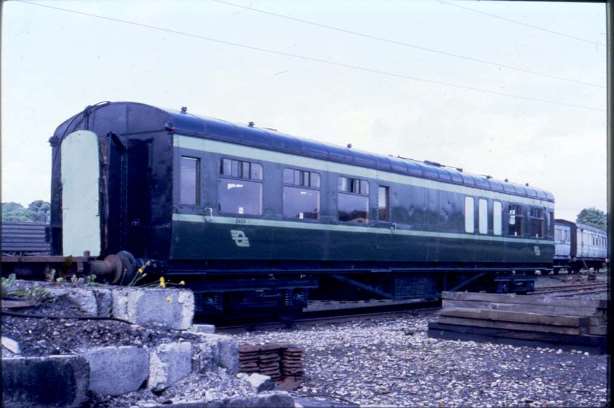
I have been looking at using the Airfix/GMR 60' Stanier coach as a donor body with etched brass sides for the 1st batch of main line coaches introduced by CIE in the 1950s. Dapol have released these coaches in kit form http://dapol.co.uk/index.php?route=product/product&path=177_60_87_220&product_id=1319 Several coach types were produced including: Buffet Car, Open Second, Side Corridor Second, Side Corridor Composite, Brake Second (railcar driving trailer). The coaches were initially introduced to provide modern trailer stock to run with the AEC railcars and later were widely used as hauled stock on both main and branch lines. Many of the corridor coaches were converted to Brake Steam Generator Vans to replace the tin vans on suburban trains, a sizable number of these coaches made it into preservation with the GSRPS, WISRA and more recently the DCDR I am looking initially at sides for the Buffet and one of the Brake Steam Generator Vans to fit the Dapol body shell, with other varieties to follow if there is interest for 10 or more of each type. The basic idea is to supply sides only to fit the Dapol body shell, and produce a correct scale length/width body shell if there is sufficient interest. GSRPS Buffet Car Mallow 1984? CIE rebuilt many of its older buffet coaches including some former GSWR coaches with B4 bogies in the late 1960s http://www.cs.vintagecarriagestrust.org/se/CarriageInfo.asp?Ref=3340
-
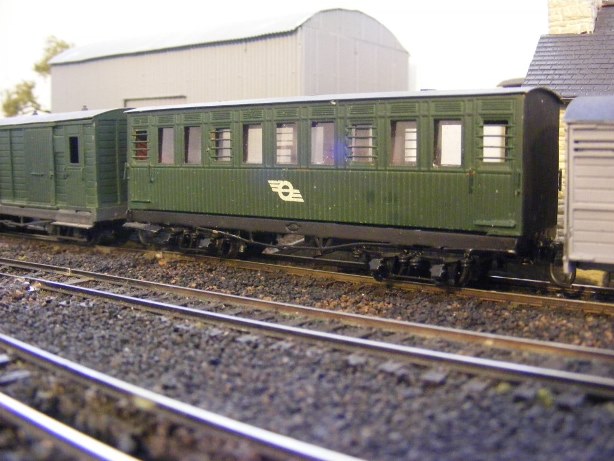
The carriage shops have been kept busy overhauling and upgrading rolling stock with a 'new' passenger train for the narrow gauge and HOn3 couplings and SSM lettering for freight rolling stock. In the early 1950s CIE transferred an ex T&D van and a coach from the West Clare to the C&L for use on the main line, it looks like another set may have been transferred or the van strayed from the main line onto the Arigna-Sligo branch. The model is a Backwoods kit dating from around 94, more or less as built, airbrush painted in a Humbrol green and Railmatch weathered black. I need to replace the snail without damaging the paint work. The GSR/CIE "cascaded" several T&D bogie coaches to the West Clare to replace the indigenous 6 wheelers which were in turn replaced by diesel railcars. The T&D coaches seem to have been a standard narrow gauge design similar to coaches supplied to the Muskerry & North Wales Narrow Gauge. Although bogie the wooden longitudinal seats were unlikely to be an improvement on the West Clare 6 wheelers and original C&L bogie stock. The model is built from a Branchlines kit of a T&D 3rd class coach dating from the early 90s, the coach is shorter and quite different in window arrangement from the coach transferred to the C&L for main line use in the 1950s I think the body was painted with a motor aerosol and finally was recently fitted with floor, seating and glazing following complaints from passengers. The convertibles were originally built from Backwoods kits in early 96 in Carrick on Shannon and painted in automotive aerosol grey primer. Before lettering the models were coated with Clear Coat Gloss using the airbrush and sealed with Testors Dullcoat aerosol. Despite the run-down locos and coaches, C&L wagon stock seems to have been maintained to a reasonable standard right up to the end of narrow gauge operation. While passenger traffic was light on the Belturbet and Arigna lines general goods and coal traffic appears to have been reasonably heavy. SSM prepared a custom deal set enough for my current wagon fleet and some additions. Most of the stock is now fitted with Kadee HOn3 couplers, a bit fiddly to assemble but mush more reliable than the N Scale couplers previously used.
-
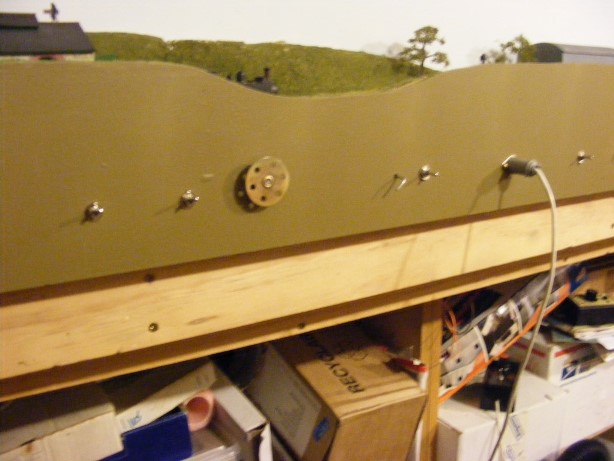
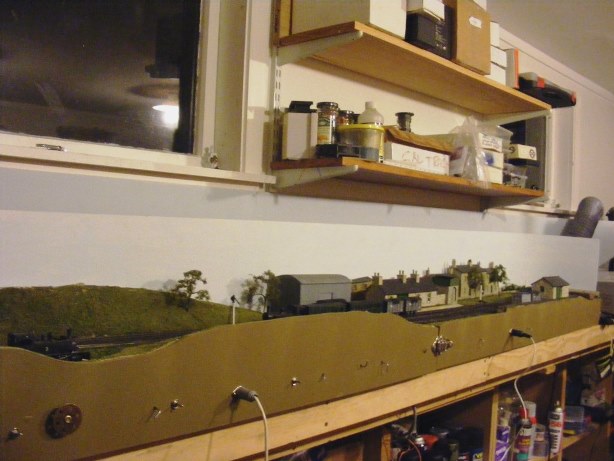
Like the Clonakilty branch in the 50s the rumours of lifting the Arigna-Sligo section appear at least a bit premature. The reserved section from the loco shed to the roadside section was quickly re-laid and trains are again running. 8L had the honours of taking the 1st westbound train with an urgent consignment from McArdles & PJ Carroll for Sligo with traffic diverted over the Belturbet Branch and C&L following the September 57 closure of the GNR lines through Enniskillen & the SLNCR main line. On the day the line through Keadue seems to have been fierce busy with 3T preparing to work the daily mixed to Sligo and 6T working a goods. [video=youtube;Lp-cfwBas1I] Meaning I have finally sorted out the control system for the yard using a combination of hand held analogue controllers, with switching between sections controlled by Blue Point point actuators and a few fascia mounted section switches.
-
Keeping Britain on Track Great behind the scenes series including the policing aspect. Perhaps RTE or UTV might do something similar on Irelands railway and public transport operations.
-
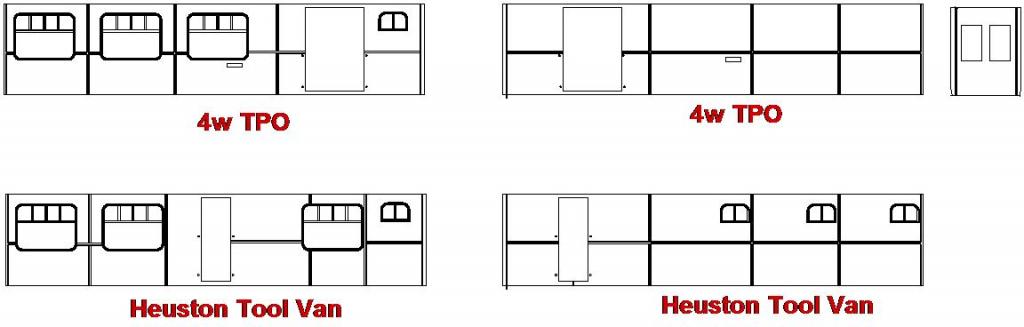
The TPO is at design stage with artwork prepared with alternative parts for the TPO and Heuston Tool van versions. I am looking at expressions of interest/orders for a minimum of 10 vans before proceeding further. The kits will be in a similar price range to the Heating Van & Luggage van, and include an etched brass body, underframe and roof, whitemetal detail castings, top hat bearings & NMRA RP25 disc wheelsets set for OO gauge.
-
Probably as much to do with politics as economics. In the long term Serbia is more likely to source new locos and stock from Russia or European build, than repair/upgrade Tito era GM power. To a certain extent the turbo charged 645 engine used in the 071 and other similar classes like the SD39-2 & NZR DFT is now considered to be obsolete with railways moving to more fuel efficient Caterpillar, MTU & GE power. Locally Kiwi Rail seems to be running down the DFT fleet dating from 1980 while continuing to upgrade older GEs to run alongside modern MTU powered CNR built locos.
-
Kieran Love the MPDs the cut an shuffle from rtr hauled stock is totally in keeping with the prototype & the UTA approach to designing relatively advanced diesel trains with very limited resources.
-
I think British Transport Police have some officers allocated to general policing and crowd control duties in the major city stations and also an investigation and education role around public safety/trespassing. BTC regularly visit schools in areas where there are reports of children trespassing or playing chicken at level crossings. When there was plenty of staff on the ground CIE checkers and porters managed crowd control/public safety. I remember a couple of rather well built Kerry railwaymen shepherding passengers onto trains at Killarney about 20 years ago when Kerry was playing in Croke Park and everyone else was visiting Kerry for the holidays.
-
CIE had plans for a city centre "Transportation Centre" in the area around Halfpenny Bridge as part of a 70s metro plan and bought up a lot of property in the Temple Bar area. I think the metro was part of an integrated transport plan for the Greater Dublin area with heavy rail services and dedicated busways and motorways to serve the new town centres planned for Tallagh, Clondalkin, Blanchardstown, Ballymun and the Airport. The metro and dedicated busways were dropped in the 80s combination of opposition to investment in public transport and an attempt to capitalise on the "Left Bank" environment which emerged in Temple Bar when CIE began renting building to art groups and artisans. The rest is history with the Taoiseach Charlie Haughey's personal opposition "over my dead body" to a bus station in Temple Bar and setting up a development corporation providing tax breaks to investors in hotels and clubs in the area. In the 90s IE looked at diverting Southern, Western and Belfast intercity services into a new "Central" North Wall station. I suppose at the time £100m to re-develop Heuston and the prospect of a future income stream from the Spencers Dock development seemed more attractive than building a North Wall Intercity Station.
-
Amazing stuff 33Lima hard to believe what can be achieved kit bashing plastic body shells. Impressed with the standard of finish and detailing especially the ends complete with jumper cables. Takes me back to one of my first journey on NIR an IRRS tour in a 70 Class set from York Road to Larne & Whitehead, lunch with the NIR driver and guard, reversed on the main line at Bleach Green and over the viaduct to a tightly timed connection with an 80 Class set on a Belfast bound train at Antrim connect into the Enterprise at Lisburn a great day out.
-
Interesting example of a crossing station squeezed into a tight space between a viaduct and a tunnel. The main line at the South end of the station is set for the siding to provide a margin of safety if a train over-runs the Down starting signal to Arklow at danger. The arrangement at the Northern end of the station is more common with greater stopping distance (overlap) between the Up starter and the beginning of the single line section to Wicklow. The goods yard closed about 50 year ago, the site became a sawmill. Apart from conversion from semaphore signalling to colour light and jointed bullhead track to CWR the station has changed little visually in the last 30-40 years. Miss those lattice post signals and loco hauled trains though.