.png.c363cdf5c3fb7955cd92a55eb6dbbae0.png)


Mol_PMB
-
Posts
3,869 -
Joined
-
Last visited
-
Days Won
239
Content Type
Profiles
Forums
Events
Gallery
Blogs
Everything posted by Mol_PMB
-
I confess I’m still teetering on the edge of ordering a blue one to join my maroon example. I see the final incarnation of 102 is sold out, but the others are all still available. Has anyone succeeded in doing a 21mm gauge conversion yet? @Horsetan? If that’s feasible I would be more tempted.
-
Many thanks. There are quite a few photos out there depicting them in a darker green than the 1958 light green. However, my belief is that there was an intermediate shade of green first used in 1954 ‘Brilliant Green’ and that the Park Royals were originally outshopped in that. It was lighter than the 1940s dark green, but darker than the 1958 light green. I’m hoping to demonstrate this by painting some models in the three shades and comparing to photos which show the different shades. But this takes time and I’ve been away from home a lot recently. Please bear with me…
-
Rails are also introducing a new ordering and payment platform called Purple Dot. I don't usually use Rails and have no direct info or experience of this, but there's a fair bit of comment on this RMweb thread. One of the present issues seems to be that even multiple similar items ordered at the same time are being sent in individual parcels. https://www.rmweb.co.uk/topic/201248-purple-dot/#comments
-
I bought 086 on eBay about 3 months ago, as-new condition, and paid £279 which I thought was a fair price. There have been a couple on eBay recently in the 400 to 500 range which is just silly!
-
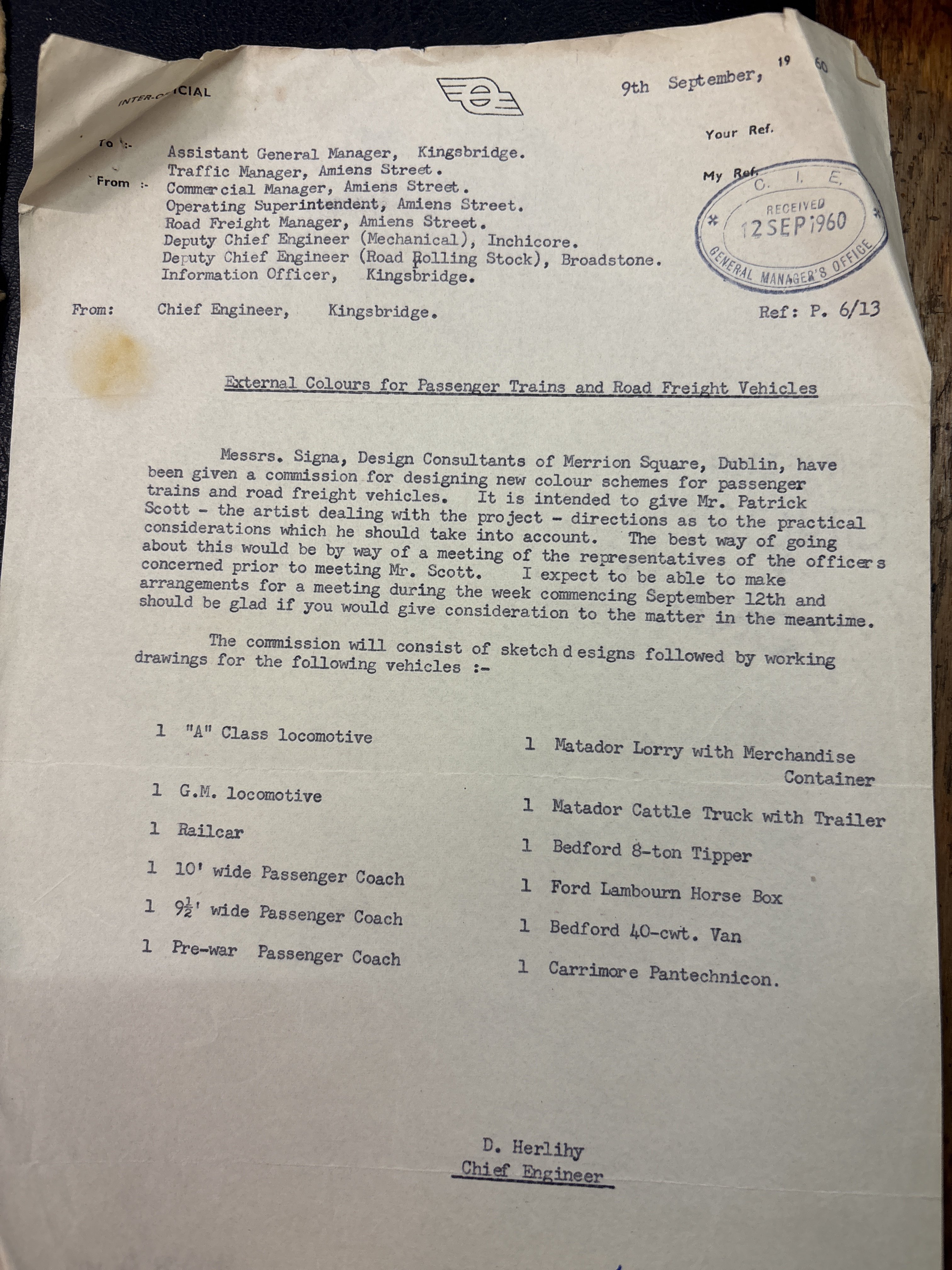
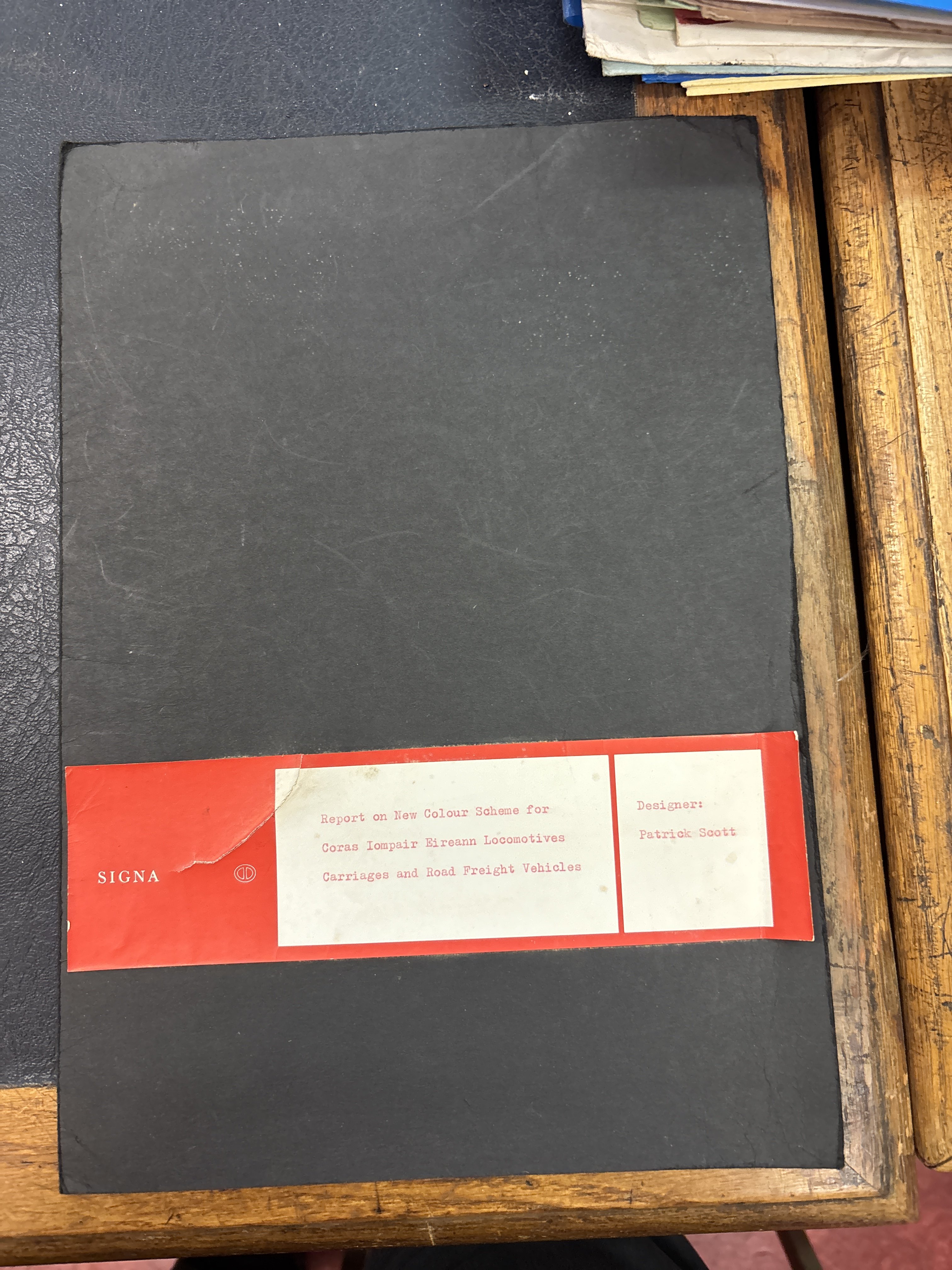
The original intention was for the area around the windows to be dark olive green, officially CC.239 'greenfinch' equivalent to BS381C 279 'steel furniture green' . As far as I am aware this was never actually applied, but was substituted with black. Black was always intended for the roof, ends and underframe/bogies. The lower colour was described by the designer as 'saffron', but the numerical colour reference CC.222 (equivalent to BCC.74) given was officially called 'golden brown'.

-
From the 1890s to the 1920s, there were various rules about wagon brakes introduced by the (British) board of trade, and the (British), which would have applied in Ireland at that time. They applied promptly to new wagons, but for existing wagons there was often a couple of decades grace - after that the older non-compliant wagons would have to be withdrawn or modified to be compliant. These rules included a brake operable from either side, and the brake lever to be at the right-hand end of the wagon. I can't dig into this too much right now but it would be worth looking at. This thread may also be useful:
-
I think it was usual to have the same arrangement on both sides of the wagon, but they were independent of each other. Some of the early Bulleid wagons on triangulated underframes (including corrugated opens and H vans) had a total of 4 brake blocks outboard of the wheels, but these seem to have been modified to the standard arrangement of a single block each side of the wagon and inboard. Hand brake only wagons with 4 blocks inboard of the wheels (common in GB) were scarce on CIE - imported oil and bitumen tanks, Palvans, ex-GNR cement vans were examples. Some of those had Morton brake gear (both sides linked) and others had independent brake gear each side. Check photos carefully! Wagons with vacuum brakes were a different category entirely, and there was considerable variation in brake gear layout.
-
Well I thought the larger size, slightly lower position and the balls on the ends of the 3's looked just like the ones on this GSR-liveried carriage: https://www.flickr.com/photos/irishrailwayarchive/53507855972 They may be ghosting through a later application of CIE green.
-
Lovely - many thanks Ernie, lots to enjoy there! Nice shots of the railcars as well as the wagons and carriages in the adjacent sidings. Note the Pullman car. The railcars with striped roof domes were 2625 and 2638, and the one in the photo above is most likely 2625.
-
There were still some carriages around in GSR livery in 1950, and perhaps a few into the early 1950s though unlikely to be in regular front-line service. It can be hard to tell because almost all photos from that era are monochrome. This photo from Ernie is interesting in that the GSR-era third class digits are clearly visible under the later CIE digits. But what colour is it? We may never know.
-
Not forgetting Cahirsiveen or Cahirciveen, Caherciveen or Cahersiveen!
-
I agree, but one of the advantages in rocking W-irons is they correct for any slight distortion or twist in the chassis. Otherwise you end up with a 3-legged wagon that is prone to derailing. 3D prints can be prone to subtle warps and twists.
-
Many thanks for the update, and I hope Roger's eye op goes well. My dad recently had a cataract op which has massively improved his eyesight. Sadly the generation of master craftsmen who made model parts and kits are all ageing. I hope these kits turn out well and sell in reasonable numbers - maybe we can persuade Roger to shrink something else.
-
When I saw the body that Rob printed, my immediate thought was to use etched W-iron units with one wheelset rocking. The https://pregroupingrailways.com Irish open wagons use 3D resin printed W-iron units which can be made to rock, and can be supplied for 21mm gauge. I found I had to remove some material to get them to work properly. Flexing them to get the axle ends into the bearings is possible, but I broke one (of eight) - I managed to glue it back together again. So it is possible but space restrictions behind the solebars and the strength needed for 3D printed parts may be an issue.
-
Lovely! I'd be up for one of them if you would consider printing them for others. 'Slanjonok' over on RMweb has done a nice stl file for the British Railways plywood 'FM' insulated container, which could be seen in Ireland in the 1960s and give a splash of colour with their ice blue livery. Pics below show one on a CIE lorry at Tralee (Kennelly Archive), and two as 'tail traffic' behind an AEC railcar on a Limerick-Waterford train (IRRS): The .stl files attached are for N gauge so would need rescaling x2 for 4mm scale. There are two versions, for FDM and resin. I'm going to draw up the transfer artwork for them in the hope that I can get one printed. BR_FM-type_Dia3-205_FDM_1-148.stl BR_FM-type_3-205_1-148.stl
-
Canarian Container Anorak
Mol_PMB replied to DJ Dangerous's topic in Photos & Videos of the Prototype
I'm not sure I should share the details of the individual containers, there's probably some commercial confidentiality there. But I can summarise: 1. I don't have details for the containers which only went from Hull to Amsterdam. 2. Hull - Vasteras: Loads in the 45HCPW and 40HCPW included: Waste Whisky Beer Wines And in the 20' HC bulks: Dolomite Also there were steel billets and bars not in containers, loaded the traditional way. 3. Amsterdam - Vasteras: Loads in the 45HCPW and 40HCPW included: Wines / Sparkling Wines (800 tonnes of wine in total) Gin Soy Sauce Food Preparations Motor Oils Wiping Rags Blasting Grit Cat Litter Pet Food And in the 20' HC bulks: Ferro Silicon 4. Vasteras - Hull: Loads in the 45HCPW and 40HCPW included: Cider (2000 tonnes of Rekordelig!) Bale Pulp Ammonium Sylvalite Nonwoven And in the 20' HC bulks: mostly empty some labelled 'keep dry' and heavy, but not sure what was in them. Also there were bundles of sawn timber, and steel coils, not in containers, loaded the traditional way. -
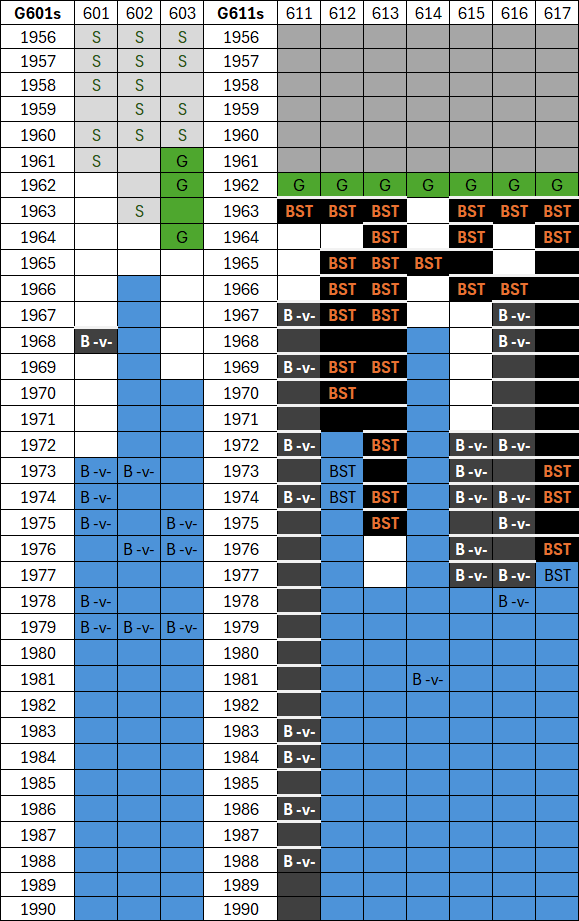
Here's the G class livery matrix I did last year, and attached a list of over 200 links to G class photos. I probably have a few more images found since then, that I haven't yet added. But it's a good start. There are loads of photos of silver G601s and several of the green G603 (I don't think any others were green), but they were very camera-shy in black livery until withdrawn and dumped at Inchicore. The G617s all entered traffic in black and tan (with large numbers, no roundel), but four of them were later repainted in the simpler black livery with roundel and small numbers. In black livery, G601-3 and G616 had their roundels lower down than G611, G614 and G615. G_class_photolist.xlsx
-
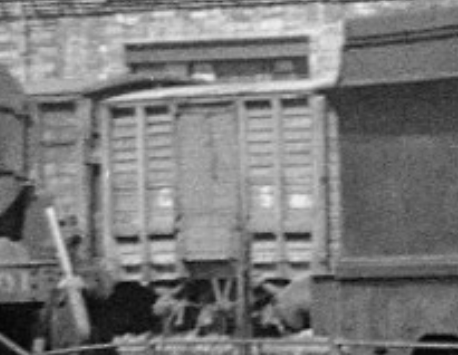
This photo sold on eBay recently, described as 1950s at Broadstone it is certainly post-1945 but none of the wagons we can see have received a snail yet (though the loco has). As usual I'm looking in the corners rather than at the main subject. Here's a wagon type I'd not seen before: Any ideas what this might be? It has doors like a cattle wagon with a drop flap. It appears to have ventilation louvres on the sides. What we can see of the brake gear is unusual for an Irish wagon and would suggest it is vacuum braked. So perhaps a wagon for perishable traffic?
-
The bar car right behind the loco - please may I book a seat in there?
-
It will include chassis, bogies and interior. The bogies are designed for 21mm gauge but could be modified for 16.5mm or you could replace with suitable RTR bogies often available as spares.
-
I've built a lot of etched kits, and designed a few. One thing I would say is that to design a good etched kit takes a lot of time and expense, and for me the stages include: Research - acquiring drawings and photos (often at a money cost as well as time), understanding the history of the vehicle and the variations. Model Planning - which thicknesses and materials will be used? What other parts (detail castings, wheels, etc) are needed, and are they available? How will the parts go together, what can be done to align them and strengthen the assembly? Where are multiple layers needed to capture the contours of the prototype? How I can I help the builder assemble it neatly, e.g. access to solder parts from the inside. How can the model be split into bolt-together sub-assemblies so it easier to paint? Am I going to include interior detail? How can I make it suitable for 16.5mm gauge as well as 21mm? Etch Design - actually drawing up the parts in CAD or other artwork package (I use CorelDraw) making sure that the dimensions and details are correct, the correct allowances for kerf and fold lines. Placing and tabbing the parts in a fret that will be strong enough to handle in the manufacturing process, but also easy to cut the parts from when building it. Can I make provision for variants in the prototype? At that point I can create a PDF of the artwork to send to the etchers. I use Arch60 (formerly 4D Modelshop) and find their service, quality and speed to be excellent. They are a bit more expensive than some, but I think it's worth it because the price of the etches is relatively small compared to the total effort I put in. They will also check the artwork and sometimes make some recommendations for minor changes to ease manufacture or reduce the risk of damage when handling. There are a number of one-off setup charges such as making the filmwork before the first etch can be produced. In an ideal world the first etch is perfect, but in practice there may be minor errors or omissions. These are usually only found when building (or attempting to build) the model. If the errors are not tolerable, there's another loop of editing the artwork, paying for some more filmwork, and second variant of the etch. By this time I've probably spent at least a couple of hundred pounds and perhaps 50 hours of my time. In my day job my employer charges me out at £142+VAT per hour (I don't get anything like that myself!), but even at minimum wage that time would be worth over £500. Fortunately, modelling is my hobby and I enjoy designing things, so I don't charge myself. And what have I got? One, maybe two nice models of an unusual prototype, and the enjoyment and satisfaction of the process. It's very satisfying when it all goes together as planned, but if not there can be frustrations! If you're just after a set of etched sides for a coach and nothing else, then the process is rather simpler and quicker, but basically the same stages are still required. I don't do this on any sort of commercial basis and I wouldn't want to; I've got plenty of other things to keep me busy in life. But I do allow others to order copies of my etches from Arch60 and a few members of the forum have done that. One day I hope to see some other examples of models built from my etches and I hope they go together well and don't cause so much frustration that they end up in the bin. I make no money at all from these sales. Equally, I don't provide any sort of warranty or after-sales service. Another thing that takes a lot of time is writing good, illustrated instructions. Not necessary if I'm building only for myself, but these are needed if others want to build the model. Posting them on here also allows people to see what's involved in building the model and to decide whether it's something they would like to try. So, to design and make a good etched kit is a labour of love, and I'd only put this level of effort into something that I want for myself, and that is unlikely to be in IRM's medium-term plans. Even if I was to do this on a commercial basis it's unlikely that the sales volume of a niche Irish model would ever come close to repaying the effort I put in to design the etch. I don't know how Allen Doherty made a business of it! I've probably waffled on long enough now. For Irish prototypes, I've done the E401 class complete, and some alternative sides and roofs for the SSM GSWR 6-wheel coaches to make a sleeping car and a full brake (these need the SSM kit as a basis). In a week's time I'll have first etches for the GSWR 50' gangwayed open third to build. There were 10 of these built in 1902 and most lasted into the 1960s in traffic, with several modifications including the addition of lavatories to some, others converted to snack cars (which were also through-wired to run with AEC railcars), and some remaining as-built. One became a camping coach and two survived into preservation after departmental use. So it's a versatile prototype and I'll build at least two variants for myself. https://irishrailwaymodeller.com/topic/19825-gswr-50-open-gangwayed-coaches/ What's on my radar for the future? No promises, I am prone to whims and changes of direction. But some of the more likely possibilities are: Alternative sides for the IRM Park Royal underframes, e.g. the 1954 conventional-bodied stock, or any of the laminates (I've draughted a couple already, but I'm wary here, it may be a gamble to avoid clashing with an IRM project) GSWR 'Big Boy' goods van and perhaps the flat wagons on the same chassis. Other carriage bodies similar to the GSWR 50' gangwayed open third, which could use the same chassis - obvious examples being a brake open third and a full brake. G601 class Wedgehead railcar (possibly a powered intermediate variant too?) but the design and desirability of this would be strongly influenced if IRM decided to do a normal AEC railcar. Occasional flights of fancy lead the silly side of my brain towards: GSWR Ivatt 2-4-2T Other GSWR carriage types D301 class E421 class GSWR 0-6-0T 90 / 100 GSWR single Fairlie (this is completely out of period and a real model design challenge, but I like Fairlies) CC1 (silly, I know!) Upscaling the E class to 7mm scale But probably none of those will see the light of day.
-
If it stays cheap it might be a useful parts donor or model it as a crash victim?
-
They’re super. I have my eye on the first one, though I expect Ernie does too. Note the nice colour view of the 1940s green livery carriage in the background, as well as one in the 1950s plain dark green. I’m gradually collecting bits like wheels and detail parts for one of those 2-4-2 tanks.
-
Excellent - I’ve sent you an email.
-
We're still hoping that Alphagraphix will produce some MGWR six wheelers in 4mm scale. My GSWR 50' bogie coach etches are complete and will be sent to me soon. I put them on hold while I was away on holiday. I'll do a thread on the build and there will be an opportunity for others to buy them direct from the etchers.